Best for
Tiny-whoop pilots managing several 1S LiPo or LiHV batteries with PH2.0 or BT2.0 connectors.
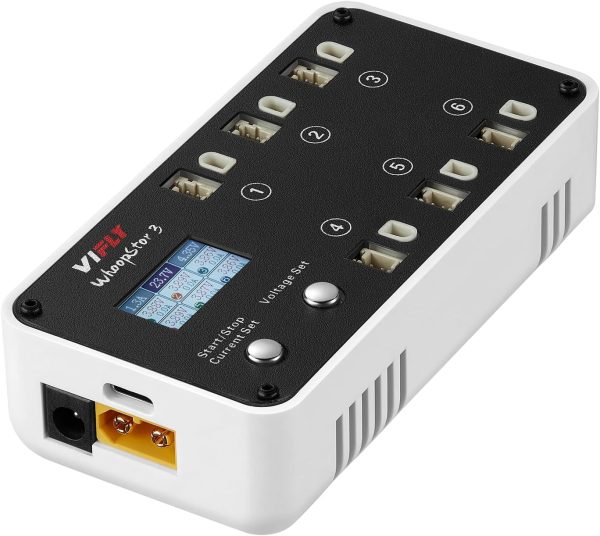
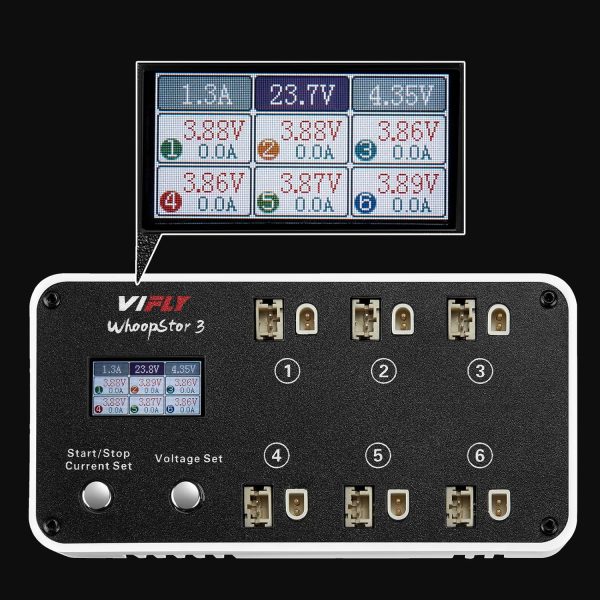
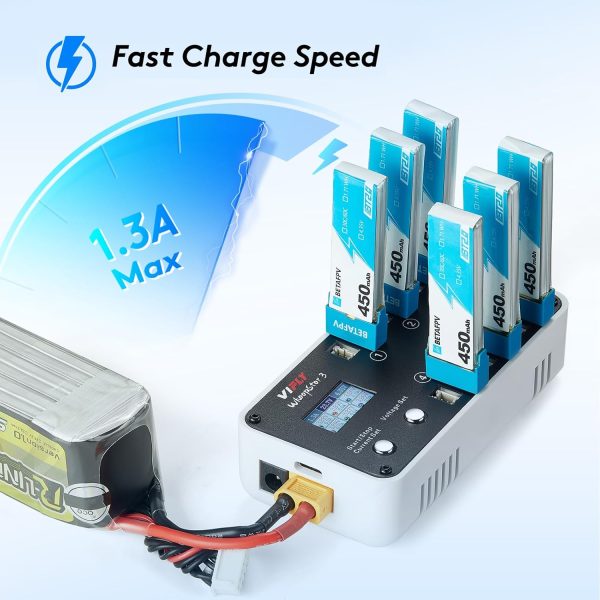
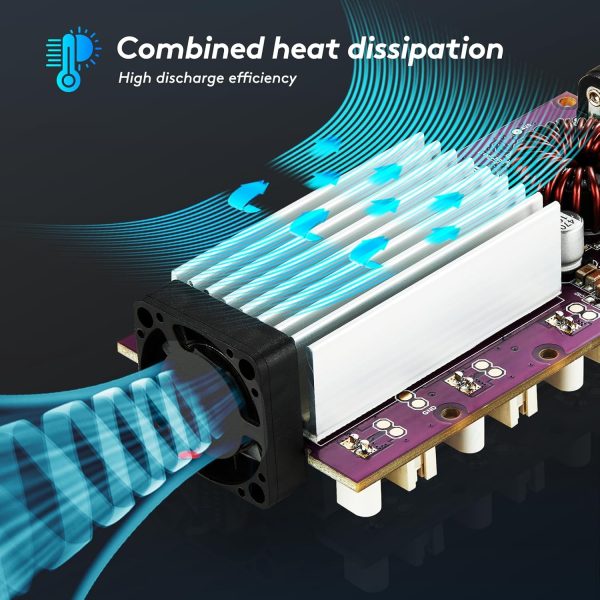
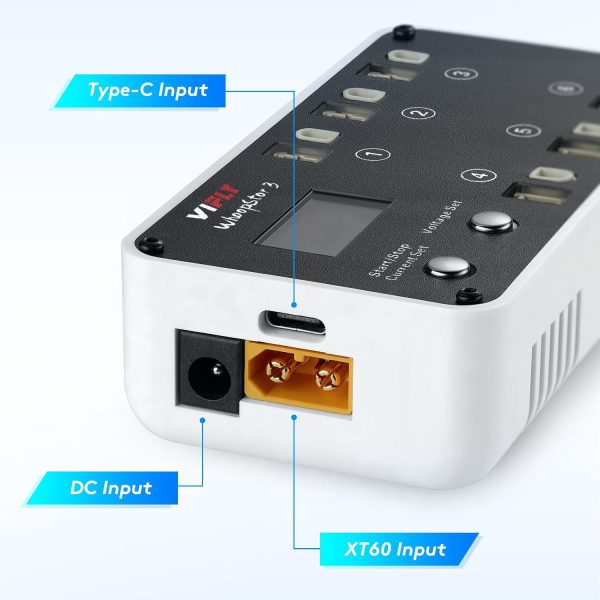
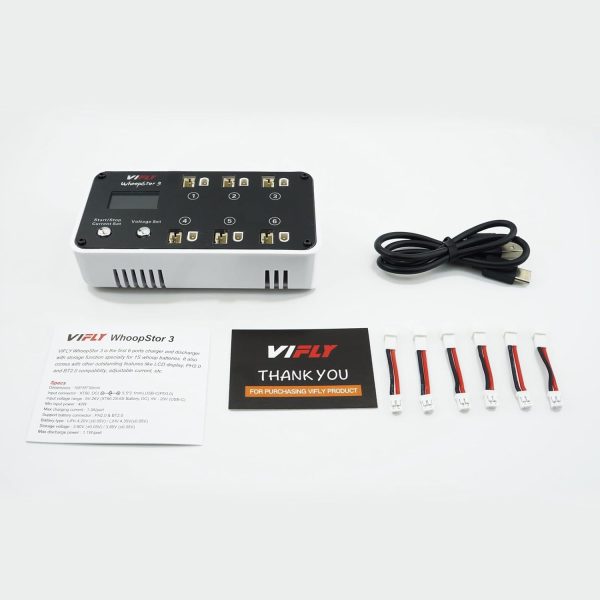
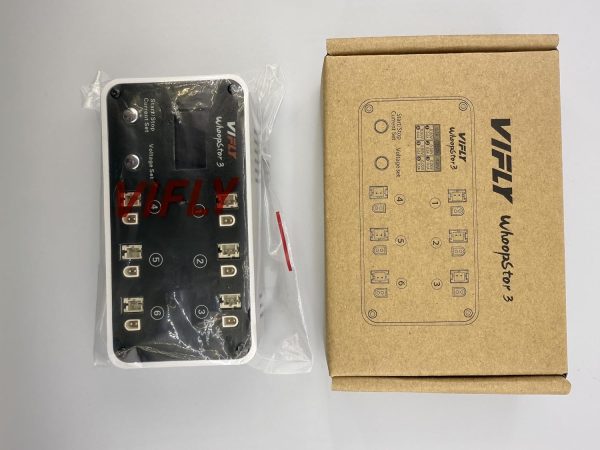
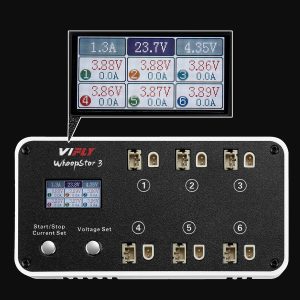
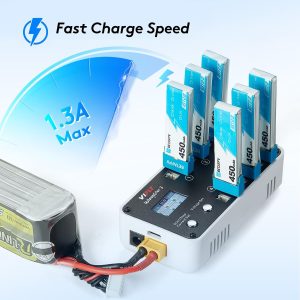
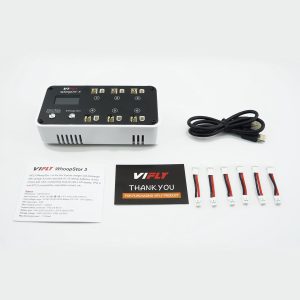
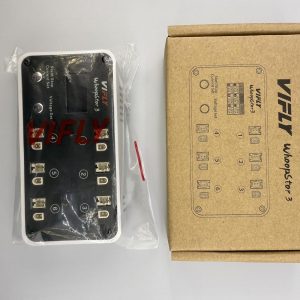
The VIFLY WhoopStor 3 charges or storage-charges as many as six 1S LiPo or LiHV tiny-whoop batteries through independent PH2.0 and BT2.0 channels.
The VIFLY WhoopStor 3 is a six-channel charger and storage discharger made specifically for 1S tiny-whoop batteries. It supports both standard 4.20V LiPo and 4.35V LiHV batteries, with native PH2.0 and BT2.0 connections on each channel.
Its most valuable feature is the ability to bring batteries up or down to an appropriate storage voltage. That makes it more useful than a basic USB charging board for pilots who regularly finish a session with partially used or fully charged batteries.
This is not a general-purpose FPV charger. It does not charge 2S–6S flight packs, and it requires a compatible USB-C PD, DC barrel or XT60 input source. A normal 5V USB charger will not power it.
Best for
Tiny-whoop pilots managing several 1S LiPo or LiHV batteries with PH2.0 or BT2.0 connectors.
Not ideal for
Charging 2S or larger FPV packs, proprietary smart batteries, or batteries using unsupported connectors.
Verify before buying
Confirm that you have a compatible power source. USB-C requires supported PD power and does not work from an ordinary 5V USB port.
| Product type | Six-channel 1S charger and storage discharger |
|---|---|
| Supported batteries | 1S LiPo and 1S LiHV only |
| Battery connections | PH2.0 and BT2.0 |
| Channels | Six independent battery channels |
| Charge-current range | 0.3A–1.3A per port |
| LiPo charge target | 4.20V ±0.05V |
| LiHV charge target | 4.35V ±0.05V |
| Storage targets | 3.80V or 3.85V ±0.05V |
| Maximum discharge power | 1.1W per port |
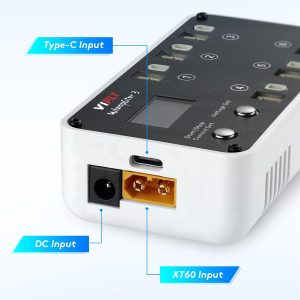
| Power inputs | USB-C PD3.0, XT60 or 5.5 × 2.1 mm DC barrel input |
| XT60/DC input range | 6–26V; XT60 supports an appropriate 2S–6S source battery |
| USB-C input range | 9–20V USB-C PD; regular 5V USB is not supported |
| Minimum recommended input power | 40W |
| Dimensions | Approximately 108 × 55 × 30 mm |
| Weight | Approximately 140 g |
Small 1S batteries are easy to neglect because many inexpensive chargers offer only a full-charge setting. Leaving lithium batteries fully charged or deeply discharged for extended periods can accelerate performance loss and increase the chance of a damaged pack becoming unusable.
The WhoopStor 3 can move a compatible battery toward a selected storage target whether its current voltage is above or below that setting. The 3.80V target is intended for standard LiPo storage, while 3.85V is available for LiHV batteries.
Storage mode does not repair a damaged or degraded battery. Swollen, punctured, leaking or unusually hot batteries should not be connected to the charger.
Each of the six channels has PH2.0 and BT2.0 connection options. These are two connector choices for the same channel—not twelve separate charging ports. Connect only one battery to each numbered channel.
The six channels can handle batteries at different starting voltages and finish independently. However, the selected target voltage and charging-current setting apply across the active channels. If batteries with different capacities are connected together, choose a current that is safe for the smallest or most restrictive battery.
Never choose a charge rate simply because the charger supports it. Follow the battery manufacturer’s maximum charging recommendation.
The WhoopStor 3 requires a supported USB-C PD power source operating above ordinary 5V USB. VIFLY specifies a minimum input power of 40W. A USB-C connector alone does not confirm that a wall adapter, cable or power bank supports the required voltage and protocol.
Before buying, check the output profile printed on the power adapter. Alternatively, the charger can use a suitable DC barrel supply or an appropriate 2S–6S battery through its XT60 input.
Verify the current Amazon bundle before ordering because a compatible wall power adapter may not be included. Do not assume a phone charger will provide the required power.
Use the product page for the purchase decision and the guides below for deeper research.
The VIFLY WhoopStor 3 is the best 1S LiPo charger for most tiny-whoop pilots. It charges six batteries on separate channels, supports both standard LiPo and LiHV packs, accepts PH2.0 and BT2.0 connectors, and can bring charged or depleted...
An FPV drone battery is not interchangeable just because its plug fits. You must match the battery chemistry, cell count, voltage range, connector and polarity, physical size, weight, and current capability to the aircraft.
The VIFLY WhoopStor 3 is a practical charger for pilots who regularly fly tiny whoops and own multiple 1S batteries. Six independent channels, selectable LiPo and LiHV targets, native PH2.0 and BT2.0 connections and storage charging address the most important parts of managing a whoop battery collection.
Its limitations are equally important. It is restricted to 1S batteries, uses one common current and voltage setting across active channels, and needs a suitable power source. When those requirements match your batteries, it is a more complete solution than the simple charge-only boards commonly included with beginner FPV kits.
Yes. It has six independent channels. Each channel accepts one battery through either its PH2.0 or BT2.0 connection.
No. The PH2.0 and BT2.0 sockets on a numbered channel are alternative connections for that same channel. Connect only one battery per channel.
Yes. It provides a 4.20V target for standard 1S LiPo batteries and a 4.35V target for 1S LiHV batteries. The correct target must be selected for the connected battery type.
No. The battery outputs are designed for 1S batteries only. The reference to a 2S–6S battery applies to using a larger battery as the charger’s XT60 power source, not charging that larger pack.
No. The USB-C input requires supported PD power at 9–20V, with VIFLY specifying at least 40W. Ordinary 5V USB charging is not supported.
The channels can accept batteries with different capacities and starting voltages, but the selected charging current applies across the active ports. Use a current that is safe for the smallest connected battery.
| Brand | VIFLY |
|---|---|
| Model | WhoopStor 3 |
| Product Type | 1S Battery Charger and Storage Discharger |
| Battery Cell Count | 1S only |
| Battery Chemistry | LiPo and LiHV |
| Charging Channels | 6 independent channels |
| Battery Connectors | PH2.0 and BT2.0 |
| Charge Current | 0.3A–1.3A per port |
| Charge Voltage | 4.20V LiPo or 4.35V LiHV |
| Storage Voltage | 3.80V or 3.85V |
| Maximum Discharge Power | 1.1W per port |
| Power Inputs | USB-C PD3.0, XT60 and 5.5 × 2.1 mm DC |
| Input Voltage | 6–26V XT60/DC; 9–20V USB-C |
| Minimum Input Power | 40W |
| Display | Color LCD |
| Dimensions | Approximately 108 × 55 × 30 mm |
| Weight | Approximately 140 g |
| Color | Red Amazon offer |
Verify power-adapter and cable ratings before connecting six batteries at higher charge-current settings. A connector fitting physically does not confirm that the source supports the required voltage or power.
Batteries at different starting voltages can use separate channels, but the selected current and target voltage apply to all active ports. Do not mix standard LiPo and LiHV batteries in the same session when they require different final voltages.
If different battery capacities are connected, configure the current for the smallest pack. When there is any uncertainty about battery chemistry, connector condition or safe charge rate, charge that battery separately after verifying its specifications.