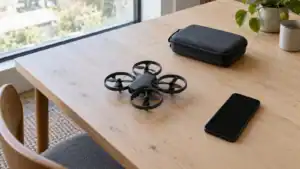
The Potensic ATOM SE battery is rated for up to 31 minutes, but a normal flight should end sooner so there is time to return, approach and land safely. For most outings, treat each pack as roughly one 20- to 25-minute flight opportunity until your own flight history shows otherwise. Charge direct by USB-C or use the official hub, and store unused batteries around 50% to 70% rather than leaving them full.
Quick answer: The original ATOM SE smart battery is a 2S, 2,500 mAh lithium-ion pack rated at 7.2 V and 18 Wh. Direct USB-C charging supports up to 5 V/3 A and takes about 1 hour 25 minutes under favorable conditions. Potensic's 60 W hub can charge as many as three ATOM SE batteries together in about 90 minutes.
Published maximum
Up to 31 minutes per battery in Potensic's controlled test conditions.
Practical planning
Start with a 20- to 25-minute expectation and shorten it for wind, cold, fast flying or an older pack.
Storage rule
Remove the battery from the drone and charging hub, then store it around 50% to 70% in a cool, dry location.
Potensic ATOM SE product and bundle options

Featured gear
Potensic ATOM SE GPS Camera Drone
The Potensic ATOM SE is an under-249 g GPS camera drone with 4K/30 fps EIS video, 12 MP RAW photos, Return to Home, a 4 km manufacturer-rated transmission system, and two batteries rated for…
The Potensic ATOM SE is an under-249 g GPS camera drone with 4K/30 fps EIS video, 12 MP RAW photos, Return to Home, a 4 km manufacturer-rated transmission system, and two batteries rated for up to 31 minutes each.
- Best for
- Best for a beginner or traveler who wants an under-249 g GPS camera drone…
- Skill level
- Beginner
- Product type
- Beginner Drones, Camera Drones, Drones, Under 249g Drones
- Best for
- A beginner or traveler who wants an under-249 g GPS camera drone with 4K…
- Skill level
- Beginner
- Product type
- Foldable GPS Camera Drone
Potensic ATOM SE battery specifications
The ATOM SE does not use a loose hobby battery with a balance lead. It uses a slide-in smart battery with an internal battery-management system. The pack balances its two cells, limits excessive charging current, monitors temperature and health, reports information to PotensicPro and protects against overcharge, over-discharge and short circuits.
| Specification | Published value | Why it matters |
|---|---|---|
| Battery model | DSBT02A | Use this model reference when checking a replacement listing. |
| Cell type | 2S lithium-ion | It is a managed camera-drone battery, not a conventional balance-charged FPV LiPo. |
| Capacity and energy | 2,500 mAh, 18 Wh | These values help distinguish the ATOM SE pack from similar-looking ATOM-series batteries. |
| Rated voltage | 7.2 V | The battery reaches 8.4 V when fully charged. |
| Maximum flight-time claim | Up to 31 minutes | This is a controlled-condition maximum, not a safe target for every flight. |
| Direct USB-C input | Up to 5 V/3 A | A suitable power supply and 3 A-capable cable are needed for the shortest direct-charge time. |
| Official charging hub | Up to three batteries simultaneously | The hub is useful when several packs return from the field depleted. |
The important correction for owners coming from FPV batteries is that Potensic identifies this as a lithium-ion battery. Do not connect it to a hobby balance charger, open the housing or try to reach the cells directly.
How long does an ATOM SE battery last in real use?
Potensic's 31-minute figure was measured in low-altitude, windless flight at a steady 5 m/s. That makes it useful for comparing products, but it does not include the reserve a pilot should keep for returning and landing.
A practical starting expectation is about 20 to 25 minutes per healthy, fully charged pack in ordinary conditions. This is a planning range, not a measured guarantee. Watch the live battery level and the remaining route more closely than the clock.
| Condition | Battery effect | Planning response |
|---|---|---|
| Wind or repeated gusts | The motors work harder, especially on the return leg. | Stay closer and begin the return earlier. |
| Sport mode, fast climbs and hard braking | Higher power demand reduces usable time. | Do not plan the flight around the advertised maximum. |
| Cold battery | Available power and flight duration fall. | Keep the pack moderately warm before use and fly conservatively. |
| Older or poorly stored battery | Capacity can fade and voltage can drop sooner. | Compare recent flights and replace a pack that behaves abnormally. |
| Long return route | Remaining percentage must cover distance, wind and landing. | Turn back with a larger margin than a close local flight. |
Do not spend the last percentage far from home. A low-battery warning is not extra usable flight time. Distance, headwind and landing space determine how early the aircraft should return.
If you are still deciding whether the aircraft itself fits your needs, the full Potensic ATOM SE review covers its camera, GPS modes and broader limitations.
A simple two-battery workflow
Two batteries are valuable because they create two separate, usable flight windows. They do not create 62 uninterrupted minutes. The aircraft must land, the first pack must be removed and the replacement must be checked and locked into place.
- Charge both packs before leaving. Also charge the controller and phone so the second flight is not stopped by another device.
- Label the batteries 1 and 2. Alternate which pack flies first so one battery does not accumulate most of the cycles.
- Use the first flight for setup and practice. Confirm GPS, Home Point, controls and camera operation while staying close.
- Land with a useful reserve. Do not stretch the first battery merely because another one is available.
- Let the used pack cool. Keep it shaded and separate from the charged battery. Do not recharge it while it is still hot.
- Inspect and install the second battery. Confirm the latch clicks and returns fully before powering the aircraft.
- Use the second flight for the planned shot or route. The second pack is most useful when the first flight has already exposed setup, wind or framing issues.
For buyers choosing between one-, two- and three-battery packages, the ATOM SE bundle guide explains when the charging hub and third battery are worth paying for.
How to charge the Potensic ATOM SE battery
A new battery may need an initial charge to wake it before the aircraft will power on. For normal direct charging, remove the battery from the drone, connect a suitable USB-C cable and use a compliant 5 V/3 A power supply. Potensic says the shortest direct-charge time is about 1 hour 25 minutes with the correct supply and cable.
| Method | Published charging behavior | Best use |
|---|---|---|
| USB-C directly to one battery | Up to 5 V/3 A; approximately 1 hour 25 minutes at the supported rate | One- or two-battery owners who do not need simultaneous charging |
| Official 60 W charging hub | Up to three ATOM SE batteries together in approximately 90 minutes | Three-battery kits and owners who routinely return with several depleted packs |
Charging rules that prevent most problems
- Let a warm battery cool before connecting it to power.
- Charge on a dry, nonflammable surface where the battery can be observed.
- Use the original cable or a USB-C cable rated for at least 3 A.
- Do not use a swollen, wet, crushed, punctured or unusually hot battery.
- Do not cover the battery or hub while charging.
- If the indicator does not illuminate, check temperature, the cable, the power supply and any battery warning in PotensicPro.
Potensic's troubleshooting guidance recommends charging in a moderate environment and allowing a hot pack to cool first. The smart battery can refuse charging when its temperature is outside the permitted range, which is a protection feature rather than proof that the charger has failed.
Storage, auto-discharge and the five-day rule
Potensic recommends storing the battery around 50% to 70% when it will not be used for an extended period. The battery-management system is designed to begin reducing a full battery after it has sat unused for five days, but owners should not assume it will reach the ideal storage level on a precise schedule.
Auto-discharge is a backup, not the storage plan. In a seven-day comparison, a battery left in the aircraft remained close to full. Packs stored loose and in the charging hub also stayed well above the recommended storage range. The practical lesson is to remove batteries from the aircraft and hub, then verify the level yourself before long storage.
How to prepare an ATOM SE battery for storage
- If the battery is full, use it for a normal, safe flight until the app shows roughly the middle of the charge range.
- Land, power everything off and allow the battery to cool.
- Remove it from the drone and charging hub.
- Store it in a cool, dry location away from direct sun, vehicles, heaters, moisture, metal objects and children.
- Check stored batteries periodically. Potensic recommends charging them at least once every three months during long periods of non-use.
Do not intentionally run the aircraft until the battery is empty to reach a storage level. Deep discharge creates a different problem and can place the battery into hibernation. If a stored pack is already low, charge it back into the middle range instead of leaving it near empty.
Battery care and signs that a pack should be replaced
Battery age alone does not tell the whole story. Heat exposure, repeated full storage, deep discharge, impact damage and charging habits can age a pack faster than the calendar suggests. PotensicPro can report battery information and warn about cell damage or imbalance, but a physical inspection remains important.
Stop using the battery if you notice:
- swelling, a distorted housing or a battery that no longer slides and latches normally;
- cracks, punctures, water exposure, corrosion or impact damage;
- unusual heat while resting, charging or during an ordinary flight;
- a sudden drop in remaining charge or much shorter flight time than the other pack;
- repeated cell, battery-health or charging errors in PotensicPro;
- a battery that will not wake, charge or power the aircraft after normal troubleshooting.
Potensic notes that battery performance generally declines with cycle count and suggests replacement after roughly 200 cycles. Treat that as a maintenance prompt, not permission to keep flying a damaged battery until it reaches a particular number. Condition and app warnings take priority.
Do not place a damaged lithium battery in household trash. Follow the battery manufacturer's instructions and use a local household hazardous-waste or battery-recycling program that accepts damaged lithium-ion packs.
Which replacement battery fits the Potensic ATOM SE?
The safest replacement is a genuine battery explicitly sold for the Potensic ATOM SE. Potensic's current replacement listing identifies it as the Original Intelligent Battery 2500mAh for ATOM SE, and the user documentation identifies the smart-battery model as DSBT02A.
Do not buy by shape alone. The ATOM, ATOM SE, ATOM LT and later ATOM models have similar names, and some accessories look alike. A listing should name the ATOM SE, match the required electrical specifications and come from a seller with a clear return and warranty path.
- Look for explicit Potensic ATOM SE compatibility.
- Confirm 2,500 mAh, 7.2 V and the correct smart-battery housing.
- Prefer a genuine Potensic pack with identifiable packaging and support.
- Avoid listings that combine several ATOM models without explaining compatibility.
- Do not assume an ATOM charging hub works with the ATOM SE unless the exact product page or packaging says it does.
- Inspect a replacement immediately and return it if the latch, housing, indicators or fit differ from the original.
An owner comment on an accessory page is not the same as a manufacturer compatibility statement. When the listing and official model documentation do not agree, use the narrower documented compatibility or ask Potensic support before connecting the battery.
The best ATOM SE battery routine
Plan each battery as a normal 20- to 25-minute flight opportunity rather than trying to reproduce the 31-minute maximum. Use two labeled packs in rotation, leave enough energy to return and land, let each pack cool before charging and verify storage level instead of relying entirely on auto-discharge.
For replacements, buy a genuine battery specifically identified for the ATOM SE. Correct model compatibility and predictable battery health are more important than saving a small amount on a generic listing.
Check the current ATOM SE package
Verify the battery count, charging hub, seller and exact model compatibility before ordering.
Frequently asked questions
How long does a Potensic ATOM SE battery really last?
Potensic rates it for up to 31 minutes in controlled conditions. For initial planning, expect roughly 20 to 25 minutes while preserving time to return and land. Wind, cold, aggressive flying, distance and battery condition can shorten that further.
How long does the ATOM SE battery take to charge?
Potensic lists about 1 hour 25 minutes for direct USB-C charging when the power supply supports 5 V/3 A and the cable can carry at least 3 A. The official 60 W hub is rated to charge up to three batteries simultaneously in about 90 minutes.
Can I leave the battery in the ATOM SE?
Remove it for storage. A battery left in the aircraft may remain near full instead of reaching the preferred storage range. Removal also lets you inspect the pack and prevents the drone from becoming the battery's storage container.
Can I store ATOM SE batteries in the charging hub?
Use the hub for charging, then remove the batteries for storage. Keeping them separate makes it easier to check each pack, avoid accidental charging and confirm that every battery is near the recommended 50% to 70% level.
Can I charge the battery with a phone charger?
A compliant USB power supply can work for direct charging, but it should support the required 5 V/3 A output and use a suitable USB-C cable. A lower-power supply can charge more slowly or fail to provide the expected charging behavior.
Are Potensic ATOM and ATOM SE batteries interchangeable?
Do not assume they are interchangeable. Buy a replacement explicitly identified for the ATOM SE and verify the model, electrical specifications, housing and charging compatibility. Similar names and appearances are not enough.
Sources
- Potensic ATOM SE specifications: battery capacity, flight-time test condition, USB-C charging limit and aircraft specifications.
- Potensic app and manual downloads: current ATOM SE user documentation, smart-battery protections, storage guidance and direct-charging procedure.
- Potensic ATOM SE battery and 60 W charging hub: model compatibility and simultaneous charging claim.
- Potensic original 2,500 mAh ATOM SE battery: current replacement-battery identification.
- Potensic battery care guidance: cooling, long-term storage, inspection and replacement indicators.
Last checked: August 20, 2026. Battery documentation, accessory availability and package contents can change. Verify the exact model and current instructions before charging or replacing a battery.