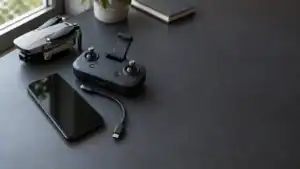
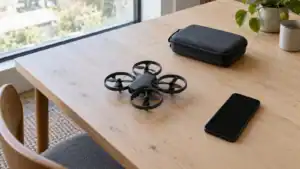
The Holy Stone HS360S is a 249 g GPS camera drone rated for a 3 km control and video link, 20 minutes of flight time, and 4K recording at 20 fps. The important limits are easy to miss: 4K requires a microSD card, the phone copy is only 720p, the camera is not stabilized by a gimbal, and the standard kit includes one battery.
Those specifications make it a practical first outdoor GPS drone, but not a long-range aircraft or a cinematic 4K camera. Its strongest features are beginner-friendly controls, GPS Return to Home, a wired phone connection, and several automated flight paths.
Key takeaway: Buy the HS360S for learning GPS-assisted flight and capturing casual aerial footage. Do not buy it for the 4K label alone.
Best for
First-time outdoor pilots who want GPS, Return to Home, brushless motors, and simple automated modes.
Main limitation
The standard HS360S has no mechanical gimbal, Holy Stone does not list EIS, and 4K records at 20 fps.
Verify before buying
Confirm the exact HS360S bundle, battery count, phone compatibility, and whether a microSD card is included.
Holy Stone HS360S GPS Camera Drone

Featured gear
Holy Stone HS360S GPS Camera Drone
The Holy Stone HS360S is a 249 g beginner GPS camera drone with brushless motors, Return to Home, HS FLY smart modes, a 3 km manufacturer-rated link, and 4K/20 fps recording to a compatible…
The Holy Stone HS360S is a 249 g beginner GPS camera drone with brushless motors, Return to Home, HS FLY smart modes, a 3 km manufacturer-rated link, and 4K/20 fps recording to a compatible microSD card.
- Best for
- Best for a beginner who wants a low-cost 249 g GPS camera drone with…
- Skill level
- Beginner
- Product type
- Beginner Drones, Camera Drones, Drones, Under 249g Drones
- Best for
- A beginner who wants a low-cost 249 g GPS camera drone with brushless motors,…
- Skill level
- Beginner
- Product type
- Foldable GPS Camera Drone
Key Holy Stone HS360S Specifications
The table below separates the useful specifications from the practical meaning of each number. It applies to the standard HS360S, not the HS360D or HS360E.
| Specification | Official value | What it means in practice |
|---|---|---|
| Weight | 249 g | Below the U.S. recreational registration threshold in its standard configuration, but not exempt from general flight rules. |
| Rated control distance | Up to 9,842 ft (3 km) | An outdoor, unobstructed maximum, not a recommended operating distance. |
| Rated video transmission | Up to 9,842 ft (3 km) | Interference, trees, buildings, terrain, phone performance, and antenna orientation can shorten the usable link. |
| Onboard video | 3840 x 2160 at 20 fps | Requires a compatible microSD card. The 20 fps frame rate is less fluid than typical 30 fps footage. |
| Phone video | 1280 x 720 at 20 fps | The phone copy is not 4K, even though the camera is marketed as 4K. |
| Camera view | 85-degree field of view, 90-degree remote tilt range | You can reframe from forward to downward views, but camera tilt is not a stabilization gimbal. |
| Flight time | Up to 20 minutes per battery | Expect less usable time after allowing for takeoff, Return to Home, landing, wind, and a battery reserve. |
| Flight battery | 1,500 mAh, 7.4 V, 11.1 Wh | The black Standard Kit contains one battery. Holy Stone also lists a separate two-battery package. |
| Speed modes | 10, 16, and 23 ft/s | Three steps let a beginner progress from slower camera movement to the rated top horizontal speed. |
| Positioning | GPS, GLONASS, optical flow, and altitude hold | Useful for hovering and RTH, but none of these systems provide obstacle avoidance. |
| Storage | FAT32, Class 10 or faster microSD up to 128 GB | A card is needed for the highest listed video resolution and is not included in the standard package. |
| Folded size | 141 x 94 x 56 mm | Compact enough for the included case, with the arms folded in the correct order. |
What the 3 km Range Actually Means
Holy Stone rates both the control link and image transmission at up to 3 km outdoors without obstructions. That figure describes a favorable signal test, not the distance a beginner should plan to fly.
A 20-minute battery must cover the outbound flight, filming, return, wind correction, and landing. The drone must also remain within the operating rules that apply to the pilot and location. In the United States, recreational pilots are required to keep the aircraft within visual line of sight.
The wired phone connection is useful, but it does not remove video delay
The phone plugs into the controller with a supplied USB-C, Lightning, or Micro-USB cable. This avoids the extra step of joining the drone's Wi-Fi network and makes the phone-to-controller connection dependable. The controller screen displays flight data, while the phone supplies the live camera view and app controls.
The wired connection does not make the entire video path instantaneous. A small amount of live-view delay remains between the aircraft camera and the phone. For learning and close-range flying, it is better to watch the aircraft directly and use the screen for framing, status checks, and smart-mode setup.
Beginner Mode starts with a much smaller boundary
The default Beginner Mode limits altitude and distance to 98 ft. It also sets a 66 ft Return to Home altitude. Those limits can be changed in HS FLY, but the smaller box is useful while learning orientation, braking, and landing. Our HS360S setup and first-flight guide explains the correct pairing, calibration, and Home Point sequence.
4K Camera: Resolution Is Only Part of the Story
The HS360S can record 3840 x 2160 video to a microSD card, but only at 20 fps. That produces more detail than a lower resolution, yet movement can look less smooth. In ordinary flying, the 2.7K/30 option often looks better because the higher frame rate handles motion more naturally.
The larger limitation is stabilization. The standard HS360S has no mechanical gimbal, and Holy Stone does not list electronic image stabilization. Aircraft tilt, turns, braking, and wind corrections therefore appear in the footage. Slow mode, gentle stick inputs, gradual turns, and calmer weather make a noticeable difference.
Best camera setting for most casual flights: Use 2.7K/30 when smoother motion matters more than the 4K label. Use 4K/20 for slower scenes where extra detail is more important and the aircraft can be flown gently.
Phone recording is not the same as onboard recording
Holy Stone lists the phone video at 1280 x 720 and 20 fps. To obtain the highest listed quality, install a Class 10 or faster microSD card up to 128 GB, formatted as FAT32. The card is not included.
The camera has an 85-degree field of view and a remotely adjustable 90-degree tilt range. That helps compose forward, angled, and downward views, but zoom and camera tilt cannot replace a stabilizing gimbal.
If stabilized footage is the priority, compare the HS360S and Potensic ATOM SE before choosing. The difference in stabilization and frame rate matters more than the shared 4K label.
One Battery Means Short Practice Sessions
The official 20-minute figure is a windless maximum. A usable session is closer to the high teens once low-battery Return to Home and landing reserve are considered. That is enough to practice a few takeoffs, circuits, and automated modes, but it can feel short when the aircraft requires time to acquire GPS and calibrate before flight.
The black Standard Kit includes one battery even though the supplied carrying case has space for two. Holy Stone lists about three hours to recharge the flight battery using a 5 V/2 A input. The controller takes about two hours to charge and is rated for about two hours of use.
A second verified HS360S battery is therefore the most useful upgrade for longer practice sessions. Check the exact model before ordering because similarly named HS360S, HS360D, and HS360E parts should not be assumed interchangeable.
The flight battery also has automatic storage protection. If it sits unused for more than three days after a full charge, it can discharge itself to roughly 70 to 75 percent. That behavior protects the battery and does not necessarily indicate a fault.
GPS, Optical Flow, and the Three Speed Modes
GPS and GLONASS support outdoor position holding, map location, and Return to Home. Near the ground or where GPS is weak, a downward optical-flow camera can help the drone hold position by reading surface texture. Holy Stone says optical flow works best below about 10 ft.
Optical flow is sensitive to lighting and the surface below the aircraft. Water, reflective floors, very dark areas, plain surfaces, and repeating patterns can reduce its accuracy. It is a positioning aid, not a downward obstacle detector.
Speed modes are intentionally modest
- Camera Mode: 10 ft/s, useful for learning and reducing abrupt camera movement.
- Normal Mode: 16 ft/s, the default balance between control and progress.
- Sport Mode: 23 ft/s, the rated maximum horizontal speed.
The app may record a momentary speed above the rated horizontal figure during a forward descent because gravity contributes to the movement. That does not make the logged peak a repeatable level-flight top speed.
Return to Home is useful, but it cannot see obstacles
The HS360S supports pilot-initiated Smart RTH, signal-loss Failsafe RTH, and Low Voltage RTH. In a clear outdoor area, it can return close to the launch point with reassuring consistency. Set the return altitude high enough to clear nearby obstacles before takeoff.
The aircraft has no obstacle-avoidance system. It will not identify a tree, wire, wall, or pole in the return path. Automatic landing can also be firm, so keep the takeoff area level and clear and remain ready to take control.
Smart Flight Modes and Their Real Limits
HS FLY includes more automated features than many entry-level drones, but the modes fall into two groups: GPS flight paths and camera-based subject recognition. The GPS functions are generally the more dependable part of the system.
| Mode | What it does | What to understand |
|---|---|---|
| GPS Follow | Follows the GPS position of the connected phone. | Worked accurately in open conditions, but the phone needs a good GPS signal and the drone must remain within the mode's 164 ft activation limit. |
| Image Follow | Attempts to keep a visually selected subject in frame while hovering. | Can lose the subject quickly. It is not equivalent to advanced visual tracking on higher-tier drones. |
| Point of Interest | Circles a selected position at a chosen radius. | Check the complete circle for trees, wires, people, and structures before starting. |
| TapFly | Flies through points drawn on the app map. | The actual path may not exactly match the drawn path, and the drone cannot avoid obstacles. |
| Spiral Up | Climbs while circling and recording the subject. | Requires open horizontal and vertical space around the subject. |
| Catapult | Flies backward about 82 ft while recording, then returns. | Inspect the entire retreat path before activation. |
| One-Key Ascension | Climbs to about 49 ft while recording, then returns. | Check overhead clearance and remain ready to cancel with the right stick. |
| Gesture, panorama, and time-lapse | Triggers the camera or automates a simple capture sequence. | Useful for experimentation, but unstabilized video still reflects aircraft movement. |
For app installation and model-specific compatibility, use the Holy Stone drone app guide. The HS360S uses HS FLY, but Holy Stone uses different apps across its model range.
Five HS360S Claims Buyers Should Understand
- "4K camera" does not mean stabilized 4K/30. The highest listed onboard setting is 4K/20, and the standard model has no mechanical gimbal or listed EIS.
- "3 km range" is not a suggested flight distance. It is an outdoor, unobstructed maximum that does not account for legal visual-line-of-sight limits, return reserve, wind, or local interference.
- "Follow Me" describes more than one system. GPS Follow tracks the connected phone's coordinates. Image Follow tries to recognize a subject visually and is less dependable.
- "Optical flow" is not obstacle avoidance. It helps hold position near the ground over suitable surfaces. The drone still cannot detect and route around hazards.
- "Under 250 g" is not rule-free. In the United States, the 249 g standard configuration can qualify for the recreational registration exception, but TRUST, airspace, visual-line-of-sight, and other operating rules still apply. Part 107 operations require registration.
The FAA states that drones weighing less than 250 g are exempt from registration only when flown under the Exception for Limited Recreational Operations. Drones that are required to be registered, or that are registered, must comply with Remote ID requirements. Added accessories can also move a 249 g aircraft above the threshold.
Practical Takeaway
The HS360S specifications make the most sense when viewed as a beginner flight package, not a camera-first drone. GPS, Return to Home, optical flow, three speed modes, and a wired phone connection make it approachable. The carrying case and compact 249 g airframe also make it easy to bring to a suitable open flying area.
The compromises are equally clear. One battery provides a short practice window, the highest 4K setting is only 20 fps, the phone copy is 720p, and automated flight has no obstacle avoidance. GPS Follow and Return to Home are the most useful smart functions. Image Follow is much less convincing.
For a broader buying verdict, see our Holy Stone HS360S review. Buy it if the goal is to learn outdoor GPS flight and experiment with basic automated shots. Choose a stabilized model if smooth aerial video is the priority.
Check the exact bundle before ordering. Confirm that the selected listing is the HS360S and verify the battery count, included cables, storage card, seller, and warranty.
Sources
- Holy Stone HS360S product page: current specifications, package options, camera details, wired connection, and smart shooting modes.
- Holy Stone HS360S user manual: operating limits, speed modes, RTH behavior, storage requirements, optical flow, and app-mode instructions.
- FAA drone registration guidance: U.S. registration and Remote ID applicability.
- FAA recreational flyer requirements: TRUST, visual-line-of-sight, airspace, and recreational operating rules.
Last checked: August 20, 2026