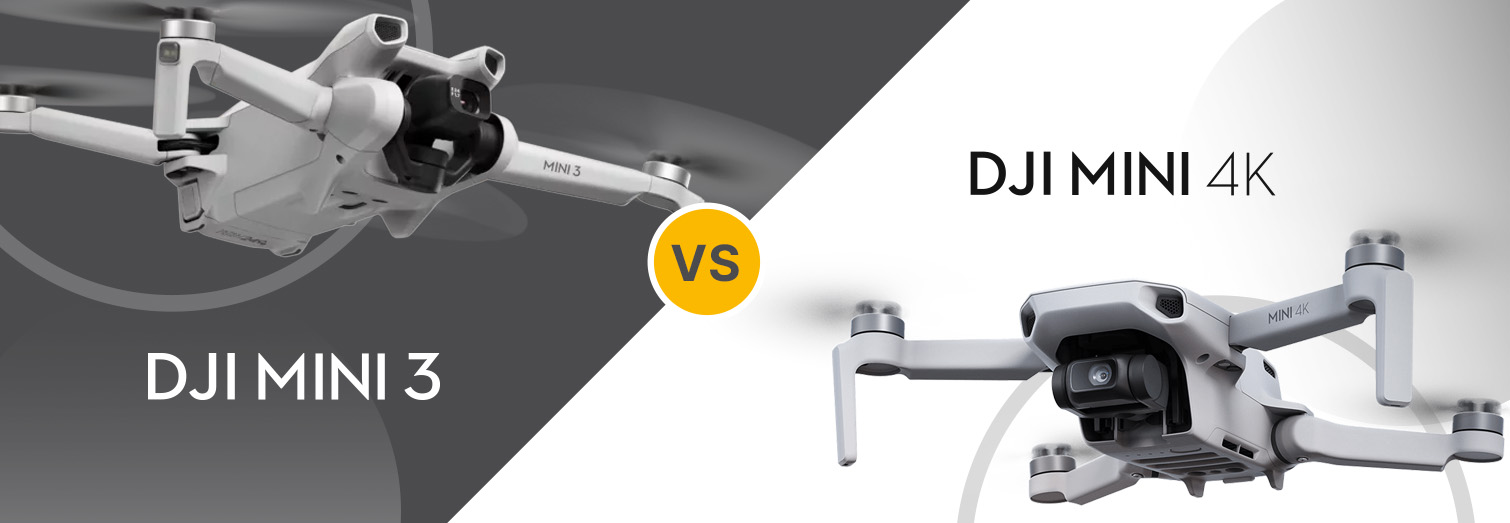
Buy the DJI Mini 4K if you want the least expensive route to stabilized 4K aerial video. Buy the DJI Mini 3 if you care more about image quality, vertical capture, longer flight time, and a controller with a built-in screen. The Mini 3 is the better camera drone overall, but the Mini 4K is the better value for occasional daylight use.
Review Video
The two models share more than their size suggests. Both weigh less than 249 g with their standard batteries, record 4K/30fps video, use a three-axis gimbal and DJI O2 transmission, resist Level 5 wind, and provide the same five QuickShots. The important differences are concentrated in the camera, gimbal movement, battery system, controller options, and operating temperature.
This DJI Mini 4K vs Mini 3 comparison is based on current DJI specifications, support documents, manuals, and feature listings. It is not presented as original FPV Drone flight testing. Bundle contents, product condition, and availability can vary by seller and region.
Quick verdict
The Mini 3 is worth paying more for when its camera or ownership improvements will be used. Its 1/1.3-inch sensor, f/1.7 lens, HDR, True Vertical Shooting, 38-minute battery rating, and DJI RC support are meaningful upgrades. If those features would sit unused, the Mini 4K preserves most of the core flight experience for less.
Choose DJI Mini 4K
Best for budget-conscious beginners, occasional daylight flights, horizontal travel footage, and buyers who want stable 4K without paying for camera features they may not use.
Choose DJI Mini 3
Best for regular creators, sunrise or sunset flights, vertical social video, longer sessions, and buyers who want the optional DJI RC screen controller.
Choose neither
Look at a different model if directional obstacle avoidance, ActiveTrack, 4K/60fps, or a flat color profile is a firm requirement.
DJI Mini 4K
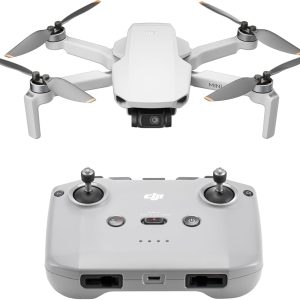
Featured gear
DJI Mini 4K Drone: Beginner 4K Camera Drone Under 249g
The DJI Mini 4K is an entry-level DJI camera drone built for beginners who want stabilized 4K footage without jumping into the higher-priced Mini models. It weighs under 249 g, supports 4K/30fps video, uses…
The DJI Mini 4K is an entry-level DJI camera drone built for beginners who want stabilized 4K footage without jumping into the higher-priced Mini models. It weighs under 249 g, supports 4K/30fps video, uses a 3-axis gimbal, and includes GPS-assisted flight features like Return to Home.
- Best for
- Best for new pilots who want a lightweight DJI camera drone with stabilized 4K…
- Skill level
- Beginner
- Product type
- Beginner Drones, Camera Drones, DJI Drones, Drones, Under 249g Drones
- Best for
- New pilots who want a lightweight DJI camera drone with stabilized 4K video, GPS-assisted…
- Skill level
- Beginner
- Product type
- Camera Drone
DJI Mini 3
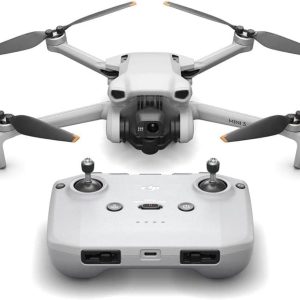
Featured gear
DJI Mini 3 Drone
The DJI Mini 3 is a lightweight beginner camera drone with 4K HDR video, True Vertical Shooting, a 1/1.3-inch CMOS sensor, and up to 38 minutes of standard-battery flight time. Best for: beginners, travel…
The DJI Mini 3 is a lightweight beginner camera drone with 4K HDR video, True Vertical Shooting, a 1/1.3-inch CMOS sensor, and up to 38 minutes of standard-battery flight time.
- Best for
- Best for beginners and casual creators who want a lightweight DJI camera drone with…
- Skill level
- Beginner
- Product type
- Beginner Drones, Camera Drones, DJI Drones, Drones, Under 249g Drones
- Best for
- Beginners and casual creators who want a lightweight DJI camera drone with 4K HDR…
- Skill level
- Beginner
- Product type
- Camera Drone
Compare both drones
| Compare | DJI Mini 4K Drone: Beginner 4K Camera Drone Under 249g | DJI Mini 3 Drone |
|---|---|---|
| Product |
DJI Mini 4K Drone: Beginner 4K Camera Drone Under 249g |
DJI Mini 3 Drone |
| Best for | Best for new pilots who want a lightweight DJI camera drone with stabilized 4K video, GPS-assisted flight, Return to Home, and beginner-friendly controls. Skip it if you want true FPV freestyle, racing, obstacle avoidance, Follow Me, or a higher-end low-light camera. | Best for beginners and casual creators who want a lightweight DJI camera drone with 4K HDR video, True Vertical Shooting, a 1/1.3-inch CMOS sensor, long flight time, and DJI’s stable camera-drone flight experience. Skip it if you want true FPV freestyle, racing, full obstacle avoidance, Follow Me, or higher-end Pro camera features. |
| Skill level | Beginner | Beginner |
| Product type | Beginner Drones, Camera Drones, DJI Drones, Drones, Under 249g Drones | Beginner Drones, Camera Drones, DJI Drones, Drones, Under 249g Drones |
| Product page | View product | View product |
| Retailer | Check Price | Check Price |
DJI Mini 4K vs Mini 3 specifications comparison
The specification table shows a clear pattern. Flight performance is close, while the Mini 3 directs most of its extra capability toward imaging, endurance, gimbal movement, and controller choice.
| Specification | DJI Mini 4K | DJI Mini 3 | Advantage |
|---|---|---|---|
| Standard takeoff weight | 246 g | 248 g | Mini 4K by 2 g; both are below 249 g as published |
| Camera sensor | 1/2.3-inch CMOS, 12 MP | 1/1.3-inch CMOS, up to 48 MP | Mini 3 |
| Lens | 24 mm equivalent, f/2.8 | 24 mm equivalent, f/1.7 | Mini 3 |
| Maximum video | 4K at 24, 25, or 30fps | 4K HDR at 24, 25, or 30fps | Mini 3 |
| Higher-frame-rate video | 2.7K and Full HD up to 60fps | 2.7K and Full HD up to 60fps | Tie |
| Maximum bitrate and codec | 100 Mbps, H.264 | 100 Mbps, H.264 | Tie |
| Photo formats | JPEG and DNG RAW | JPEG and DNG RAW | Tie |
| True Vertical Shooting | No | Yes | Mini 3 |
| Maximum upward gimbal tilt | 20° in extended mode | 60° | Mini 3 |
| Maximum rated flight time | 31 minutes | 38 minutes with standard battery | Mini 3 |
| Extended battery | No official Plus option | Up to 51 minutes with Battery Plus in selected markets | Mini 3 |
| Transmission | DJI O2, 720p/30 live view | DJI O2, 720p/30 live view | Tie |
| Maximum FCC transmission rating | 10 km | 10 km | Tie |
| Maximum horizontal speed | 16 m/s | 16 m/s | Tie |
| Wind resistance | 10.7 m/s, Level 5 | 10.7 m/s, Level 5 | Tie |
| Directional obstacle sensing | No | No | Tie |
| QuickShots | Dronie, Helix, Rocket, Circle, Boomerang | Dronie, Helix, Rocket, Circle, Boomerang | Tie |
| Controller options | DJI RC-N1C phone controller | DJI RC-N1 phone controller or DJI RC screen controller | Mini 3 |
| Aircraft operating temperature | 0°C to 40°C | -10°C to 40°C | Mini 3 for colder conditions |
| Internal media storage | None | None | Tie |
The Mini 3 is not a major range, speed, or wind-resistance upgrade. Its value comes from the camera system, native vertical orientation, seven additional published minutes with the standard battery, wider operating range, and the option to fly without attaching a phone.
For deeper reference material, see our DJI Mini 4K specifications guide and DJI Mini 3 specifications guide.
The biggest difference is the camera
Both drones put “4K” on the specification sheet, but resolution does not make their footage equivalent. Sensor size, aperture, HDR processing, and camera orientation affect what can be captured before the file is compressed.
Sensor size and practical image quality
The Mini 4K uses a 1/2.3-inch sensor with 12 million effective pixels. It supports DNG RAW, automatic exposure bracketing, and stabilized 4K video, making it a capable daylight camera rather than a basic toy-drone camera.
The Mini 3 uses a larger 1/1.3-inch sensor with 12 MP and 48 MP photo modes. A larger sensor and a brighter lens give the imaging system more light to work with. The Mini 3 therefore has the stronger hardware foundation for scenes containing bright skies, darker foregrounds, sunrise, sunset, or shaded subjects.
The difference will not transform every midday clip viewed on a phone. It becomes more valuable when the light is difficult, the scene has a wide brightness range, or the footage will be edited and displayed carefully.
f/2.8 versus f/1.7
The Mini 4K's lens has a fixed f/2.8 aperture. The Mini 3 uses a fixed f/1.7 aperture. The lower f-number represents a wider opening, so the Mini 3 can gather more light at the same shutter speed and ISO.
This does not make the Mini 3 a large-sensor night camera. Both are small, lightweight drones with fixed apertures and Normal color profiles. The Mini 3 simply offers more imaging headroom before low light forces greater compromises.
HDR and 48 MP photos
DJI states that the Mini 3 outputs HDR video at 24, 25, or 30fps and supports HDR single photos. Its dual-native-ISO system combines two gain paths at the lower video frame rates to improve dynamic-range handling. The Mini 4K does not list the same HDR imaging path.
The Mini 3 can also capture 48 MP images up to 8064 × 6048, while the Mini 4K tops out at 12 MP and 4000 × 3000. The 48 MP option provides more pixels for cropping or large output, but it does not guarantee a better photograph in every condition. Lens quality, exposure, motion, noise, and processing still matter.
| Camera use | Better choice | Reason |
|---|---|---|
| Daylight travel clips | Mini 4K can be enough | Stabilized 4K/30fps and RAW photos cover casual horizontal capture. |
| Sunrise, sunset, and mixed light | Mini 3 | Larger sensor, f/1.7 aperture, dual native ISO, and HDR provide more headroom. |
| Cropping still photographs | Mini 3 | Optional 48 MP output provides more source pixels. |
| Simple sharing without extensive editing | Either | Both provide stabilized H.264 video and JPEG capture. |
| Advanced color grading | Neither | Both list Normal as the color mode and lack a flat 10-bit profile. |
Video, True Vertical Shooting, and gimbal movement
The Mini 4K and Mini 3 both record 4K at up to 30fps, 2.7K at up to 60fps, and Full HD at up to 60fps. Both use H.264 and a maximum published bitrate of 100 Mbps. Neither records 4K/60fps, so buyers needing high-resolution slow motion should choose a different model.
The Mini 3's advantage is the image entering that shared recording pipeline. Its larger sensor, brighter lens, HDR, and dual-native-ISO processing make the camera system more flexible even though both files can say 4K/30fps.
True Vertical Shooting
The Mini 3 rotates its camera 90 degrees for native portrait capture. Reels, TikTok videos, Shorts, and other vertical deliverables can use the full sensor orientation without discarding the sides of a horizontal frame.
The Mini 4K records horizontally. Its 4K footage can be cropped into a vertical edit, but that removes a large part of the original frame and requires the pilot to compose for the future crop. If vertical content is a regular deliverable, the Mini 3 is the clear choice.
Upward camera movement
Both aircraft use a three-axis mechanical gimbal, but the controllable range differs. The Mini 4K can tilt from straight down at -90° to 20° upward in extended mode. The Mini 3 reaches 60° upward and rotates its roll axis to -90° for portrait orientation.
The added upward range helps frame cliffs, trees, bridges, buildings, and reveal shots where the subject sits above the aircraft's level. For ordinary forward-looking landscapes, both gimbals provide the essential stabilization that matters most.
Compare Current Prices
Match the controller, battery count, charging equipment, condition, warranty region, and included accessories before comparing bundles.
Flight time, batteries, and charging
DJI rates the Mini 4K for up to 31 minutes with its 2,250 mAh standard battery. The Mini 3 is rated for up to 38 minutes with its 2,453 mAh standard battery. Both tests continue until forced landing from battery depletion under controlled windless conditions, so normal usable flight time is shorter.
The seven-minute published difference is meaningful. It gives the Mini 3 more time to reach a location, settle on a composition, repeat a QuickShot, and return with reserve. It does not remove the effects of wind, cold, climbing, battery age, route, or the energy needed to land safely.
In selected markets, the Mini 3 can use the 3,850 mAh Intelligent Flight Battery Plus for a published maximum of 51 minutes. DJI lists the aircraft at about 290 g with that pack, which means it is no longer in its standard sub-249 g configuration. Rules and availability vary by location.
The batteries are not interchangeable
The Mini 4K uses the DJI Mini 2 Intelligent Flight Battery family. The Mini 3 uses DJI Mini 3 Pro Intelligent Flight Batteries. Their charging hubs are also different. Buying an accessory based only on the word “Mini” can result in the wrong part.
Charging speed
DJI lists about 1 hour 22 minutes to charge one Mini 4K battery with its 18 W charger. The Mini 3 standard battery is listed at 64 minutes in the aircraft or 56 minutes in the compatible hub with a DJI 30 W USB-C Charger. Charger, cable, temperature, and starting level can change actual time.
Battery count often matters more than a small difference in theoretical charging speed. A Mini 4K package with three healthy batteries may support a longer outing than a Mini 3 package with one. Compare the complete system, not only the aircraft name. Our DJI Mini 4K battery guide explains practical flight-time planning.
Range, wind resistance, speed, and GPS are effectively tied
Both drones use DJI O2 transmission and provide a 720p/30fps controller view. DJI rates both for up to 10 km under FCC conditions or 6 km under CE, SRRC, and MIC conditions in an unobstructed environment without interference.
Those are link-test maximums, not recommended operating distances. Terrain, buildings, radio interference, antenna orientation, regulatory power limits, wind, battery reserve, and visual-line-of-sight requirements create much shorter practical boundaries.
The aircraft also share a 16 m/s maximum horizontal speed, 5 m/s ascent, 3.5 m/s descent, 10.7 m/s Level 5 wind resistance, GPS with GLONASS and Galileo, Return to Home, and downward vision positioning.
The Mini 3 therefore does not buy a stronger published radio link, a higher top speed, or better wind resistance. If those are the only specifications that matter, the Mini 4K offers essentially the same headline flight performance.
Buyer implication: Do not pay more for the Mini 3 expecting a faster or longer-range aircraft. Pay more when the camera, battery, cold-weather operating range, gimbal, or controller option changes what you can accomplish.
Obstacle sensing and tracking: neither drone has the upgrade
The Mini 4K and standard Mini 3 have downward vision systems that support low-altitude positioning and landing. Neither has forward, rear, side, or omnidirectional sensing that scans the flight path for branches, cables, walls, or other hazards.
Downward positioning should not be described as full obstacle avoidance. It observes the surface below under suitable lighting and texture conditions. It cannot protect the aircraft from an object ahead during manual flight, QuickShots, or Return to Home.
DJI documents the same five QuickShots for both: Dronie, Helix, Rocket, Circle, and Boomerang. Neither product's feature list includes ActiveTrack or a general Follow Me function. A QuickShot executes a defined movement around a selected subject; it does not continuously follow a moving person or vehicle.
This is where the Mini 3 is often confused with the Mini 3 Pro. The Pro is a different aircraft with additional sensing, tracking, and video capabilities. A listing that says “Mini 3” should not be assumed to include Mini 3 Pro features.
For a first flight, use an open, well-lit area away from trees, poles, wires, buildings, vehicles, and people. The Mini 3's better camera does not make it safer around obstacles than the Mini 4K.
DJI Mini 4K vs Mini 3 controller comparison
The Mini 4K is listed with the DJI RC-N1C. This phone-based controller provides physical sticks and holds a compatible mobile device running DJI Fly. The phone supplies the display, live view, maps, camera controls, and app connection.
The Mini 3 supports the DJI RC-N1 and DJI RC. RC-N1 is also phone-based. DJI RC has an integrated display and DJI Fly installed, creating a self-contained controller that does not require attaching a phone for normal flight.
| Controller choice | Advantages | Tradeoffs |
|---|---|---|
| Phone-based RC-N1C or RC-N1 | Usually lower bundle cost; familiar phone screen; easy access to editing and sharing. | Requires a compatible phone, cable, mounting, and enough phone battery. |
| DJI RC with Mini 3 | Faster setup; dedicated controls and screen; phone remains available; flight does not drain the phone. | Higher bundle cost; another screen device to charge; no third-party app installation. |
DJI RC is a convenience upgrade, not a transmission upgrade. The Mini 3 uses the same O2 class and 720p/30fps live-view specification with either supported controller. Compare listings carefully because “Mini 3” may refer to an aircraft-only package, phone-controller kit, or DJI RC kit.
Portability, sub-249 g status, and accessories
The Mini 4K weighs 246 g in its standard configuration and folds to 138 × 81 × 58 mm. The Mini 3 weighs 248 g with its standard battery and folds to 148 × 90 × 62 mm. The Mini 4K is slightly smaller and lighter, but both fit easily into a compact camera bag.
The standard weights include the battery, propellers, and a microSD card. Accessories can change the actual takeoff weight. The Mini 3 Battery Plus raises the aircraft to about 290 g. A number printed for the standard configuration does not automatically describe every way the aircraft can be operated.
Rules depend on location, purpose, and configuration. Being below 249 g may simplify some requirements, but it does not eliminate airspace rules, visual-line-of-sight requirements, operating restrictions, or every registration obligation.
What to verify after choosing the aircraft
- a compatible microSD card, because neither drone has internal media storage;
- the exact controller included with the listing;
- the number, type, and condition of flight batteries;
- the correct charging hub for that battery family;
- a suitable USB-C wall adapter and cable;
- model-specific spare propellers and screws;
- a gimbal protector and transport case;
- seller identity, warranty region, return terms, and product condition.
A well-equipped Mini 4K package can be more useful than a bare Mini 3 if buying the more expensive aircraft leaves no budget for a spare battery, memory card, or safe transport. Compare total setup cost rather than one advertised aircraft price.
Which drone is better for your use?
Basic operation is similar. Both use DJI Fly, satellite positioning, Return to Home, physical controller sticks, automatic takeoff and landing support, and a stabilized camera view. The right first drone depends more on the footage you want and the budget you can support than on the learning curve.
| Buyer or use case | Better choice | Why |
|---|---|---|
| Lowest-cost stabilized 4K entry | DJI Mini 4K | Provides the shared core flight features without paying for the Mini 3 camera platform. |
| Occasional daylight travel video | DJI Mini 4K | Its camera is sufficient when light is good and native vertical capture is unnecessary. |
| Sunrise, sunset, or high-contrast scenes | DJI Mini 3 | Larger sensor, f/1.7 lens, HDR, and dual native ISO provide more imaging flexibility. |
| Reels, TikTok, and Shorts | DJI Mini 3 | True Vertical Shooting records in native portrait orientation. |
| Longer sightseeing sessions | DJI Mini 3 | Seven additional published minutes with the standard battery. |
| Phone-free controller setup | DJI Mini 3 | Compatible with DJI RC. |
| Colder-weather operating specification | DJI Mini 3 | Aircraft range begins at -10°C rather than 0°C, subject to battery and safety guidance. |
| Occasional hobby use | DJI Mini 4K | Avoids paying for camera and battery improvements that may rarely be used. |
| Obstacle avoidance is essential | Neither | Both lack forward, rear, and side obstacle sensing. |
| Active subject tracking is essential | Neither | Neither lists ActiveTrack or a general Follow Me mode. |
| 4K slow motion or flat color is essential | Neither | Both stop at 4K/30fps and list Normal as the color mode. |
Is the Mini 3 worth the extra money?
Yes when at least one of its upgrades changes the result or ownership experience. True Vertical Shooting alone can justify it for a social creator. The camera system matters for difficult light. Longer endurance and DJI RC compatibility improve every flight, even when the finished clip is viewed on a small screen.
No when the buyer only wants occasional horizontal daylight footage. In that case, both provide 4K/30fps, O2 transmission, the same wind rating and top speed, and the same QuickShots. Paying more does not add obstacle avoidance or tracking.
If comparable bundles are close in total cost, condition, and warranty, the Mini 3 is the stronger long-term choice. If the price gap prevents you from buying essential accessories or a spare battery, a complete Mini 4K setup can be the smarter purchase.
For complete single-product recommendations, see our DJI Mini 4K review and DJI Mini 3 review.
Final verdict: DJI Mini 4K or Mini 3?
The DJI Mini 3 wins overall. It preserves the approachable sub-249 g standard configuration and shared O2 flight platform while adding the improvements most likely to remain useful: a larger and brighter camera, HDR, native vertical capture, longer standard battery life, greater upward gimbal movement, a colder aircraft operating range, and DJI RC support.
The DJI Mini 4K wins on value. It is the sensible choice for someone who wants stabilized horizontal 4K at the lowest practical cost and will mostly fly in good daylight. Its published range, speed, wind resistance, GPS system, and QuickShots are not meaningfully behind the Mini 3.
Our recommendation is to buy the Mini 3 for regular content creation or when the bundles are reasonably close after matching batteries, controller, accessories, condition, and warranty. Buy the Mini 4K for occasional use, a tighter budget, or a first purchase where the Mini 3's camera advantages would go unused.
Choose Your DJI Mini
Verify the exact controller, battery count, charging equipment, condition, seller, warranty region, and return terms before ordering.
DJI Mini 4K vs Mini 3 FAQs
Which is better, the DJI Mini 4K or DJI Mini 3?
The Mini 3 is better overall because it has a larger sensor, brighter lens, HDR, True Vertical Shooting, longer rated flight time, greater upward gimbal range, and DJI RC compatibility. The Mini 4K is better for a buyer prioritizing the lowest total cost.
Do both drones record 4K video?
Yes. Both record up to 4K at 30fps with a maximum published bitrate of 100 Mbps. The Mini 3 adds HDR output at 24, 25, and 30fps. Neither records 4K/60fps.
Is the Mini 3 camera much better?
It has a meaningful hardware advantage: a 1/1.3-inch sensor and f/1.7 lens compared with the Mini 4K's 1/2.3-inch sensor and f/2.8 lens. The benefit matters most in low light and high-contrast scenes. In even daylight on a small screen, the difference may look less dramatic.
Does the DJI Mini 4K shoot vertical video?
It cannot rotate its camera for native portrait recording. Its horizontal 4K footage can be cropped for a vertical edit. The Mini 3 rotates the gimbal 90 degrees for True Vertical Shooting.
Does either drone have obstacle avoidance?
No directional obstacle avoidance is listed for either model. Both use downward vision positioning, but neither has forward, rear, or side sensors that can protect the flight path.
Does either drone have Follow Me or ActiveTrack?
No. Both provide five QuickShots, but neither product's documented feature set includes ActiveTrack or a general Follow Me mode.
Which drone has better battery life?
The Mini 3. DJI rates it for up to 38 minutes with its standard battery, compared with 31 minutes for the Mini 4K. A Battery Plus can extend the Mini 3 rating to 51 minutes in selected markets, but it raises aircraft weight to about 290 g.
Do the DJI Mini 4K and Mini 3 use the same battery?
No. The Mini 4K uses the DJI Mini 2 Intelligent Flight Battery family. The Mini 3 uses DJI Mini 3 Pro Intelligent Flight Batteries. Their charging hubs are different as well.
Can the DJI Mini 4K use the DJI RC screen controller?
DJI lists the Mini 4K with the RC-N1C phone controller. The Mini 3 supports the phone-based RC-N1 and the DJI RC with an integrated screen.
Which is better for a first drone?
The Mini 4K is the stronger first drone when minimizing cost is the priority. The Mini 3 is the better first purchase when the buyer expects to create content regularly and wants more room to grow without upgrading soon.
Sources
- DJI Mini 4K specifications: official aircraft, camera, gimbal, sensing, transmission, battery, storage, and controller values.
- DJI Mini 3 specifications: official aircraft, camera, gimbal, sensing, transmission, battery, charging, storage, and controller values.
- DJI Mini 3 FAQ: official HDR behavior, True Vertical Shooting, remote-controller compatibility, battery options, and accessory compatibility.
- DJI Mini 4K beginner and support guide: official feature, controller, charging, battery, storage, and accessory information.
Last checked: July 13, 2026. Specifications, firmware behavior, battery availability, controller combinations, package contents, and seller availability can change.