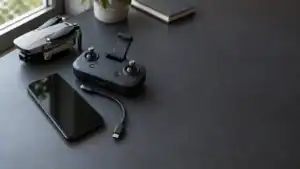
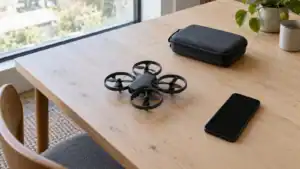
The DJI Mini 3 is a 248 g folding camera drone with a 1/1.3-inch sensor, 4K HDR video, True Vertical Shooting, GPS-assisted flight, and up to 38 minutes of rated flight time with the standard battery. It offers a stronger camera and longer endurance than DJI's basic entry models, but it does not include the forward and rear obstacle sensing found on the Mini 3 Pro.
Its best specifications are the f/1.7 lens, 12 MP and 48 MP photo options, DNG RAW, 4K/30 HDR, a rotating three-axis gimbal, and compatibility with the DJI RC screen controller. Its biggest omissions are directional obstacle avoidance, ActiveTrack, 4K/60 recording, and a flat color profile.
This guide translates current DJI Mini 3 specifications, product documentation, and official support information into buyer decisions. It is not presented as original FPV Drone flight or camera testing. Maximum flight time, range, speed, wind resistance, and hovering accuracy are controlled-condition ratings; actual results vary.
DJI Mini 3 specs at a glance
The Mini 3 is best understood as a camera-and-battery upgrade over DJI's entry-level Mini models, not as an obstacle-avoidance or tracking upgrade.
Best camera feature
A 1/1.3-inch sensor with an f/1.7 lens, 4K HDR, RAW photos, and true portrait capture.
Standard endurance
Up to 38 minutes with the 2,453 mAh battery, measured under controlled conditions until forced landing.
Main limitation
Downward sensing only, with no forward, rear, side, or omnidirectional obstacle detection.
Featured DJI Mini 3

Featured gear
DJI Mini 3 Drone
The DJI Mini 3 is a lightweight beginner camera drone with 4K HDR video, True Vertical Shooting, a 1/1.3-inch CMOS sensor, and up to 38 minutes of standard-battery flight time. Best for: beginners, travel…
The DJI Mini 3 is a lightweight beginner camera drone with 4K HDR video, True Vertical Shooting, a 1/1.3-inch CMOS sensor, and up to 38 minutes of standard-battery flight time.
- Best for
- Best for beginners and casual creators who want a lightweight DJI camera drone with…
- Skill level
- Beginner
- Product type
- Beginner Drones, Camera Drones, DJI Drones, Drones, Under 249g Drones
- Best for
- Beginners and casual creators who want a lightweight DJI camera drone with 4K HDR…
- Skill level
- Beginner
- Product type
- Camera Drone
Complete DJI Mini 3 specifications table
The table pairs DJI's published values with the practical question each one answers. Regional availability, aircraft configuration, and test conditions still matter.
| Category | Official specification | Practical meaning |
|---|---|---|
| Standard takeoff weight | 248 g with standard battery, propellers, and microSD card | Portable and below 250 g as published, but rules still apply and actual weight can vary. |
| Plus-battery weight | About 290 g | The larger pack removes the standard sub-250 g configuration and can change registration requirements. |
| Camera sensor | 1/1.3-inch CMOS, 48 MP effective pixels | Supports 12 MP and 48 MP photos and provides a larger imaging foundation than a 1/2.3-inch entry camera. |
| Lens | 24 mm equivalent, 82.1° field of view, f/1.7, focus from 1 m to infinity | A wide fixed lens for landscapes and travel; bright aperture, but no optical zoom. |
| Video | 4K up to 30fps; 2.7K and 1080p up to 60fps; H.264 MP4; 100 Mbps | Detailed 4K HDR capture, but smoother 48/50/60fps recording requires lower resolution. |
| Photos | JPEG and DNG RAW; 12 MP or 48 MP; AEB, HDR, and panoramas | RAW and bracketing provide useful editing flexibility beyond finished JPEG files. |
| Gimbal | Three-axis mechanical stabilization; -90° or 0° roll position | The camera physically rotates for uncropped portrait-oriented capture. |
| Standard flight time | Up to 38 minutes; up to 33 minutes hovering | Controlled-condition maximums measured to depletion, not routine landing targets. |
| Plus flight time | Up to 51 minutes; up to 44 minutes hovering | Longer endurance in selected markets, with more weight and different regulatory implications. |
| Positioning | GPS, GLONASS, and Galileo | Supports outdoor position holding, Home Point functions, telemetry, and Return to Home. |
| Obstacle sensing | Downward vision system only | No forward, rear, side, or omnidirectional obstacle detection. |
| Transmission | DJI O2, 720p/30 live view, up to 10 km FCC or 6 km CE, SRRC, and MIC | A capable link in ideal conditions, not a safe or legal beyond-sight target. |
| Maximum speed | 16 m/s horizontal, 5 m/s ascent, 3.5 m/s descent | About 35.8 mph at maximum horizontal speed under DJI's test conditions. |
| Wind resistance | 10.7 m/s, Level 5 | A resistance rating, not a recommendation for beginners to fly in 24 mph wind. |
| Storage | No internal storage | A compatible microSD card is needed for normal photo and video capture. |
| Controllers | DJI RC-N1 or DJI RC | Choose a phone-connected controller or a dedicated controller with a screen. |
Do not compare every distance number as though it measures the same thing. DJI's 18 km standard-battery and 25 km Plus-battery flight-distance figures are endurance tests. The 10 km FCC figure is an ideal one-way communication rating. None is a safe, legal, or realistic normal-flight goal.
Check current DJI Mini 3 packages
Compare the controller, battery type and count, charging equipment, microSD card, condition, accessories, and warranty region before choosing a bundle.
Weight and dimensions: what “under 249 g” means
DJI lists the standard Mini 3 at 248 g, including its standard Intelligent Flight Battery, propellers, and a microSD card. Folded without propellers, it measures 148 × 90 × 62 mm. Unfolded with propellers, it measures 251 × 362 × 72 mm.
The aircraft is genuinely portable, but the published weight describes a particular configuration. DJI notes that actual weight can vary because of materials and external factors. Accessories add weight, and the Intelligent Flight Battery Plus raises the aircraft to about 290 g.
That Plus battery changes more than endurance. Current FAA recreational guidance says drones weighing 250 g or more must be registered for U.S. recreational operation. The standard Mini 3 is below that threshold as published; the Plus configuration is above it. Purpose, Remote ID, TRUST, airspace, visual line of sight, and local restrictions still require separate evaluation.
DJI lists the Mini 3 as C0 in the European Union. Buyers should still use the aviation regulator and local authority for the country where the aircraft will fly rather than assuming one weight or class creates the same rules everywhere.
Camera specs: why the 1/1.3-inch sensor matters
The camera is the main reason to choose the Mini 3 over a simpler entry-level Mini. Its 1/1.3-inch CMOS sensor has 48 million effective pixels and a bright, fixed f/1.7 lens. DJI lists dual native ISO values of ISO 100 and ISO 800, with its processing combining gain paths for better dynamic range in supported modes.
A larger sensor does not guarantee a better image by itself, but it gives the camera a stronger light-gathering foundation than a smaller 1/2.3-inch design. The f/1.7 aperture also helps in lower light. Because the aperture is fixed, bright-day exposure is controlled with shutter speed, ISO, or compatible ND filters rather than an adjustable iris.
Lens and exposure specifications
- 24 mm equivalent wide-angle view;
- 82.1° field of view;
- fixed f/1.7 aperture;
- focus from 1 m to infinity;
- ISO 100 to 3200 for photo and video;
- electronic shutter from 2 to 1/8000 second.
Photo output
The Mini 3 captures 12 MP standard photos or 48 MP high-resolution images. It supports JPEG and DNG RAW, three-frame AEB at 2/3 EV steps, single-shot HDR, and Sphere, 180°, and Wide Angle panoramas.
The 48 MP setting is not automatically best for every scene. It provides more source pixels and can improve cropping flexibility in favorable light. The 12 MP mode produces more manageable files and can be the better everyday choice when light, motion, haze, or noise reduces the practical advantage of maximum resolution.
For photographers who edit, DNG RAW support may matter more than the largest pixel count. RAW retains more capture information for adjusting exposure, highlights, shadows, white balance, and color than a finished JPEG.
Video specs: 4K HDR, frame rates, zoom, and gimbal
The Mini 3 records 4K at 24, 25, or 30 frames per second. It records 2.7K and Full HD at up to 60fps. DJI says HDR is enabled by default for video at 30fps or lower and identifies 4K/30 as the best balance of dynamic range and image detail. At 48, 50, or 60fps, movement is smoother but dynamic range decreases.
| Resolution | Frame rates | Best fit | Main limitation |
|---|---|---|---|
| 4K | 24, 25, 30fps | Maximum detail and HDR capture | No 4K/60 option |
| 2.7K | 24, 25, 30, 48, 50, 60fps | Smoother movement with more detail than 1080p | Less spatial detail than 4K |
| Full HD | 24, 25, 30, 48, 50, 60fps | Smaller files and moderate slow motion | Lowest resolution of the three modes |
Maximum bitrate is 100 Mbps, and files are H.264 MP4. The only listed color mode is Normal. That keeps the workflow simple, but creators who need 4K/60 or a flat profile for heavier grading should choose a different model.
Digital zoom is not optical reach
DJI lists up to 2× digital zoom in 4K, 3× in 2.7K, and 4× in Full HD. The lens does not physically zoom. Digital magnification crops or enlarges the sensor image, so fine detail declines as magnification increases.
True Vertical Shooting and upward tilt
The three-axis gimbal stabilizes tilt, roll, and pan and can rotate the camera 90 degrees. That produces a portrait-oriented file without cropping the sides from a horizontal frame. The controllable tilt range reaches from straight down at -90° to 60° upward, adding useful angles for buildings, trees, cliffs, and reveal shots.
Vertical capture preserves sensor use, not automatic composition. The pilot still needs to plan movement, exposure, gimbal angle, and a clear route. The stabilized camera also does not detect obstacles.
Battery specs: 38 minutes versus 51 minutes
DJI supports two battery sizes where both are available. The standard Intelligent Flight Battery keeps the aircraft in its published 248 g configuration. The Intelligent Flight Battery Plus increases rated endurance but raises the aircraft to about 290 g.
| Specification | Standard battery | Battery Plus |
|---|---|---|
| Capacity | 2,453 mAh | 3,850 mAh |
| Energy | 18.1 Wh | 28.4 Wh |
| Battery weight | About 80.5 g | About 121 g |
| Aircraft takeoff weight | 248 g standard specification | About 290 g |
| Maximum flight time | 38 minutes | 51 minutes |
| Maximum hovering time | 33 minutes | 44 minutes |
| Charge in aircraft at 30 W | About 64 minutes | About 101 minutes |
| Charge in hub at 30 W | About 56 minutes | About 78 minutes |
The 38-minute and 51-minute figures are not routine landing targets. DJI measures maximum flight time in windless, sea-level-equivalent conditions with the aircraft moving forward at 21.6 km/h in Photo mode until forced landing. Wind, temperature, altitude, maneuvering, battery age, accessories, and return reserve reduce usable time.
DJI recommends its 30 W USB-C charger or another 30 W USB Power Delivery charger. The compatible hub charges up to three batteries in sequence, not simultaneously.
The standard pack is the cleaner choice for buyers prioritizing low weight. The Plus pack is the endurance choice where available, but it should be treated as a different aircraft configuration for weight and rule checks.
Range, speed, wind resistance, and operating limits
DJI O2 transmission range
The Mini 3 uses DJI O2 transmission with a 720p/30fps controller view. DJI rates the interference-free link up to 10 km under FCC rules or 6 km under CE, SRRC, and MIC rules. DJI identifies those maximums as one-way, non-return communication measurements in an unobstructed environment.
With typical FCC interference, DJI provides reference ranges of approximately 1.5 to 3 km in strong urban interference, 3 to 6 km in medium suburban interference, and 6 to 10 km in lower-interference open suburbs or seaside environments. These references are not guaranteed operating distances.
Maximum flight distance is a different number
DJI lists 18 km with the standard battery and 25 km with the Plus battery as maximum total flight distance. Those are controlled endurance tests at 43.2 km/h until forced landing. They are not one-way radio range and do not imply that the aircraft can fly 18 km outbound and return.
Speed and wind resistance
Maximum horizontal speed is 16 m/s, or about 35.8 mph. Maximum ascent is 5 m/s, and maximum descent is 3.5 m/s. These are top figures under DJI's stated conditions rather than the calmer response normally used for cinematic flight.
The Level 5 wind-resistance rating is 10.7 m/s, roughly 24 mph. It is not a recommended wind for beginners. Gusts, altitude, terrain, and an upwind return can force a lightweight aircraft to tilt harder, use more energy, and make less progress than expected.
Temperature and takeoff altitude
DJI publishes an aircraft operating range of -10°C to 40°C. The drone is not waterproof, and DJI says to avoid water exposure and land as soon as possible if rain begins.
Maximum takeoff altitude is 4,000 m above sea level with the standard battery and 3,000 m with the Plus battery. That describes the propulsion operating envelope at elevation, not legal permission to fly thousands of meters above the ground.
GPS, hovering, Return to Home, and obstacle sensing
The Mini 3 receives GPS, GLONASS, and Galileo signals. With suitable reception, it can hold position outdoors, record a Home Point, display telemetry, and support Return to Home. DJI lists GNSS hovering accuracy of ±0.5 m vertically and ±1.5 m horizontally under specified conditions.
At lower altitude over a textured, well-lit surface, the downward vision system can provide more precise positioning. DJI lists a precise-hovering range of 0.5 to 10 m and requires adequate light and a diffuse reflective surface with a clear pattern.
The important limitation is direction. The Mini 3 senses downward for positioning and landing assistance. It cannot identify trees, wires, buildings, or terrain ahead during manual flight, QuickShots, or Return to Home.
Included flight aids
Multi-constellation GNSS, Home Point recording, Return to Home, downward positioning, infrared sensing, and five QuickShots.
Not included
Forward, rear, side, or omnidirectional sensing; ActiveTrack; FocusTrack; MasterShots; or automatic obstacle bypass.
Pilot implication
Use open routes, verify the Home Point and RTH altitude, keep visual line of sight, and do not expect the aircraft to stop for hazards.
The five QuickShots are Dronie, Helix, Rocket, Circle, and Boomerang. They automate a defined camera movement around a selected subject, not continuous tracking. The flight area must remain clear because the aircraft cannot detect directional obstacles.
DJI RC vs RC-N1, storage, and QuickTransfer
DJI confirms two compatible controllers for the Mini 3. Both use the same O2 transmission specification, but they create different setup and ownership experiences.
| Controller | Main advantage | Main tradeoff |
|---|---|---|
| DJI RC-N1 | Usually lowers bundle cost and uses a familiar phone for DJI Fly and sharing. | Depends on phone compatibility, cable setup, screen brightness, and phone battery. |
| DJI RC | Built-in screen and preinstalled DJI Fly reduce setup and phone interruptions. | Higher price, separate device to charge, and no third-party app installation. |
Packages do not always include the same controller, battery count, charger, or accessories. Read the entire listing rather than comparing only the lowest displayed price. The confirmed DJI Mini 3 product page keeps the buyer path tied to the correct model.
The aircraft has no internal media storage. Use a compatible microSD card from DJI's current list, format it in the aircraft after backing up any files, and record a test clip before an important flight.
QuickTransfer connects the Mini 3 directly to a phone over Wi-Fi for downloads up to DJI's rated 25 MB/s under suitable conditions. With DJI RC, DJI recommends using a phone and QuickTransfer to manage and share original footage because the controller is focused on flight operation.
DJI Mini 3 vs DJI Mini 4K specifications
The Mini 4K is the simpler value option. The Mini 3 directs its upgrade toward camera quality, vertical capture, flight time, low-temperature operation, upward gimbal movement, and controller choice rather than speed, range, or obstacle sensing.
| Specification | DJI Mini 3 | DJI Mini 4K |
|---|---|---|
| Sensor | 1/1.3-inch, 48 MP | 1/2.3-inch, 12 MP |
| Lens | 24 mm equivalent, f/1.7 | 24 mm equivalent, f/2.8 |
| Maximum 4K | 4K/30 with HDR | 4K/30 |
| True Vertical Shooting | Yes | No |
| Standard flight-time rating | 38 minutes | 31 minutes |
| Extended battery | Up to 51 minutes in selected markets | No official Plus option listed |
| Obstacle sensing | Downward only | Downward only |
| Transmission | O2, up to 10 km FCC | O2, up to 10 km FCC |
See our dedicated DJI Mini 4K vs Mini 3 comparison for the full buying decision. If budget matters more than vertical capture, battery time, or the larger sensor, review the DJI Mini 4K specifications before paying more.
Final verdict: who do the DJI Mini 3 specs suit?
The Mini 3 is best for travel, landscapes, vertical social content, and beginners who value camera quality and battery life more than obstacle sensing. Its 1/1.3-inch sensor, 4K HDR, RAW photos, f/1.7 lens, rotating gimbal, and 38-minute standard rating are meaningful advantages over a basic entry model.
It is less suitable for buyers who require 4K/60, a flat grading profile, automatic subject tracking, or forward and rear obstacle detection. Those omissions matter more than the 48 MP headline if the goal is action tracking or highly automated flight.
Choose the standard battery for the published 248 g configuration. Choose the Plus battery where available when added endurance is worth the roughly 290 g takeoff weight and the resulting rule checks.
Compare current DJI Mini 3 offers
Verify the controller, battery type and count, charging equipment, microSD card, seller, condition, and warranty region before comparing prices.
DJI Mini 3 specs FAQs
How much does the DJI Mini 3 weigh?
DJI lists 248 g with the standard battery, propellers, and a microSD card. With the Intelligent Flight Battery Plus, the aircraft weighs about 290 g. Actual product weight can vary.
What size sensor does the DJI Mini 3 use?
It uses a 1/1.3-inch CMOS sensor with 48 million effective pixels. The camera outputs 12 MP standard photos or 48 MP high-resolution images and supports JPEG and DNG RAW.
Does the DJI Mini 3 shoot 4K/60?
No. Maximum 4K recording is 30fps. Recording at 48, 50, or 60fps requires 2.7K or 1080p resolution.
Does the DJI Mini 3 record HDR video?
Yes. DJI states that 24, 25, and 30fps video supports HDR output and that HDR is enabled by default at 30fps or lower.
Does the DJI Mini 3 have True Vertical Shooting?
Yes. The three-axis gimbal physically rotates the camera 90 degrees, producing portrait-oriented files without cropping a landscape frame.
How long does the DJI Mini 3 battery last?
DJI rates the standard battery for up to 38 minutes and the Plus battery for up to 51 minutes. Both are controlled-condition maximums measured until battery depletion, so usable flight time is shorter.
How far can the DJI Mini 3 fly?
DJI rates O2 transmission up to 10 km under FCC rules or 6 km under CE, SRRC, and MIC rules in an unobstructed, interference-free environment. Safe and legal operating distance is normally much shorter.
Does the DJI Mini 3 have obstacle avoidance?
It has downward vision for positioning and landing assistance but no forward, rear, side, or omnidirectional obstacle detection. The pilot must keep the flight and Return to Home paths clear.
Does the DJI Mini 3 have GPS?
Yes. It supports GPS, GLONASS, and Galileo for outdoor position holding, Home Point functions, telemetry, and Return to Home when the required conditions are met.
Does the DJI Mini 3 have internal storage?
No. DJI lists internal storage as unavailable. Use a compatible microSD card for normal photo and video capture.
Which controllers work with the DJI Mini 3?
DJI lists the phone-connected RC-N1 and the DJI RC screen controller as compatible. Check the bundle carefully because controller choice changes setup and package price.
Is the DJI Mini 3 waterproof?
No. DJI says to avoid contact with water and to return and land as soon as possible if rain begins. Allow the aircraft to dry fully before using it again.
Sources
- DJI Mini 3 specifications: aircraft weight, dimensions, speed, batteries, camera, video, gimbal, positioning, sensing, transmission, charging, storage, and controller values.
- DJI Mini 3 FAQ: HDR, dual native ISO, controller compatibility, Plus-battery warning, waterproofing, charging, and QuickTransfer.
- DJI Mini 3 downloads page: current User Manual v1.2, safety guidelines, release notes, DJI Fly, and quick-start guides.
- FAA Recreational Flyers and Community-Based Organizations: current U.S. recreational registration, TRUST, visual-line-of-sight, airspace, altitude, and Remote ID guidance.
Last checked: July 13, 2026. Specifications, regional battery availability, firmware, controller compatibility, app support, software commitments, and aviation rules can change.