DJI Mini 4K Specs Explained: Camera, Range & Battery
The DJI Mini 4K specification sheet looks straightforward until its numbers become a buying decision. A 10 km transmission rating does not mean most pilots should fly 10 km away. A 31-minute maximum does not equal 31 minutes of normal usable airtime. Downward sensing does not mean the aircraft can avoid a tree in front of it.
This guide explains the DJI Mini 4K specs in practical terms, including the camera, video modes, gimbal, battery, flight time, speed, wind rating, transmission, GPS, storage, controller, intelligent modes, package contents, and missing features.
The information is based on current DJI specifications, the user manual, support documentation, regulator guidance, and the standard-package listing. It is not presented as original FPV Drone flight testing.
Quick answer
The Mini 4K has strong fundamentals for an entry-level camera drone. It weighs 246 g in its standard configuration and combines a 12 MP, 1/2.3-inch sensor, mechanically stabilized 4K/30fps video, DJI O2 transmission, satellite positioning, and a 31-minute maximum flight-time rating.
Strongest specifications
Three-axis gimbal, 4K/30 video at 100 Mbps, 246 g standard weight, GPS positioning, and DJI O2 transmission.
Important limits
No directional obstacle sensing, ActiveTrack, true vertical shooting, internal storage, 4K/60fps, or built-in controller screen.
Verify first
Phone compatibility, DJI Fly installation, microSD card, charger, battery count, seller, bundle contents, and local operating rules.
Featured product

Featured gear
DJI Mini 4K Drone: Beginner 4K Camera Drone Under 249g
The DJI Mini 4K is an entry-level DJI camera drone built for beginners who want stabilized 4K footage without jumping into the higher-priced Mini models. It weighs under 249 g, supports 4K/30fps video, uses…
The DJI Mini 4K is an entry-level DJI camera drone built for beginners who want stabilized 4K footage without jumping into the higher-priced Mini models. It weighs under 249 g, supports 4K/30fps video, uses a 3-axis gimbal, and includes GPS-assisted flight features like Return to Home.
- Best for
- Best for new pilots who want a lightweight DJI camera drone with stabilized 4K…
- Skill level
- Beginner
- Product type
- Beginner Drones, Camera Drones, DJI Drones, Drones, Under 249g Drones
- Best for
- New pilots who want a lightweight DJI camera drone with stabilized 4K video, GPS-assisted…
- Skill level
- Beginner
- Product type
- Camera Drone
DJI Mini 4K specs at a glance
The most useful reading of the specification sheet pairs each published maximum with its practical consequence. The aircraft has capable beginner hardware, but its lower price depends on specific omissions that matter for safety, automation, and advanced video.
| Specification | Published value | What it means |
|---|---|---|
| Standard takeoff weight | 246 g | Below 250 g in its standard configuration, but actual takeoff weight and the operating rules still matter. |
| Camera sensor | 1/2.3-inch CMOS, 12 MP | Designed primarily for daylight aerial photos and video rather than demanding low-light production. |
| Maximum video | 4K at 24, 25, or 30fps; 100 Mbps | Detailed standard-speed 4K recording, but no 4K/60 slow-motion option. |
| Stabilization | Three-axis mechanical gimbal | Physically stabilizes the camera for a controlled horizon and smoother footage. |
| Maximum flight time | 31 minutes | Controlled-test maximum, not a guaranteed normal flight duration. |
| Transmission | DJI O2, up to 10 km FCC or 6 km CE/SRRC/MIC | Strong link specification under ideal conditions, not a recommended flight distance. |
| Positioning | GPS, GLONASS, and Galileo | Supports outdoor position hold, home-point recording, and Return to Home. |
| Obstacle sensing | Downward positioning only | Helps low-altitude hovering and landing but cannot see hazards ahead, behind, or beside the aircraft. |
| Wind resistance | 10.7 m/s, Level 5 | Rated for roughly 24 mph wind, although operating near the limit reduces performance margin. |
| Storage | No internal media storage | A compatible microSD card is required for normal onboard recording. |
| Controller | DJI RC-N1C | Provides physical sticks but requires a compatible phone running DJI Fly. |
Context matters: for the complete purchase recommendation, read our DJI Mini 4K review. This page focuses on what the published numbers mean.
Weight and dimensions
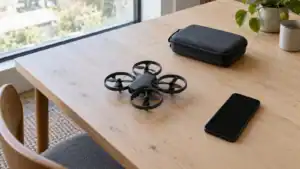
DJI lists the Mini 4K at 246 g in its standard flight configuration. That figure includes the standard Intelligent Flight Battery, propellers, and a microSD card. DJI also notes that actual product weight can vary slightly because of manufacturing materials and external factors.
| Configuration | Dimensions |
|---|---|
| Folded without propellers | 138 × 81 × 58 mm |
| Unfolded with propellers | 245 × 289 × 56 mm |
Those measurements make the aircraft small enough for a compact camera bag, but the controller, spare batteries, charging equipment, propeller spares, and protective case determine the real travel footprint.
The 246 g number should not be treated as permanent regardless of configuration. Propeller guards, lights, identification modules, mounts, or other accessories can raise the actual takeoff weight. Flight rules apply to the aircraft as operated, not simply the number printed on the box.
In the United States, the FAA currently requires registration when a drone weighs 250 g or more. A standard 246 g Mini 4K flown solely under the recreational exception generally falls below that threshold, but TRUST, visual-line-of-sight, airspace, and other operating rules still apply. Part 107 operations require registration.
Camera and video specifications explained
The Mini 4K uses a 1/2.3-inch CMOS sensor with 12 million effective pixels. This is a compact imaging system intended for good-light aerial capture rather than advanced low-light production.
| Camera specification | Published value | Buyer impact |
|---|---|---|
| Sensor | 1/2.3-inch CMOS | Smaller than the sensors in more advanced Mini models. |
| Effective resolution | 12 MP | Maximum still size of 4000 × 3000 pixels. |
| Lens equivalent | 24 mm | Wide view suited to landscapes, properties, and establishing shots. |
| Field of view | 83° | Wide aerial context without an extreme fisheye appearance. |
| Aperture | Fixed f/2.8 | No mechanical aperture adjustment. |
| Focus range | 1 m to infinity | Designed for subjects beyond very close range. |
| ISO range | 100 to 3200 | Small-sensor noise becomes more relevant as light falls. |
| Electronic shutter | 4 seconds to 1/8000 second | Broad photo exposure control, subject to the selected mode. |
| Photo formats | JPEG and DNG RAW | RAW provides more editing flexibility than a processed JPEG alone. |
What the 1/2.3-inch sensor means
Sensor size affects more than resolution. A larger sensor generally has more room to retain highlights, shadow detail, and cleaner results as available light falls. The Mini 4K can produce detailed daylight footage, but its specification does not suggest the same low-light or high-dynamic-range headroom as a model built around a 1/1.3-inch sensor.
The fixed f/2.8 aperture means exposure is controlled through shutter speed, ISO, and optional neutral-density filters rather than an adjustable lens opening.
Photo capabilities
The 12 MP camera supports single photos, timed capture, three-frame automatic exposure bracketing, and Sphere, 180°, and Wide-Angle panoramas. DNG RAW capture is meaningful for photographers who want to recover highlights, adjust white balance, or process the image independently.
The specification is less suitable for buyers who expect high-resolution cropping from a 48 MP image or a dedicated telephoto camera. Digital zoom crops the existing sensor output; it is not optical magnification.
Video resolution, frame rates, and bitrate
The complete recording specification is more useful than the word “4K” alone.
| Resolution | Available frame rates | Maximum digital zoom |
|---|---|---|
| 4K, 3840 × 2160 | 24, 25, or 30fps | 2× |
| 2.7K, 2720 × 1530 | 24, 25, 30, 48, 50, or 60fps | 3× |
| Full HD, 1920 × 1080 | 24, 25, 30, 48, 50, or 60fps | 4× |
Video is recorded as H.264 MP4 at up to 100 Mbps. Normal is the only published color mode.
- 4K/30fps: Best when maximum detail matters and standard-speed playback is appropriate.
- 2.7K/60fps: Useful when smoother motion or half-speed slow motion matters more than full 4K resolution.
- Full HD/60fps: Produces smaller files and smoother motion while giving up significant resolution.
There is no 4K/60fps mode, 10-bit recording, published HDR video mode, or flat log-style profile. Buyers planning aggressive color correction or matching with advanced cameras should understand those limits before choosing the Mini 4K solely for its resolution.
Three-axis gimbal specifications
The mechanical gimbal is one of the most important DJI Mini 4K specs because it separates the aircraft from many inexpensive drones that depend only on electronic stabilization.
The gimbal mechanically stabilizes tilt, roll, and pan. DJI publishes a normal controllable tilt range from straight down at -90° to level at 0°, with an extended upward limit of 20° when that option is enabled.
The upward angle is useful for revealing cliffs, structures, trees, or terrain above the aircraft's position. It does not turn the camera vertically for portrait-format recording. True vertical shooting requires a camera or gimbal designed to rotate the sensor orientation.
The gimbal stabilizes the camera, not the aircraft. Strong wind can make the drone visibly work to maintain position even when the recorded horizon remains relatively controlled.
Check the complete Mini 4K bundle
Verify the seller, battery count, charging equipment, microSD card, warranty region, and return terms before ordering.
Flight performance specifications
| Flight specification | Published maximum | Practical meaning |
|---|---|---|
| Horizontal speed | 16 m/s, about 35.8 mph | Sport-mode capability under DJI's specified test conditions. |
| Ascent speed | 5 m/s, about 11.2 mph | Fastest published climb rate. |
| Descent speed | 3.5 m/s, about 7.8 mph | Fastest published descent rate. |
| Flight time | 31 minutes | Controlled-test endurance until forced landing from battery depletion. |
| Wind resistance | 10.7 m/s, Level 5 | Approximately 24 mph rated resistance. |
| Takeoff altitude | 4,000 m above sea level | Propulsion-density limit, not legal permission to fly 4,000 m above the ground. |
| Operating temperature | 0°C to 40°C, 32°F to 104°F | Published environmental range for aircraft operation. |
Maximum speed
The 16 m/s maximum horizontal speed is approximately 35.8 mph. It is a Sport-mode figure measured under controlled conditions near sea level. Wind direction, battery state, altitude, temperature, mode, and firmware can change actual speed.
Speed is not a substitute for wind margin. An aircraft capable of moving quickly in calm air may make much slower progress returning against a headwind. The useful speed is the one that preserves control, visibility, battery reserve, and a safe route home.
The 31-minute flight-time specification
DJI measured the maximum while the drone flew forward at a constant 17 kph in windless, sea-level test conditions with the camera in Photo mode until forced landing from battery depletion. Normal operation includes hovering, climbing, repositioning, camera setup, wind correction, and a landing reserve.
The full 31 minutes should not be built into a flight plan. The specification is useful for comparing products tested under the same method, but it is not a promise that every battery will provide 31 minutes from launch to a comfortable landing. Our DJI Mini 4K battery guide explains practical session planning.
Wind resistance
Level 5 resistance corresponds to a published maximum of 10.7 m/s, or roughly 24 mph. That figure describes the propulsion system's ability to resist wind, not ideal filming weather. Near the rated limit, less performance remains for returning, holding position, and maintaining battery reserve. Treat the rating as an upper boundary, not a target.
Maximum takeoff altitude is often misunderstood
The 4,000 m maximum takeoff altitude refers to the elevation above sea level from which the propulsion system is rated to operate. Air becomes less dense as elevation increases, reducing propeller and motor performance.
It does not mean the Mini 4K may legally climb 4,000 m above its launch point. Operational limits are governed by applicable airspace and aviation rules. DJI reduces the published takeoff-altitude limit to 2,000 m when propeller guards are installed.
DJI O2 transmission and range
The Mini 4K uses DJI O2 for command, control, and live video. The controller feed is specified at 720p/30fps with approximate minimum latency of 200 milliseconds, although actual delay depends on the environment and connected phone.
| Transmission condition | DJI reference distance |
|---|---|
| FCC, unobstructed and interference-free | Up to 10 km |
| CE, SRRC, or MIC, unobstructed and interference-free | Up to 6 km |
| Strong interference, such as an urban area | Approximately 1.5 to 3 km |
| Medium interference, such as a suburban area | Approximately 3 to 6 km |
| Low interference, such as open outskirts or coastline | Approximately 6 to 10 km |
Buildings, terrain, trees, antennas, Wi-Fi activity, controller orientation, regulatory power limits, and the phone environment all influence the link. More importantly, a maximum transmission number does not override visual-line-of-sight or airspace rules. A small gray aircraft becomes difficult to see long before 10 km, while battery reserve, wind, and the return trip create shorter boundaries.
The useful conclusion is that O2 provides more link margin than a short-range Wi-Fi toy drone. It should not be interpreted as permission to conduct a 10 km outbound flight. Our guide to DJI Mini 4K range covers the planning factors in more detail.
GPS, hovering, and downward sensing
The DJI Mini 4K receives satellite positioning from GPS, GLONASS, and Galileo. Outdoors with sufficient satellites, that system supports location hold, home-point recording, and Return to Home behavior.
DJI publishes vertical accuracy of ±0.1 m and horizontal accuracy of ±0.3 m when downward vision positioning is available. With satellite positioning, the published values are ±0.5 m vertically and ±1.5 m horizontally.
The downward vision system has a published precision range of 0.5 to 10 m. It requires sufficient light and a surface with discernible patterns and adequate reflectivity. Water, darkness, highly reflective surfaces, or uniform textures can reduce performance.
Downward sensing is not obstacle avoidance
The aircraft does not have forward, backward, side, or omnidirectional obstacle sensors. Its downward system helps estimate movement and distance from the surface below. It does not scan the flight path for branches, cables, walls, poles, vehicles, or people.
Return to Home must therefore be configured with an appropriate altitude and used with a clear route. The aircraft cannot plan around a hazard its sensing system does not detect. See our guide to DJI Mini 4K GPS and Return to Home for weak-signal behavior and setup guidance.
Battery, controller, and storage specifications
The standard aircraft uses the DJI Mini 2 Intelligent Flight Battery, and the RC-N1C relies on a connected phone for display and DJI Fly. Storage and charging equipment are therefore part of the usable system even when they are not included in the standard package.
| Battery specification | Published value |
|---|---|
| Chemistry | Lithium-ion |
| Capacity | 2,250 mAh |
| Nominal voltage | 7.7 V |
| Maximum charging voltage | 8.8 V |
| Energy | 17.32 Wh |
| Battery weight | 82.5 g |
| Charging temperature | 5°C to 40°C, 41°F to 104°F |
The official standard box includes a USB-C data cable but does not list a wall power adapter or multi-battery hub. The optional two-way charging hub holds up to three batteries and charges them sequentially. One battery provides one short session followed by charging downtime, so repeated practice usually benefits from additional batteries.
| Controller specification | Published value |
|---|---|
| Maximum supported phone dimensions | 180 × 86 × 10 mm |
| Maximum runtime without charging the phone | 4 hours |
| Maximum runtime while charging the phone | 2 hours |
| Operating temperature | -10°C to 40°C, 14°F to 104°F |
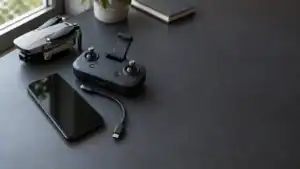
| Included phone connections | USB-C, Lightning, and standard Micro-USB cables |
Phone compatibility is a product requirement, not a minor convenience. Check current DJI Fly support, physical phone dimensions, connector type, screen brightness, and whether the device permits installation. The aircraft requires DJI Fly for activation and normal operation.
The Mini 4K has no internal media storage. DJI's published list includes recommended cards from 16 GB through 256 GB, with many V30-rated SanDisk, Samsung, and Lexar options. At a maximum bitrate of 100 Mbps, 4K recording can use roughly 750 MB per minute before container and bitrate variation. Use a card with sufficient sustained write performance and format it through the aircraft when appropriate.
Flight modes, automated features, and package contents
The RC-N1C provides Cine for softer movement, Normal for general-purpose flying, and Sport for maximum response and published top-speed capability.
The aircraft also supports Dronie, Helix, Rocket, Circle, and Boomerang QuickShots. These automate a defined camera move around a selected subject. They are not continuous Follow Me or ActiveTrack modes, and the pilot must confirm the complete path is clear before starting. Panorama modes include Sphere, 180°, and Wide-Angle.
DJI's current U.S. store listed both the standard kit and Fly More Combo as out of stock when checked July 13, 2026. Other sellers and regions can differ, so package contents, seller identity, condition, warranty region, and return terms need verification.
| Included item | Quantity |
|---|---|
| DJI Mini 4K aircraft | 1 |
| DJI RC-N1C controller | 1 |
| DJI Mini 2 Intelligent Flight Battery | 1 |
| Spare propellers | 1 pair |
| Spare screws | 6 |
| Gimbal protector | 1 |
| Screwdriver | 1 |
| USB-C data cable | 1 |
| RC cable with USB-C connector | 1 |
| RC cable with Lightning connector | 1 |
| RC cable with standard Micro-USB connector | 1 |
A wall adapter, two-way charging hub, carrying case, additional batteries, and microSD card are not listed as standard-package contents. Retailer bundles can differ. Follow our DJI Mini 4K setup checklist after confirming the exact package.
Missing features and Mini 2 SE comparison
The absence of a feature can matter more than an impressive maximum. The Mini 4K does not provide the following capabilities.
| Missing feature | Buyer consequence |
|---|---|
| Forward, rear, or side obstacle avoidance | The pilot must maintain a clear path and cannot expect automatic braking around hazards. |
| ActiveTrack or continuous Follow Me | Not designed to autonomously follow a moving person or vehicle. |
| True vertical shooting | Vertical clips require cropping or a model with a rotating camera. |
| 4K/60fps video | Slow motion is limited to 2.7K or Full HD at 60fps. |
| 10-bit or flat video profile | Less flexibility for extensive color grading and camera matching. |
| Internal media storage | Requires a microSD card for normal onboard originals. |
| Controller with built-in screen | Requires a compatible smartphone. |
| Waterproofing | Avoid rain, snow, fog, and other moisture exposure. |
DJI Mini 4K versus Mini 2 SE specifications
The Mini 4K and Mini 2 SE share many airframe, battery, positioning, and transmission characteristics. The camera pipeline is the clearest difference.
| Specification | DJI Mini 4K | DJI Mini 2 SE |
|---|---|---|
| Maximum video | 4K/30fps | 2.7K/30fps |
| Maximum video bitrate | 100 Mbps | 40 Mbps |
| Maximum 2.7K frame rate | 60fps | 30fps |
| 4K digital zoom | 2× | Not applicable |
| Camera sensor | 1/2.3-inch, 12 MP | 1/2.3-inch, 12 MP |
| Maximum flight time | 31 minutes | 31 minutes |
| Transmission | DJI O2 | DJI O2 |
| Standard battery | 2,250 mAh | 2,250 mAh |
The Mini 4K is best understood as a familiar entry-level platform with a more capable recording pipeline. Focus on the value of 4K, the higher bitrate, and 60fps recording at 2.7K rather than expecting a completely different aircraft.
Buyers comparing the current entry models should also read our DJI Mini 4K versus Mini 3 comparison.
Which DJI Mini 4K specs matter most?
- Three-axis gimbal: This has a greater effect on usable aerial footage than resolution alone.
- 4K/30fps at 100 Mbps: Provides detailed standard-speed video with a respectable data rate for the class.
- 246 g standard weight: Keeps the aircraft compact and can simplify some rules, but does not remove the need to understand the operation.
- GPS with Return to Home: Makes outdoor position hold and recovery behavior more predictable.
- Downward-only sensing: Explains why a careful pilot and open practice area remain necessary.
The 10 km transmission and 31-minute endurance ratings help compare products tested under similar methods. They should not outweigh missing features that directly affect the intended use, such as obstacle sensing, subject tracking, vertical capture, or a larger camera sensor.
For a buyer-focused recommendation, read the full Mini 4K review. This specifications guide is intended to explain the numbers without duplicating that decision article.
Frequently asked questions
Does the DJI Mini 4K actually record in 4K?
Yes. It records 3840 × 2160 video at 24, 25, or 30fps with a maximum published bitrate of 100 Mbps. It does not record 4K at 60fps.
Does the DJI Mini 4K have GPS?
Yes. It uses GPS, GLONASS, and Galileo satellite positioning for outdoor position hold, home-point recording, and Return to Home support.
How far can the DJI Mini 4K transmit video?
DJI publishes up to 10 km under FCC conditions and 6 km under CE, SRRC, or MIC conditions in an unobstructed environment without interference. Real environments and visual-line-of-sight requirements produce a much shorter practical operating distance.
How long does the DJI Mini 4K battery last?
The published maximum is 31 minutes under DJI's controlled test conditions. Normal safe usable time is shorter because of wind, hovering, climbing, maneuvering, temperature, battery reserve, and the return flight.
How fast is the DJI Mini 4K?
DJI lists a maximum horizontal speed of 16 m/s, which is about 35.8 mph, under its specified Sport-mode test conditions.
Does the DJI Mini 4K have obstacle avoidance?
No. It has downward vision positioning but no forward, backward, side, or omnidirectional obstacle-avoidance system.
Does the DJI Mini 4K have Follow Me?
No. It offers QuickShots for specific automated camera moves, but it does not provide continuous Follow Me or ActiveTrack.
Does the DJI Mini 4K need a microSD card?
Yes for normal onboard recording. The aircraft has no internal media storage. Use a compatible card with sufficient sustained write speed.
Is the DJI Mini 4K the same as the Mini 4 Pro?
No. The Mini 4K is an entry-level model. The Mini 4 Pro is a separate, more advanced aircraft with a different camera and feature set.
Is the DJI Mini 4K waterproof?
No. Avoid rain, snow, fog, and other conditions where moisture can enter the aircraft.
Final takeaway
The DJI Mini 4K specifications form a balanced entry-level package. The 12 MP camera and three-axis gimbal support stable daylight aerial capture. The 4K/30fps, 100 Mbps recording mode is a meaningful step above basic 2.7K drones. GPS, Return to Home, O2 transmission, and the 246 g folding airframe make it practical for a careful beginner or traveler.
The same specifications define its limits. There is no directional obstacle avoidance, continuous subject tracking, true vertical capture, internal storage, 4K/60fps mode, or integrated controller screen. Buyers who need those features should compare an upgraded model rather than assuming they can be added later.
Check the current Mini 4K package
Verify the seller, condition, battery count, charger, microSD card, warranty region, and return terms.
Sources
- DJI Mini 4K and Mini 2 SE specifications: official aircraft, camera, gimbal, transmission, battery, controller, storage, and comparison values.
- DJI Mini 4K product page: current features, configurations, included items, charging accessories, and U.S. availability checked July 13, 2026.
- DJI Mini 4K User Manual: operation, positioning, Return to Home, flight modes, and safety guidance.
- DJI Download Center: current DJI Fly and Mini 4K product-family support information.
- FAA recreational flyer guidance: current U.S. registration threshold, TRUST, visual-line-of-sight, airspace, and operating requirements.
Last checked: July 13, 2026. Specifications, firmware behavior, package contents, compatibility, regulations, and availability can change.