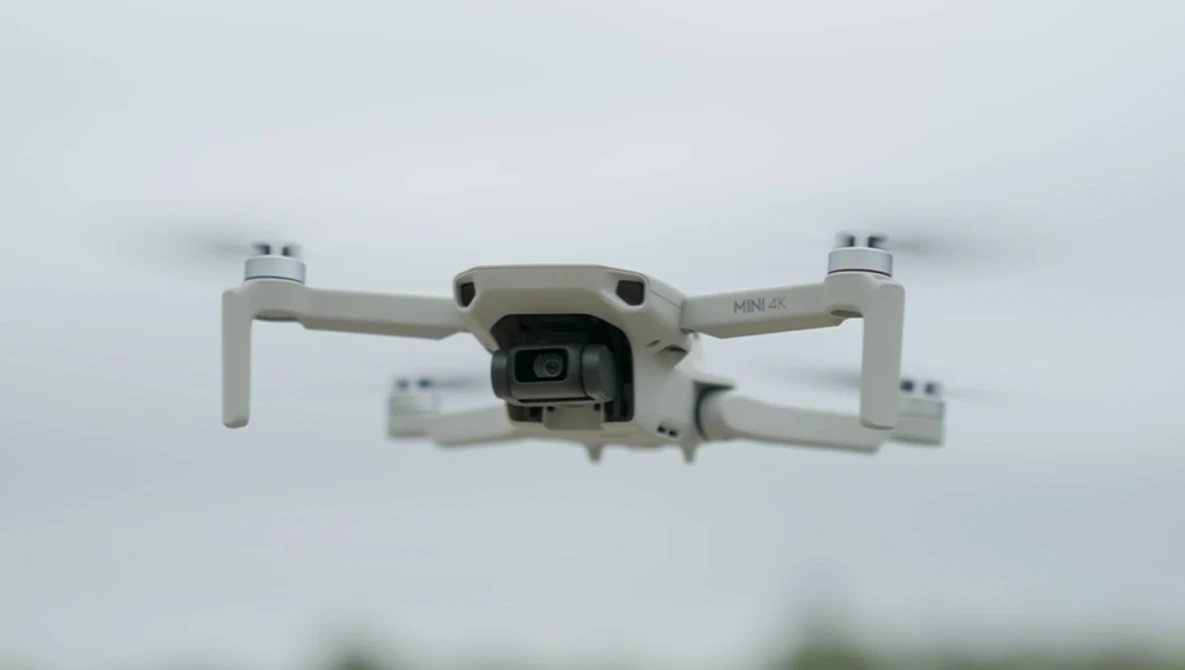
Yes, the DJI Mini 4K has GPS. More precisely, its onboard Global Navigation Satellite System uses GPS, GLONASS, and Galileo signals for positioning. Satellite positioning helps the drone hold its location outdoors, record a Home Point, display flight telemetry, and support Smart RTH, Low Battery RTH, and Failsafe RTH when the required conditions are met.
GPS does not give the Mini 4K obstacle avoidance, ActiveTrack, Follow Me, or an independent cellular tracker. It is a valuable positioning and return aid, not a substitute for pilot control, visual observation, battery planning, or a clear flight path.
This guide is based on current DJI specifications, the DJI Mini 4K User Manual v1.0, and current U.S. FAA recreational-flyer guidance. It is not presented as original FPV Drone positioning or Return to Home testing. Aircraft behavior can vary with firmware, settings, satellite reception, compass condition, lighting, terrain, and weather.
Quick answer
The Mini 4K combines multi-constellation satellite positioning with downward vision and infrared sensing. In suitable outdoor conditions, this system gives beginners much more predictable position holding and enables Home Point-based return functions.
Best GPS benefit
Outdoor position holding, Home Point recording, location telemetry, and conditional Return to Home.
Not included
Forward obstacle avoidance, ActiveTrack, general Follow Me, cellular service, or an independent tracking beacon.
Verify before takeoff
GPS status, Home Point location, compass and IMU status, lost-signal action, battery, and Return to Home altitude.
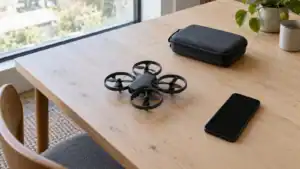
Featured DJI Mini 4K

Featured gear
DJI Mini 4K Drone: Beginner 4K Camera Drone Under 249g
The DJI Mini 4K is an entry-level DJI camera drone built for beginners who want stabilized 4K footage without jumping into the higher-priced Mini models. It weighs under 249 g, supports 4K/30fps video, uses…
The DJI Mini 4K is an entry-level DJI camera drone built for beginners who want stabilized 4K footage without jumping into the higher-priced Mini models. It weighs under 249 g, supports 4K/30fps video, uses a 3-axis gimbal, and includes GPS-assisted flight features like Return to Home.
- Best for
- Best for new pilots who want a lightweight DJI camera drone with stabilized 4K…
- Skill level
- Beginner
- Product type
- Beginner Drones, Camera Drones, DJI Drones, Drones, Under 249g Drones
- Best for
- New pilots who want a lightweight DJI camera drone with stabilized 4K video, GPS-assisted…
- Skill level
- Beginner
- Product type
- Camera Drone
What GPS does on the DJI Mini 4K
The familiar word GPS describes only part of the positioning system. DJI lists support for three navigation constellations: GPS, GLONASS, and Galileo. The flight controller combines available satellite information with the compass, inertial sensors, barometer, and downward sensing to estimate the aircraft's position and movement.
That combination supports several practical features, but it does not create every intelligent function associated with a more expensive camera drone.
| Capability | Does GPS support it? | What the owner should know |
|---|---|---|
| Outdoor position hold | Yes | With suitable reception, the aircraft can locate itself and resist horizontal drift. |
| Home Point recording | Yes | The aircraft records a Home Point after receiving a sufficiently strong satellite signal. Confirm it before flying away. |
| Smart, Low Battery, and Failsafe RTH | Yes, conditionally | Return functions depend on the Home Point, positioning, settings, battery, compass, wind, and route. |
| Map position and telemetry | Yes | DJI Fly can display location, Home Point, distance, height, speed, and GPS status. |
| Find My Drone assistance | Partly | App and flight-record information may help identify the last recorded location, but the drone is not a cellular tracker. |
| Obstacle avoidance | No | Position coordinates do not reveal whether a tree, wire, wall, or moving object blocks the route. |
| Follow Me or ActiveTrack | No | The Mini 4K has QuickShots, but it does not offer DJI's general subject-tracking modes. |
| Automatic safe flight | No | The pilot remains responsible for visibility, airspace, weather, battery, obstacles, and control. |
Buyer takeaway: GPS makes the Mini 4K easier to manage outdoors, but it is a positioning system rather than a collision-avoidance or hands-free tracking system.
How GPS helps the DJI Mini 4K hover
In Normal mode, the Mini 4K uses GNSS and its Downward Vision System to locate and stabilize itself. Sport mode also uses these systems for positioning, while Cine mode is based on Normal mode with reduced flight speed for smoother camera movement.
DJI publishes GNSS hovering accuracy of approximately ±0.5 m vertically and ±1.5 m horizontally. Under suitable vision-positioning conditions, it lists approximately ±0.1 m vertically and ±0.3 m horizontally.
These are specification ranges, not a promise that the aircraft will remain perfectly motionless. Wind, satellite geometry, compass interference, lighting, surface texture, altitude, calibration, firmware, and other environmental factors can affect position holding.
| Positioning method | Vertical accuracy range | Horizontal accuracy range |
|---|---|---|
| GNSS positioning | ±0.5 m | ±1.5 m |
| Vision positioning | ±0.1 m | ±0.3 m |
The three-axis gimbal performs a different job. GPS and vision positioning help hold the aircraft in place; the gimbal stabilizes the camera's tilt, roll, and pan so the recorded image remains level and smooth. One system does not replace the other.
For the rest of the camera, battery, speed, transmission, and sensing details, see our DJI Mini 4K specifications explained.
Check current DJI Mini 4K packages
Compare the included battery count, controller, charging equipment, microSD card, product condition, and warranty region before choosing a bundle.
GPS, GLONASS, and Galileo explained
GNSS means Global Navigation Satellite System. GPS is the United States constellation and the name most people use for satellite navigation generally. The Mini 4K also supports Russia's GLONASS and the European Union's Galileo constellation.
- GPS: the United States satellite navigation constellation.
- GLONASS: the Russian satellite navigation constellation.
- Galileo: the European Union satellite navigation constellation.
Access to multiple constellations gives the aircraft more potential satellites to use than a GPS-only receiver. It can improve satellite availability, but it does not guarantee perfect accuracy or eliminate the need for open sky.
Tall buildings, cliffs, dense cover, metal structures, electrical infrastructure, and some indoor locations can block or reflect signals or interfere with the compass. Satellite count alone is not the whole safety picture. A strong navigation signal does not correct a disturbed compass, and a healthy compass does not replace missing position data.
Choose an open launch area and pay attention to DJI Fly status messages. If the app reports a compass or positioning problem, do not treat a visible map location as proof that the aircraft is ready for normal GPS-assisted flight.
How GPS supports Return to Home
The Mini 4K supports Smart RTH, Low Battery RTH, and Failsafe RTH. All three depend on the aircraft knowing where home is and having the conditions needed to navigate there.
Home Point recording
The DJI Mini 4K manual identifies the default Home Point as the first location where the aircraft receives a strong or moderately strong GPS signal. DJI recommends waiting until the Home Point is recorded before flying. The app provides a prompt, and the aircraft status indicator slowly blinks green when GPS positioning is enabled.
Do not assume the Home Point is correct merely because the map has loaded. Check the spoken or on-screen confirmation and verify that the Home Point shown in DJI Fly matches the intended return area.
Smart RTH
With sufficient positioning, the pilot can start Smart RTH in DJI Fly or by pressing and holding the RTH button on the remote controller. The aircraft then uses the last recorded Home Point and the return behavior documented in the manual.
Low Battery RTH
DJI Fly evaluates information such as distance from the Home Point and the estimated battery needed for return. Its warning is a safety aid, not a reason to fly until the app forces a decision. Wind, temperature, climbing, obstacles, and a changed landing area can make the return more demanding than an earlier estimate.
Failsafe RTH
DJI Fly allows the lost-signal action to be set to Return to Home, Land, or Hover. When RTH is selected, the manual states that Failsafe RTH requires a recorded Home Point, good GPS, and a normally functioning compass. User Manual v1.0 says it activates after the controller signal has been lost for more than 11 seconds.
Failsafe RTH behavior includes details that vary with aircraft distance, altitude, settings, and the stage of the return. Read the current manual rather than relying on a memorized summary from another DJI model.
RTH is not obstacle avoidance. The Mini 4K has downward sensing but no forward, rear, side, or omnidirectional obstacle-detection system. A return path can still intersect trees, power lines, buildings, or terrain. Set an appropriate RTH altitude before takeoff and keep the route clear.
GPS also does not make the 10 km FCC transmission rating a safe flight target. Our DJI Mini 4K range guide separates radio capability from battery, visibility, legal, and safe-return limits.
What happens when the DJI Mini 4K loses GPS?
A weak satellite signal does not always cause an immediate loss of control. When the surface has a clear pattern and the lighting is sufficient, the Downward Vision System and infrared sensing can help the aircraft maintain position at lower altitudes.
DJI lists a precise hovering range of 0.5 to 10 m for the downward system. The manual describes a wider operating range of 0.5 to 30 m under suitable conditions, with best performance in the more limited precise-hovering range.
Downward vision can perform poorly over water, transparent or reflective surfaces, monochrome areas, repeated patterns, moving ground, steep slopes, or locations with weak or rapidly changing light. The system looks downward and does not detect obstacles in front of the aircraft.
| Condition | Likely positioning aid | What the pilot should expect |
|---|---|---|
| Strong GPS in an open outdoor area | GNSS plus onboard sensors | Normal satellite-based position hold and Home Point functions, subject to settings and conditions. |
| Weak GPS with adequate light and textured ground | Downward vision and infrared sensing | Positioning may remain available within the sensing system's limits. |
| Weak GPS over water, darkness, or unsuitable surfaces | Vision positioning may be unreliable | Drift risk increases; do not assume the aircraft will hold location. |
| Weak GPS plus unavailable vision, or compass interference | ATTI mode | No automatic horizontal position hold or braking; land safely as soon as possible. |
ATTI mode is the important warning
The aircraft can automatically enter Attitude mode when GPS is weak and downward vision is unavailable or disabled, or when the compass experiences interference. In ATTI mode, wind can push the aircraft horizontally. It cannot position itself or brake automatically as it would with normal position holding.
Maintain deliberate control, avoid abrupt inputs, and land safely as soon as possible. A small drone can drift into a wall, tree, person, or restricted area quickly when the pilot expects it to stop after the sticks are centered.
Does DJI Mini 4K GPS work without internet or cell service?
Yes. The aircraft receives navigation signals through its own onboard GNSS hardware, so satellite positioning does not require a phone data plan, nearby Wi-Fi, or cell coverage. The radio connection between the remote controller and aircraft is also separate from cellular service.
Internet access can still matter for the wider DJI Fly experience. Account functions, firmware downloads, current map content, some airspace information, and certain online services may require a connection. Prepare the app, firmware, maps where supported, and any required authorization before traveling to an area without service.
The phone can contribute its own location to app features, but it is not supplying the aircraft's satellite positioning. Turning off cellular data does not disable the GNSS receiver inside the Mini 4K.
A map that does not load is not automatically a GPS failure, and a loaded map is not proof of strong aircraft GPS. Map imagery, phone location, aircraft satellite status, and the aircraft-controller radio link are separate pieces of the system.
Does GPS add tracking or obstacle avoidance?
GPS does not mean Follow Me
GPS tells the flight controller where the aircraft is. It does not automatically identify a person or vehicle to follow, and it does not give the Mini 4K ActiveTrack or a general Follow Me mode.
The drone includes Dronie, Helix, Rocket, Circle, and Boomerang QuickShots. These are preset camera maneuvers around a selected subject, not continuous subject tracking. They require adequate space, GPS, and pilot supervision.
GPS does not see obstacles
The Mini 4K has downward vision and infrared sensing for positioning and landing support. It does not have forward or omnidirectional obstacle avoidance. GPS may know that the aircraft is returning toward a coordinate without knowing that a wire or branch crosses the route.
GPS does not make it an independent tracker
DJI Fly's Find My Drone tools and recorded flight information may help identify the aircraft's last reported position. The Mini 4K does not have its own cellular data connection that continues broadcasting its live location like a dedicated tracking device.
If the aircraft loses power, suffers damage, or disconnects before updating its position, the displayed location may be incomplete or only a starting point for a search. Preserve the flight record and follow safe access rules when attempting recovery.
GPS does not override flight rules
Satellite capability does not permit beyond-visual-line-of-sight flight by itself. Current U.S. recreational guidance requires the drone to remain within visual line of sight of the operator or a co-located visual observer in direct communication with the operator. Check the rules for the actual jurisdiction and operation.
Our full DJI Mini 4K review explains how its GPS, camera, QuickShots, sensing limitations, controller, and price fit a first-time buyer.
DJI Mini 4K GPS and Home Point checklist
This checklist does not replace DJI's manual or local aviation rules. It is a compact way to avoid the most common GPS and RTH assumptions.
Before takeoff
- Choose an open area away from tall structures, large metal objects, and strong electromagnetic interference.
- Confirm that DJI Fly shows normal aircraft, compass, IMU, battery, and GPS status.
- Wait for the Home Point confirmation instead of leaving immediately after power-on.
- Check that the Home Point on the map matches the intended return and landing area.
- Set maximum altitude, maximum distance, and RTH altitude for the actual site and applicable rules.
- Confirm the selected lost-signal action rather than assuming it is Return to Home.
- Check wind direction, visibility, battery, and the entire return path.
During flight
- Monitor GPS status, battery, compass warnings, distance, and wind behavior together.
- Keep the aircraft within required visual line of sight and avoid flying behind structures or terrain.
- Do not rely on RTH to avoid trees, wires, buildings, or elevated ground.
- If the aircraft enters ATTI mode or begins drifting, maintain control and land safely as soon as possible.
- Return before weak GPS, wind, or low battery turns a routine flight into a recovery problem.
Battery reserve remains part of every GPS and RTH plan. The DJI Mini 4K battery guide explains why the published 31-minute maximum is not the same as usable filming and return time.
Final verdict: does GPS make the DJI Mini 4K beginner-friendly?
Yes, within its limits. GPS-assisted position holding, Home Point recording, and Return to Home make the Mini 4K much easier to manage than a basic drone that drifts continuously and has no location-aware return function.
The limitation is that useful automation can create false confidence. The aircraft still needs open-space practice, a verified Home Point, appropriate RTH settings, visual observation, conservative weather and battery decisions, and active obstacle awareness.
The DJI Mini 4K has genuine multi-constellation positioning through GPS, GLONASS, and Galileo. It supports stable outdoor hovering, useful telemetry, and conditional return functions. It does not provide obstacle avoidance, Follow Me, ActiveTrack, or independent cellular tracking, so GPS should be treated as a strong flight aid rather than a guarantee against loss.
Compare current DJI Mini 4K offers
Verify the battery count, controller, charging equipment, microSD card, condition, seller, and warranty region before comparing prices.
DJI Mini 4K GPS FAQs
Does the DJI Mini 4K have GPS?
Yes. DJI lists GPS, GLONASS, and Galileo as the aircraft's supported satellite navigation systems.
Does the DJI Mini 4K have Return to Home?
Yes. It supports Smart RTH, Low Battery RTH, and Failsafe RTH. A successful return depends on a recorded Home Point, positioning, settings, compass status, battery, wind, and a clear route.
Can the DJI Mini 4K fly without GPS?
It may use downward vision for positioning when GPS is weak and the surface and lighting are suitable. If GPS is weak and vision positioning is unavailable, or the compass is experiencing interference, the aircraft can enter ATTI mode and lose automatic horizontal position holding.
Does DJI Mini 4K GPS work without a phone signal?
Yes. The aircraft receives GNSS signals directly and does not need cellular service for satellite positioning. Internet access may still be needed for current maps, firmware, account functions, or certain online DJI Fly services.
How accurate is DJI Mini 4K GPS?
DJI publishes GNSS hovering accuracy of approximately ±0.5 m vertically and ±1.5 m horizontally. Those figures depend on suitable conditions and should not be treated as survey-grade positioning.
How long does the DJI Mini 4K take to find GPS?
DJI does not publish one guaranteed acquisition time. Satellite visibility, location, nearby interference, and startup conditions vary. Wait for DJI Fly and the aircraft indicator to confirm GPS and Home Point status before flying away.
Does GPS prevent the DJI Mini 4K from flying away?
No system can guarantee that. GPS and RTH reduce certain risks, but incorrect settings, compass interference, wind, low battery, obstacles, pilot error, or hardware problems can still result in a loss.
Can you track a lost DJI Mini 4K?
DJI Fly's Find My Drone information and flight records may help identify the last reported position. The Mini 4K is not an independent cellular tracker, so the displayed location may not be a continuous live position after disconnection or power loss.
Does the DJI Mini 4K have Follow Me?
No. It provides five QuickShots, but it does not offer a general Follow Me or ActiveTrack mode.
Does GPS give the Mini 4K obstacle avoidance?
No. GPS provides location information. The drone has downward sensing for positioning and landing assistance but no forward or omnidirectional obstacle-avoidance system.
Can you fly the DJI Mini 4K indoors?
Downward vision and infrared sensing may support indoor positioning when the surface and lighting meet their requirements. Indoor flight remains higher risk because GPS may be unavailable, space is limited, and the Mini 4K has no forward obstacle avoidance.
Does GPS allow the Mini 4K to fly beyond visual line of sight?
No. GPS does not override aviation rules. Under current U.S. recreational guidance, the FAA requires the drone to remain within visual line of sight of the operator or a co-located visual observer in direct communication with the operator.
Sources
- DJI Mini 4K specifications: supported GNSS constellations, hovering accuracy, downward sensing, transmission, battery, and aircraft specifications.
- DJI Mini 4K User Manual v1.0: flight modes, Home Point recording, Return to Home, GPS loss, ATTI mode, vision-system limitations, and DJI Fly status information.
- FAA Recreational Flyers and Community-Based Organizations: current U.S. recreational visual-line-of-sight, altitude, and airspace guidance.
Last checked: July 13, 2026. DJI Fly behavior, firmware, manuals, positioning specifications, and aviation rules can change.