DJI Avata 2 Review: Is It Still Worth Buying?
The DJI Avata 2 is still worth buying in 2026 if you want the easiest complete route into immersive FPV flight, conventional framed 4K footage, and a path from motion control to true Manual mode. It remains unusually approachable because the drone, goggles, video link, GPS-assisted flight modes, emergency brake, Return to Home, and stabilized camera work as one system.
DJI Avata 2 Overview
It is no longer an automatic recommendation for every creator. DJI Avata 360 now offers 8K 360-degree capture, post-flight reframing, tracking, and obstacle sensing, while a traditional carbon-fiber FPV quad is more repairable and better suited to repeated freestyle crashes. Avata 2 earns its place between those options: it is a cinematic FPV drone for people who want the feeling of flying through the camera without building, tuning, and repairing an entire system.
Review basis: This is a research-based review, not a claim of hands-on testing by FPV Drone. The verdict combines DJI's current specifications and support documentation with attributed observations from independent reviewers. Specifications, compatibility, competing products, and U.S. operating guidance were checked on July 16, 2026.
Quick Verdict
Avata 2 remains one of the best all-in-one systems for a beginner who wants immersive FPV rather than a conventional camera drone. Its 1/1.3-inch camera, O4 live view, stabilized 4K recording, protected frame, and up-to-23-minute flight rating make it far easier to own than a custom cinewhoop. The limitations are equally important: it has no obstacle avoidance, requires goggles, weighs 377g, is not built for repeated hard freestyle crashes, and needs an additional FPV Remote Controller for true Manual mode. It is a strong buy at a meaningful discount from newer DJI systems, especially when a complete three-battery bundle is available from a reputable seller.
Best for
First-time FPV pilots, cinematic creators, property fly-through work, and DJI users who want a complete goggles system.
Not ideal for
Freestyle pilots who expect frequent crashes, still photographers, 360-video creators, or buyers wanting a sub-250g aircraft.
Strongest qualities
Intuitive motion control, crisp O4 goggles feed, useful safety assists, strong stabilized video, and longer flights than most FPV quads.
Main thing to verify
The exact goggles, controller, battery count, charging hub, seller support, and whether Manual mode hardware is included.
Featured product
Featured gear
DJI Avata 2 FPV Drone
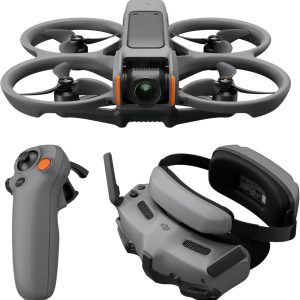
The DJI Avata 2 is an immersive FPV camera drone with a 1/1.3-inch sensor, stabilized 4K video, built-in propeller guards, DJI O4 transmission, and an approachable Goggles 3 plus RC Motion 3 control path.…
The DJI Avata 2 is an immersive FPV camera drone with a 1/1.3-inch sensor, stabilized 4K video, built-in propeller guards, DJI O4 transmission, and an approachable Goggles 3 plus RC Motion 3 control path.
- Best for
- Best for buyers who want an approachable, all-in-one cinematic FPV system with goggles and…
- Skill level
- Beginner with motion control; advanced in Manual mode
- Product type
- Beginner Drones, Camera Drones, DJI Drones, Drones
- Best for
- Buyers who want an approachable, all-in-one cinematic FPV system with goggles and motion control.…
- Skill level
- Beginner with motion control; advanced in Manual mode
- Product type
- FPV Camera Drone
DJI Avata 2 Specifications That Matter
Avata 2 is neither a standard GPS camera drone nor a conventional hobby-built FPV quad. Its specification sheet reflects that hybrid role. It provides more assistance, endurance, and integrated imaging than most freestyle systems, but gives up folding portability, obstacle avoidance, and easy field repair.
| Specification | Published value | What it means for the buyer |
|---|---|---|
| Takeoff weight | Approximately 377g | Portable for a protected FPV drone, but above the U.S. recreational registration threshold. |
| Camera | 12MP, 1/1.3-inch sensor, f/2.8, up to 155-degree field of view | Built for wide, kinetic video rather than high-resolution still photography. |
| Video | Up to 4K/100 in 16:9, 4K/60 in 4:3, 10-bit D-Log M | Supports smooth action, slow motion, and a flexible grading workflow without an external action camera. |
| Stabilization | Single-axis mechanical gimbal, RockSteady 3.0+, HorizonSteady, or EIS off for Gyroflow | Offers ready-to-share stability or a more controllable post-production workflow. |
| Storage | 46GB internal plus microSD support | Internal capacity can save a flight when a card is missing, while removable storage supports longer sessions. |
| Flight modes | Normal, Sport, and Manual | Beginners can start with assistance and progress to full stick control after training. |
| Maximum speed | 8 m/s Normal, 16 m/s Sport, 27 m/s Manual outside regional limits | Fast enough for dynamic footage, but Manual mode requires a compatible FPV Remote Controller and real practice. |
| Maximum flight time | Approximately 23 minutes | Long for FPV, but an ideal-condition maximum rather than the usable time from an aggressive flight. |
| Video transmission | DJI O4, up to 1080p/100 live view and 13km FCC-rated maximum transmission distance | The clear, low-latency feed is more important than the headline distance, which exceeds normal legal and battery-limited use. |
| Obstacle avoidance | Not supported | Backward and downward visual positioning help stability, but the pilot must avoid obstacles. |
That mix is still unusual. Avata 2 gives a beginner the confidence of GPS-assisted modes and an emergency stop, then leaves a genuine Manual mode available when the pilot is ready. It is easier than a custom FPV build without becoming only a preset-shot camera.
Flight Experience: Why Avata 2 Is So Approachable
The product's greatest strength is not a single camera specification. It is the way the aircraft, O4 transmission, goggles, and controls reduce the number of systems a new FPV pilot has to understand at once. With RC Motion 3, the operator points and steers with hand movement rather than coordinating two sticks in full acro flight. Normal mode can hover, stop, reverse, hold position, and Return to Home in ways a typical manual FPV quad cannot.
Sport mode increases speed while retaining flight assistance. It provides a stronger sensation of motion without requiring the continuous throttle and attitude management of Manual mode. Easy ACRO adds one-push flips, rolls, and a 180-degree drift through RC Motion 3. These moves are physical aircraft maneuvers, not simply an editing effect, so they still require open space and a safe recovery margin.
Manual mode changes the product. With DJI FPV Remote Controller 3, the pilot can control throttle and aircraft attitude directly, perform dives and rolls, and carry momentum through a line. This is the closest Avata 2 comes to a traditional FPV quad. It is also where the safety net becomes much smaller and the risk of damage becomes much larger.
TechRadar's hands-on review praised the easy entry into FPV but found the aircraft less satisfying and less naturally tuned in Manual mode than a well-built carbon-fiber quad. That distinction explains the product's ideal owner. Avata 2 is excellent for cinematic lines, accessible flight, and occasional aerobatics. It is not the best platform for a pilot whose main goal is repeated freestyle practice and crash recovery.
Flight takeaway
RC Motion 3 makes Avata 2 easy to enjoy. FPV Remote Controller 3 makes it possible to grow. Neither turns the protected DJI aircraft into a disposable or easily rebuilt freestyle quad.
New pilots who are still learning the terminology can begin with our explanation of how an FPV drone system works, including the separate roles of the video link, goggles, radio control, and flight controller.
Camera and Video Quality
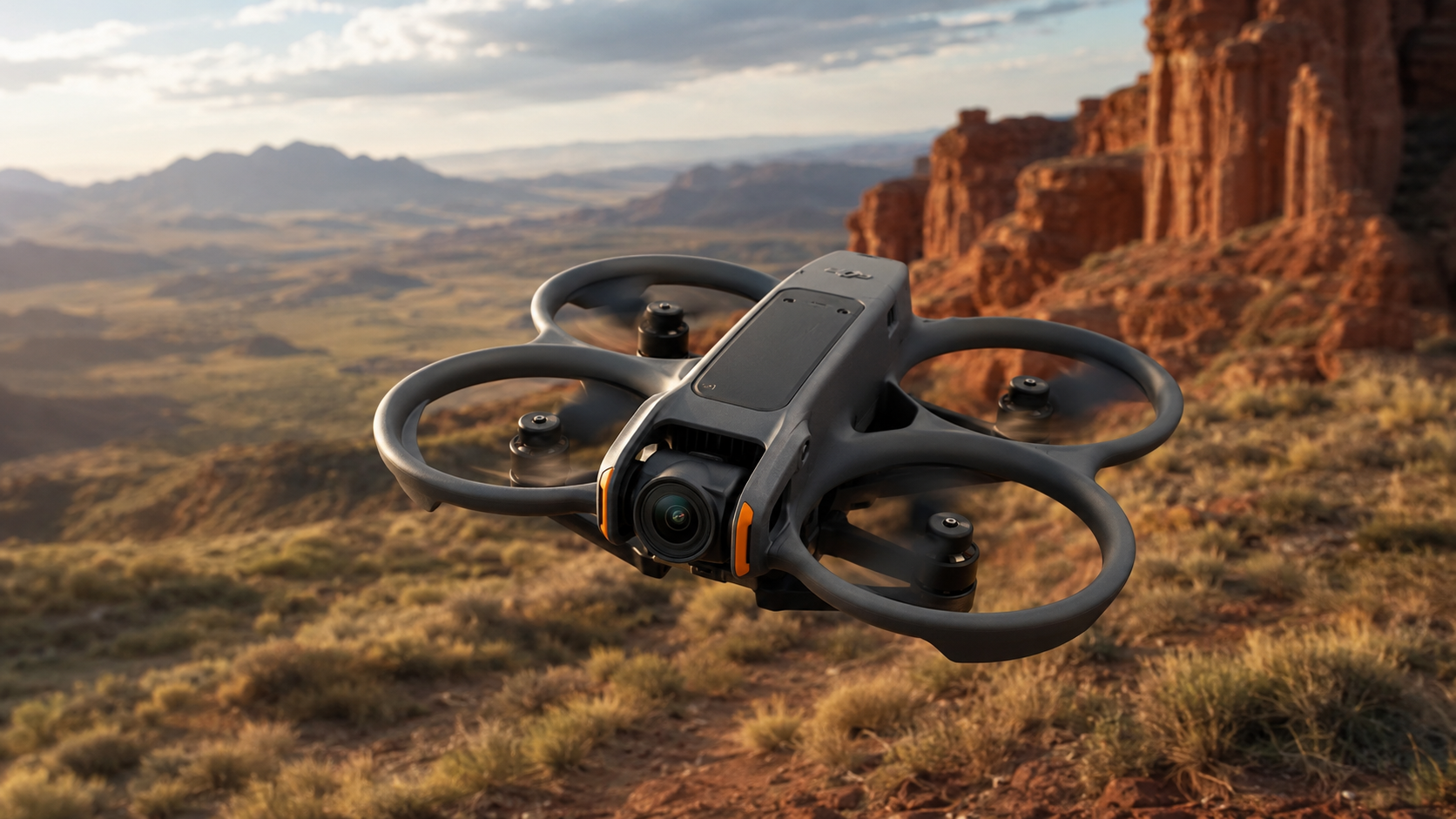
Avata 2 was a substantial imaging upgrade over the original Avata and still produces strong conventional FPV footage. Its 1/1.3-inch sensor is paired with an ultra-wide lens that can show as much as 155 degrees. The result feels fast and immersive because the viewer sees more of the aircraft's movement and the surrounding environment than with a narrow camera-drone perspective.
Current DJI specifications list 4K recording up to 100 fps in 16:9 and 4K/60 in the taller 4:3 format. The 4:3 option preserves more vertical image area, which is useful when stabilizing or creating multiple crops. Ten-bit D-Log M retains more color information for grading, while the normal profile is simpler for buyers who want to edit quickly.
Engadget's hands-on review found the larger sensor produced sharper footage, more accurate color, and better dynamic range than the first Avata. It also noted that fast 4K/60 footage can show compression artifacts in demanding scenes. That is a useful boundary: Avata 2 can eliminate the need for a separate action camera in many cinematic flights, but it does not create unlimited detail when the entire frame is moving through foliage or texture at speed.
Three stabilization workflows
- RockSteady 3.0+: The best default for smooth footage that retains the banking and energy of FPV flight.
- HorizonSteady: Keeps the horizon level for a calmer, camera-drone-like result, with a more restricted field of view.
- EIS off with Gyroflow: Records compatible gyro data in the supported wide setting so stabilization can be adjusted later.
The camera is much less compelling for still photography. It captures 12MP JPEG files rather than RAW images, uses a fixed f/2.8 aperture, and is designed around a wide action-video perspective. A Mini or Air-series camera drone is a better purchase when the primary output is photography, slow scenic composition, or controlled low-light work.
Practical camera setup for a first cinematic flight
- Use 4K/60 in 4:3 when you want more crop and stabilization room.
- Choose the normal profile for a fast turnaround or D-Log M for planned color grading.
- Start with RockSteady before deciding whether Gyroflow is worth the extra post-production step.
- Add an ND filter in bright conditions when maintaining a slower shutter speed matters.
- Format or clear the internal storage after transferring important footage.
- Record short test clips before the main flight to confirm exposure, stabilization, and field of view.
For a complete filming process, our FPV drone videography workflow covers camera settings, shot planning, stabilization, backups, and editing.
Goggles and Controllers Matter as Much as the Drone
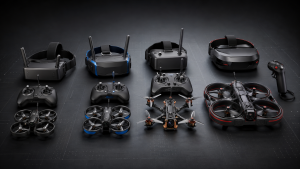
Avata 2 cannot be flown without compatible goggles. That is not a minor accessory requirement. The goggles and controller determine how the system feels, whether Manual mode is available, how comfortable longer sessions are, and how much the complete setup costs.
| Control path | What it enables | Best fit | Main limitation |
|---|---|---|---|
| Goggles N3 and RC Motion 3 | Normal, Sport, motion steering, emergency brake, Easy ACRO | Value-focused beginners, including many users who wear glasses | No true Manual mode through the motion controller. |
| Goggles 3 and RC Motion 3 | Same accessible motion flight with premium optics and Real View features | Buyers who prioritize headset quality, adjustment, and awareness features | Costs more without changing the aircraft's camera or battery. |
| Goggles 3 or N3 and FPV Remote Controller 3 | Normal, Sport, and true Manual mode with dual sticks | Pilots who intend to train in a simulator and progress beyond assisted flight | The remote is commonly an additional purchase, and Manual mode raises crash risk. |
| Older compatible goggles and controllers | Selected pairings with Goggles 2 or Integra and generation-matched controls | Existing DJI owners who already have confirmed compatible hardware | Compatibility depends on exact goggles, controller, and firmware pairing. |
Goggles N3 make the complete system less expensive and can accommodate personal glasses. Goggles 3 provide a more premium headset experience, adjustable diopters, micro-OLED displays, and external-camera Real View features. Neither changes Avata 2's recorded camera quality, so the upgrade should be justified by comfort and the pilot experience rather than the final video file.
RC Motion 3 is the right starting controller for most new owners. The FPV Remote Controller 3 should be added only when the buyer plans to practice Manual mode in a simulator and understands that the control style is fundamentally different. DJI recommends simulators including Liftoff, Uncrashed, The Drone Racing League, and DCL.
Our FPV goggles compatibility guide explains why digital video systems and controllers cannot be mixed solely because their connectors or product names look similar.
Safety Features Do Not Include Obstacle Avoidance
Avata 2 includes an integrated propeller guard, GPS, Smart Return to Home, Low Battery Return to Home, Failsafe Return to Home, Turtle mode, and an emergency brake through the compatible controller. Its backward and downward fisheye sensors improve visual positioning in Normal and Sport modes. These features reduce workload and can recover from some common problems.
DJI explicitly states that Avata 2 does not support obstacle avoidance. It will not reliably route around a tree, cable, wall, doorway, or person. Backward and downward visual positioning should not be described as a collision-avoidance system. The front of the aircraft depends on the pilot seeing the route through the goggles and leaving enough room to stop or turn.
The guards protect the propellers from some glancing, low-energy contact. They also make the drone better suited to close, low-altitude filming than an exposed-prop camera drone. They do not make contact acceptable around uninvolved people, fragile property, traffic, or animals.
First-flight safety checklist
- Begin in a wide, open area with no cables, thin branches, traffic, or uninvolved people.
- Set a conservative Return to Home altitude that clears relevant obstacles.
- Confirm GPS, Home Point, battery, propellers, guards, and gimbal before launch.
- Practice braking and hovering in Normal mode before using Sport or Easy ACRO.
- Use a visual observer whenever goggles prevent the pilot from maintaining unaided visual sight.
- Practice Manual mode in a simulator before enabling it on the aircraft.
- Leave a larger safety margin indoors because GPS and Return to Home behavior can differ.
At 377g, Avata 2 must be registered for recreational use in the United States. Registered drones must comply with Remote ID rules. The FAA also states that a pilot using FPV technology must have a visual observer keep the drone within unaided sight under Part 107. Recreational operations must likewise remain within visual line of sight and follow the applicable community-based safety guidelines.
Battery Life, Charging, and Useful Range
DJI rates Avata 2 for approximately 23 minutes of forward flight in controlled conditions and about 21 minutes of hovering. Those figures are impressive for an FPV aircraft, but neither describes an aggressive Manual flight. Speed, wind, repeated acceleration, cold temperature, low-altitude corrections, and the reserve needed for Return to Home all reduce usable time.
Independent testing commonly places moderate real-world sessions below the published maximum while still well above the endurance of many racing or freestyle quads. A practical expectation is a mid-to-high-teens flight in assisted modes when conditions are reasonable, with much shorter sessions possible under sustained Manual-mode throttle. The goggles' battery warnings, return estimate, and landing reserve should govern the flight, not a stopwatch based on the specification sheet.
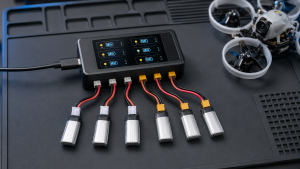
The three-battery setup matters because charging is sequential, not simultaneous. DJI states that its Two-Way Charging Hub can charge one battery from empty in about 45 minutes with sufficient USB Power Delivery input. The hub prioritizes the battery with the highest remaining charge and can consolidate power from several partly depleted batteries into the fullest one. Direct charging through the aircraft takes longer.
The 13km FCC transmission figure should not be used as a mission-planning target. It is a one-way laboratory communication maximum in an unobstructed environment, and DJI also lists a 13km maximum flight-distance rating. Battery, terrain, interference, legal visual-line-of-sight requirements, and the need to return safely will constrain normal operations first.
Battery takeaway
One battery is enough to learn the system. Three batteries and the charging hub are the practical configuration for planned filming, travel, or repeated practice.
Durability, Noise, and Ownership Cost
Avata 2 is lighter, flatter, and quieter than the original Avata. DJI publishes a sound level of 81 decibels, and hands-on reviewers consistently found its tone less harsh than the first generation. It is still an FPV drone moving a significant amount of air. Expect people nearby to notice it, especially in Sport or Manual mode.
The integrated guard and Turtle mode help with ordinary ownership. If the aircraft lands upside down in a suitable area, Turtle mode can attempt to flip it upright. Propellers, guards, and normal accessories are available as service parts. That does not make the airframe as field-repairable as a modular carbon quad.
A custom FPV pilot can often replace one arm, motor, antenna, camera, or electronic board and return to flying. Avata 2 packages more proprietary hardware into a molded aircraft. A serious crash may require a larger assembly or manufacturer service. The camera and gimbal also sit near the front, where a direct impact can become expensive.
TechRadar's experienced FPV reviewer specifically warned that Avata 2 is not designed to survive repeated heavy freestyle impacts. This is not a criticism of its intended role. It is a reason to decide whether the owner wants to capture controlled cinematic lines or learn by crashing a repairable quad.
| Item | Who needs it | Why it affects value |
|---|---|---|
| Extra batteries and charging hub | Most regular users | Extends a session and reduces the pressure to capture everything in one flight. |
| USB-C PD charger | Buyers whose bundle lacks a suitable power adapter | The hub reaches its useful charge times only with adequate input power. |
| FPV Remote Controller 3 | Pilots progressing to Manual mode | It unlocks the aircraft's highest-skill control path but adds cost and training. |
| ND filters | Creators controlling shutter speed outdoors | Useful for natural motion blur in bright light. |
| microSD card | Anyone recording beyond the internal 46GB | Provides removable storage and a simpler transfer workflow. |
| Protection or repair plan | New Manual-mode pilots and commercial users | A crash-prone aircraft should be evaluated by total repair path, not purchase price alone. |
| Replacement propellers and guard parts | Every active owner | Normal contact and wear can end a session if no spares are available. |
DJI Avata 2 Versus DJI Avata 360 in 2026
DJI Avata 360 changes the buying decision because it can record the full view around the aircraft and choose the final framing later. It also adds tracking, conventional camera-drone controls, and obstacle-sensing capabilities that Avata 2 lacks. It is a newer and more versatile content platform.
It is not simply Avata 2 with a better camera. The two products prioritize different workflows. Avata 2 asks the pilot to frame the shot while flying and offers a documented progression into true Manual mode. Avata 360 lets a creator capture first and reframe later, with 360-degree tools doing more of the camera work.
| Decision factor | Choose DJI Avata 2 | Choose DJI Avata 360 |
|---|---|---|
| Primary goal | Immersive piloting and conventional framed FPV footage | Capture every direction and choose the shot in post-production |
| Camera workflow | Up to 4K action footage, D-Log M, RockSteady or Gyroflow | 8K 360 HDR plus a separate single-lens 4K mode |
| Pilot progression | Normal and Sport through motion control, plus documented Manual mode with FPV Remote Controller | Creator-centered control through standard remotes, tracking, goggles, and motion features |
| Obstacle support | No obstacle avoidance | Omnidirectional sensing in 360 mode and forward sensing in single-lens mode under supported conditions |
| Editing workload | Lower if the shot is framed correctly during flight | Higher when the value comes from reframing 360 footage |
| Value case | Strong when a complete bundle is substantially less expensive | Strong when 360 capture, tracking, and obstacle sensing will be used regularly |
Avata 360 is the better choice for creators who worry about missing a subject or want to generate several views from one flight. Avata 2 remains the more direct recommendation for buyers who want to fly the camera, build traditional FPV skills, and produce familiar wide-angle cinematic footage without a 360 editing workflow.
Which DJI Avata 2 Bundle Should You Buy?
Bundle names have changed across time, region, and retailer. Compare included hardware line by line rather than assuming every Fly More or Fly Smart listing contains the same goggles, controller, batteries, hub, case, charger, and accessories.
| Buyer | Best starting configuration | Why | What to confirm |
|---|---|---|---|
| First-time FPV buyer | Three batteries, Goggles N3, RC Motion 3, charging hub | Balances a complete system, useful session length, and lower headset cost. | Adequate USB-C charger, seller warranty, and exact battery count. |
| Premium headset buyer | Three batteries, Goggles 3, RC Motion 3, charging hub | Best fit when optics, diopter adjustment, and Real View features justify the premium. | Whether the current price difference is worth paying over N3. |
| Future Manual-mode pilot | Three-battery goggles bundle plus FPV Remote Controller 3 | Supports assisted learning first and true stick-controlled Manual flight later. | The remote is included or budgeted separately, plus simulator time. |
| Existing compatible DJI owner | Aircraft-only package | Avoids repurchasing goggles or controls already owned. | Exact generation, firmware, and controller pairing before ordering. |
| Curious first-time buyer on a tight budget | One-battery Goggles N3 bundle | Lowest sensible complete entry when the buyer is unsure FPV will become a regular hobby. | The cost of adding batteries and a hub later. |
Avata 2 becomes especially compelling when an authorized or reputable seller discounts a complete bundle well below Avata 360. At similar total prices, the newer model's capture and sensing features deserve serious consideration. At a large discount, Avata 2's camera, flight system, and Manual-mode path remain highly competitive.
Buyers comparing Avata 2 against smaller ready-to-fly systems can use our beginner FPV drone kit comparison to see the differences in included hardware, repairability, flight difficulty, video ecosystem, and long-term progression.
Check the complete Avata 2 package
Compare the goggles, controller, battery count, charging hub, seller, and warranty before judging the price.
Who Should Buy DJI Avata 2?
Buy it if you want FPV without building an FPV system
Avata 2 eliminates most of the component compatibility, radio configuration, soldering, firmware setup, and tuning decisions associated with a custom quad. That convenience is the product. A buyer can focus on learning routes and camera movement rather than diagnosing a video transmitter or flight-controller problem.
Buy it if you want cinematic motion more than aerial photography
It is excellent for low passes, reveals, orbiting through structures where permitted, interior transitions, and following a planned line. The video feels different from a hovering camera drone because banking and forward movement are part of the visual language.
Buy it if Manual mode is a future goal, not the starting point
Normal mode, Sport mode, and RC Motion 3 provide a controlled path into the experience. The separate FPV Remote Controller can be added after simulator practice. That progression is safer and more realistic than treating a new Avata 2 as a first-day Manual-mode aircraft.
Skip it if you want a crash-friendly freestyle trainer
A smaller whoop or modular carbon-fiber quad will usually be easier and cheaper to repair after repeated impacts. Avata 2 can perform aerobatics, but its proprietary integrated design makes every hard crash a more consequential event.
Skip it if you want 360 capture or automatic subject tracking
Avata 360 is the more capable creator platform when the goal is to reframe after the flight, follow a subject, or rely on supported obstacle-sensing assistance. Avata 2 demands more deliberate framing from the pilot and provides no obstacle avoidance.
Skip it if your main output is still photography
The 12MP JPEG camera is secondary to the flight experience. Buyers focused on photos, long hovering compositions, vertical social capture, or a three-axis gimbal should choose a conventional camera drone.
For other established routes into FPV, see our best FPV drones by use case.
Final Verdict: Is DJI Avata 2 Still Worth It?
Yes, DJI Avata 2 is still worth buying for a beginner or creator who wants a complete, conventional FPV filming system at the right price. Its O4 goggles feed, motion control, stabilized wide-angle camera, GPS-assisted modes, emergency brake, useful battery life, and optional Manual mode still form one of the cleanest progressions from first flight to advanced control.
Its age now works in the buyer's favor only when pricing reflects it. Avata 360 offers more flexible capture, obstacle sensing, and creator automation. A custom quad offers better repairability and freestyle performance. Avata 2 should cost meaningfully less than the newer DJI option and should be purchased for intentional cinematic FPV, not because the buyer assumes it can avoid obstacles or survive endless crashes.
The three-battery Goggles N3 bundle is the best-value default for most first-time buyers. Choose Goggles 3 when headset quality justifies the upgrade, add FPV Remote Controller 3 only with a simulator-training plan, and buy aircraft-only only after confirming every existing component is compatible.
Compare current Avata 2 availability
Confirm the complete bundle and after-sales path before deciding whether the discount is large enough.
DJI Avata 2 FAQ
Can DJI Avata 2 fly without goggles?
No. DJI states that compatible goggles are required to operate Avata 2. A phone can display a shared live feed in supported configurations, but it does not replace the required goggles control path.
Does DJI Avata 2 have obstacle avoidance?
No. It has downward and backward visual positioning that can improve stability in Normal and Sport modes, but DJI explicitly states that obstacle avoidance is not supported. The pilot must see and avoid the route.
Can a beginner fly DJI Avata 2?
Yes. Normal mode, RC Motion 3, assisted hovering, Return to Home, and the emergency brake make the initial experience approachable. A beginner should not start in Manual mode and should practice in a wide open area with a visual observer.
Does DJI Avata 2 need FAA registration?
Yes for U.S. recreational operations because it weighs approximately 377g, above the 250g exception. Registered drones must comply with Remote ID requirements, and the pilot must also follow airspace, visual-line-of-sight, and other applicable operating rules.
How long does an Avata 2 battery last?
DJI publishes a maximum of approximately 23 minutes. Moderate assisted flights often finish below that figure, while fast or aggressive Manual-mode flying can reduce endurance substantially. Three batteries are the practical choice for repeated filming.
Is Avata 2 better than Avata 360?
It is better for buyers who want lower-cost conventional FPV footage and a documented path into Manual mode. Avata 360 is better for 360-degree capture, reframing, tracking, obstacle sensing, and flexible standard-controller workflows.
Can DJI Avata 2 fly in Manual mode?
Yes, with a compatible DJI FPV Remote Controller and goggles pairing. Manual mode removes much of the flight assistance and should be attempted only after simulator practice and controlled training.
Sources
- DJI Avata 2 official support and specifications: Aircraft, camera, gimbal, sensing, transmission, flight-time, storage, charging, and control specifications.
- DJI Avata 2 official FAQ: Obstacle-avoidance limitation, goggles and controller compatibility, Manual mode, Return to Home, Gyroflow, and battery-hub functions.
- TechRadar DJI Avata 2 review: Attributed hands-on observations on approachability, camera quality, Manual-mode handling, noise, and crash suitability.
- Engadget DJI Avata 2 review: Attributed hands-on assessment of dynamic range, color, stabilization, and fast-motion compression.
- DJI Avata 360 official product page: Current 360 capture, single-lens mode, obstacle sensing, tracking, control methods, and charging information used for the 2026 decision comparison.
- FAA recreational flyer guidance and FAA Part 107 operating requirements: U.S. registration, Remote ID, visual-line-of-sight, and visual-observer guidance.
Last checked: July 16, 2026