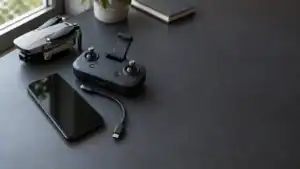
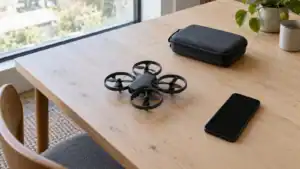
A VR drone is usually an FPV drone that sends a live camera view to dedicated goggles. It is not normally a drone that works with any consumer virtual-reality headset. The most important buying rule is to choose the video ecosystem first, because the drone camera, video transmitter, goggles, controller combination, firmware, and regional version must all be compatible.
This is a research-based compatibility guide. It uses current DJI and BETAFPV product documentation plus current U.S. flight guidance. No original FPV Drone headset, latency, range, or flight test is claimed.
Quick Answer
Buy a complete kit when you want the simplest path to a working goggles-based drone. Buy separate goggles only after confirming the exact aircraft or air unit, video protocol, controller generation, firmware, and regional requirements.
Choose DJI Avata 2
When you want an integrated 4K camera drone, DJI goggles ecosystem, assisted controls, and an optional path to Manual mode.
Choose Aquila20 HD
When you want a smaller ready-to-fly digital FPV kit that already includes goggles, a radio, batteries, and a charger.
Verify before buying
Video protocol, exact goggles model, controller pairing, firmware generation, recording needs, fit, corrective-lens support, and included accessories.
Current Complete FPV Options

Featured gear
DJI Avata 2 FPV Drone
The DJI Avata 2 is an immersive FPV camera drone with a 1/1.3-inch sensor, stabilized 4K video, built-in propeller guards, DJI O4 transmission, and an approachable Goggles 3 plus RC Motion 3 control path.…
The DJI Avata 2 is an immersive FPV camera drone with a 1/1.3-inch sensor, stabilized 4K video, built-in propeller guards, DJI O4 transmission, and an approachable Goggles 3 plus RC Motion 3 control path.
- Best for
- Best for buyers who want an approachable, all-in-one cinematic FPV system with goggles and…
- Skill level
- Beginner with motion control; advanced in Manual mode
- Product type
- Beginner Drones, Camera Drones, DJI Drones, Drones
- Best for
- Buyers who want an approachable, all-in-one cinematic FPV system with goggles and motion control.…
- Skill level
- Beginner with motion control; advanced in Manual mode
- Product type
- FPV Camera Drone

Featured gear
BETAFPV Aquila20 HD FPV Kit
The BETAFPV Aquila20 HD is a complete digital RTF FPV kit with a 1080p P1 video feed, assisted hovering, manual flight modes and protected propellers. Best for: Beginners who want clearer digital video and…
The BETAFPV Aquila20 HD is a complete digital RTF FPV kit with a 1080p P1 video feed, assisted hovering, manual flight modes and protected propellers.
- Best for
- A beginner-oriented digital RTF kit with assisted flight, protected propellers and a clear 1080p…
- Skill level
- Beginner to Advanced Training
- Product type
- Beginner Drones, Beginner FPV Kits, Drones, Under 249g Drones
- Best for
- A beginner-oriented digital RTF kit with assisted flight, protected propellers and a clear 1080p…
- Skill level
- Beginner to Advanced Training
- Product type
- Digital HD RTF FPV Whoop Kit
What a VR Drone Actually Is
The phrase VR drone is commonly used for a drone flown through FPV goggles. A camera on the aircraft sends a live view to screens inside the headset, so the pilot sees approximately what the drone sees. This creates an immersive perspective and can make aircraft orientation more intuitive than watching a small object from the ground.
That does not make most FPV goggles equivalent to a general-purpose virtual-reality headset. A typical FPV system displays a live piloting feed from one onboard camera. It may add flight data, warnings, recording controls, or a view of the surrounding environment, but the main job is low-delay video for controlling the aircraft. A gaming headset is designed around different connections, software, tracking, and content.
The goggles also do not control the drone by themselves. Most FPV systems have at least two separate wireless paths:
- Video link: the aircraft camera and video transmitter send the live image to the goggles or receiver.
- Control link: the radio controller sends pilot commands to the aircraft receiver or integrated flight system.
Some integrated ecosystems coordinate those links closely, while custom FPV builds let pilots select them separately. The foundational guide to how FPV drone systems work explains the camera, video transmitter, goggles, radio, receiver, flight controller, motors, and battery as separate components.
Plain-language rule: A headset can fit your face and still be electronically incompatible with your drone. Physical fit and wireless compatibility are different questions.
Why FPV Goggles Are Not Universal
Matching a frequency such as 5.8 GHz is not enough to prove compatibility. Two products can use the same frequency band while using different modulation, encoding, pairing, encryption, channel, firmware, and regional rules. Digital systems are especially dependent on an exact protocol and supported device list.
| Layer | What must match | Common buying mistake |
|---|---|---|
| Video protocol | The aircraft air unit or video transmitter must be supported by the goggles receiver. | Assuming every digital HD goggle can decode every digital HD transmitter. |
| Device generation | The specific goggles, air unit, aircraft, and sometimes controller generation must appear on the manufacturer's compatibility list. | Buying by brand name without checking the exact model number. |
| Firmware | Devices may need compatible firmware branches or a required minimum version before binding. | Updating only one component and creating a version mismatch. |
| Controller pairing | Some aircraft support different controller generations only with specific goggles. | Confirming the goggles but overlooking the included or separately purchased controller. |
| Region and radio rules | Frequency availability, transmitter power, channels, certification, and supported modes can vary by country. | Importing a different regional version and assuming all bands and features will be available. |
| Ports and external inputs | An HDMI or analog input needs the correct external receiver and signal format. | Assuming a display input means the goggles can directly receive any aircraft's wireless signal. |
The same caution applies to used equipment. A listing that says “DJI goggles” or “HD FPV” is not specific enough. Ask for the exact model, hardware revision where applicable, included cables and antennas, current firmware, account or activation status, battery condition, and proof that the intended aircraft or air unit binds correctly.
Analog, Digital, and Integrated FPV Systems
The most useful way to shop is by video ecosystem rather than by screen resolution alone. Each path changes image quality, latency behavior, cost, repair options, and the number of compatible aircraft.
| System path | Best fit | Main advantage | Main limitation |
|---|---|---|---|
| 5.8 GHz analog FPV | Pilots who value broad component choice, low replacement cost, and a mature custom-build ecosystem | Many analog goggles and receivers can work with standard analog transmitters when bands and channels are supported. | Lower image clarity and a picture that can degrade with interference, distance, antenna orientation, or obstruction. |
| Proprietary digital FPV | Pilots prioritizing a clearer live view, onboard recording workflows, or specific supported air units | High-definition viewing and an integrated feature set within the chosen ecosystem. | Goggles, air units, cameras, and firmware are tied to an explicit compatibility list. |
| Complete ready-to-fly kit | New pilots who want the aircraft, goggles, radio, batteries, and charger selected together | Fewer initial compatibility decisions and a faster path to setup. | The included ecosystem may offer fewer upgrade choices than a deliberately planned custom system. |
| External receiver into a display | Experienced users who already understand the signal path and need a specific conversion or display workflow | Can expand how a compatible receiver's video is displayed or shared. | The display still does not decode an unsupported wireless protocol without the correct receiver and connections. |
Analog equipment can be more interoperable than digital equipment, but it is not automatic. The goggles need a compatible analog receiver, supported frequency bands and channels, appropriate antennas and connectors, and lawful regional operation. Digital systems require even more exact matching. Do not treat words such as 1080p, HD, O4, or 5.8 GHz as interchangeable protocols.
Two Current Complete Options
The site currently carries two useful complete-system paths. They serve different pilots and should not be treated as interchangeable goggles packages.
| Decision | DJI Avata 2 | BETAFPV Aquila20 HD |
|---|---|---|
| Best for | Immersive 4K camera flight, assisted motion control, stabilized recording, and an optional Manual-mode path | Learning digital FPV in a smaller protected-prop kit with assisted and Manual flight modes |
| Video ecosystem | DJI O4 with specific supported DJI goggles and controller pairings | ArtLynk P1 video system with included VR04 HD goggles |
| Package approach | Bundle contents vary, so confirm goggles, controller, battery count, and charger or hub. | Manufacturer package lists the aircraft, VR04 HD goggles, LiteRadio 4 SE, two batteries, charger, and accessories. |
| Camera role | Integrated stabilized 4K recording platform with D-Log M and internal storage | 1080p digital FPV view and goggle recording in a beginner training kit |
| Main compatibility caution | The selected goggles determine which DJI controller generation is supported. | ArtLynk firmware generations must match, and the supported-device list is narrower than a generic “digital FPV” label suggests. |
For a broader look at assisted cinematic systems, beginner kits, and manual freestyle options, see the best FPV drones by use case. The correct choice depends more on the intended flight experience than on which headset has the highest headline resolution.
Compare Complete FPV Paths
Confirm the included goggles, controller, battery count, charger, firmware requirements, and return policy before comparing bundles.
DJI Avata 2 Goggles Compatibility
DJI's current Avata 2 FAQ lists four compatible headset families: DJI Goggles 3, DJI Goggles N3, DJI Goggles 2, and DJI Goggles Integra. The controller cannot be selected independently from that goggles choice.
Official controller pairings to verify
- DJI Goggles 3 or DJI Goggles N3: DJI lists support for DJI RC Motion 3 and DJI FPV Remote Controller 3.
- DJI Goggles 2 or DJI Goggles Integra: DJI lists support for DJI RC Motion 2 and DJI FPV Remote Controller 2.
- Manual mode: DJI states that Manual mode requires a compatible DJI FPV Remote Controller 2 or 3, not only a motion controller.
- Goggles required: DJI states that Avata 2 cannot be used without goggles.
This is why a low-priced aircraft-only or partial bundle can be misleading. Add the cost of the supported goggles, the correct control device, batteries, charging equipment, storage, and any vision-correction accessories before comparing it with a complete bundle. Also verify that every device can be activated and updated in your region.
The DJI Avata 2 product guide covers the aircraft, camera, controls, bundle checks, and buyer fit. Creators planning camera moves can also use the FPV drone videography workflow to plan routes, stabilization, media, and production safety.
Do not mix generations by assumption: “Works with Avata 2” does not mean every supported goggle works with every supported controller. Verify the three-device combination.
BETAFPV Aquila20 HD Goggles Compatibility
The BETAFPV Aquila20 HD FPV Kit reduces the first compatibility decision by including the aircraft, VR04 HD goggles, LiteRadio 4 SE transmitter, two dedicated batteries, and a charger. BETAFPV identifies the aircraft video system as P1 HD and the associated protocol as ArtLynk.
BETAFPV currently lists the VR04 HD goggles, Aquila20 P1, Meteor75 Pro P1, and HGLRC Draco among supported ArtLynk devices. That list is useful, but it should not be generalized to every HD air unit or every BETAFPV drone. The analog VR04 goggles are also a different product from the digital VR04 HD goggles.
Firmware is a material compatibility check. BETAFPV notes that third-party ArtLynk equipment may require version 2.0.5 or later and warns that the listed version 2 firmware is not compatible with version 1 firmware branches. The company instructs users to align the ground-station and air-unit firmware before updating. Check the current support page and release notes rather than relying on an old setup video.
The included VR04 HD goggles have onboard recording to microSD according to the manufacturer. That DVR is useful for reviewing a flight, but it is still important to confirm the resolution, storage card requirements, and whether the recorded file meets the quality expected for final delivery. A clear piloting feed and a production camera are related but different requirements.
FPV Goggle Features That Matter
Resolution is only one part of the experience. A technically compatible headset can still be uncomfortable, hard to focus, or poorly suited to the aircraft you plan to fly. Check these factors before treating any option as the best goggles for you.
Fit, focus, and corrective vision
Confirm interpupillary-distance adjustment where applicable, diopter range, available corrective-lens inserts, glasses clearance, face padding, light leakage, nose pressure, weight, balance, and strap design. Manufacturer fit claims cannot predict every face shape or prescription. A retailer with a clear return policy is valuable when the headset cannot be tried locally.
Display clarity and latency
Look beyond nominal resolution. Refresh rate, field of view, image scaling, optics, processing delay, air-unit mode, interference, and link quality all affect what the pilot sees. Manufacturer latency figures are usually measured under defined conditions and should not be treated as guaranteed performance in every location or mode.
Receiver and antenna design
For systems with removable antennas, verify connector type, polarization, supported frequency, physical clearance, and whether the package actually includes them. An antenna that attaches mechanically can still be the wrong polarization, band, or connector gender. Never power video equipment when the manufacturer requires an antenna and none is connected.
DVR, storage, and video output
Onboard DVR can document a flight and help diagnose signal loss. Check recording resolution, frame rate, file format, microSD requirements, whether telemetry overlays are recorded, and how files are recovered after an interrupted recording. HDMI input or output may help with spectators, training, or external recording, but it does not create wireless compatibility with an unsupported air unit.
Power and field use
Determine whether the goggles use an internal battery, external pack, USB power source, or proprietary cable. Confirm operating time, charging requirements, spare-power options, connector strain relief, and whether the headset can be powered safely while in use. Include the goggles in the field charging plan rather than focusing only on aircraft batteries.
VR Drone Compatibility Checklist
Complete this checklist for the exact products in the cart. Do not fill it from a product-family name or a similar-looking bundle.
- Name the intended aircraft. Record the exact model, version, air unit, and region.
- Identify the video protocol. Confirm analog or the exact digital ecosystem and generation.
- Verify the goggles model. Find it on the aircraft or air-unit manufacturer's current supported-device list.
- Verify the controller with those goggles. Confirm the exact motion controller or conventional radio generation supported by the three-device combination.
- Check firmware requirements. Record the compatible or minimum versions and the required update order.
- Check activation and apps. Confirm the required account, mobile device, cable, application, operating system, and regional availability.
- Check vision fit. Verify glasses clearance, diopter range, lens inserts, interpupillary adjustment, and return policy.
- Check antennas and ports. Confirm included antennas, connector types, polarization, external receivers, adapters, and cables.
- Check recording needs. Separate the piloting feed, goggle DVR, and aircraft camera recording requirements.
- Price the whole system. Include goggles, controller, aircraft, batteries, charger, storage, replacement propellers, case, and any vision accessories.
- Confirm where you can fly. Review airspace, line-of-sight, observer, registration, Remote ID, property, and local requirements before buying for a specific use.
Custom systems require additional component checks. The FPV drone build compatibility guide explains how the video system, receiver, radio, flight controller, ESC, motors, battery, and charger fit together.
Flying Safely and Legally With Goggles
Goggles improve the piloting view but block the pilot's direct view of the surrounding airspace. In the United States, FAA recreational guidance says to keep the drone within visual line of sight or use a visual observer who is co-located and in direct communication with the pilot. Part 107 operations have their own visual-line-of-sight and visual-observer requirements. Check the rules that apply to the purpose, aircraft, and location of the flight.
A visual observer is not a substitute for poor planning. Before launch, agree on short calls for aircraft position, people, vehicles, crewed aircraft, obstacles, degraded video, lost orientation, battery status, and landing. The observer should understand the route and maintain effective communication without needing to see the goggles display.
Start in a large, controlled area with conservative settings. Learn arming, disarming, takeoff, landing, mode changes, signal warnings, low-battery behavior, failsafe behavior, and emergency stops before flying near structures. Use a simulator before Manual mode and do not assume propeller guards or assisted controls provide obstacle avoidance. DJI specifically states that Avata 2 does not support obstacle avoidance.
Safety takeaway: The goggles help you see the camera path. They do not show every aircraft, person, wire, branch, or hazard around the drone.
Final Verdict
The best VR drone is not the one that promises the most immersion. It is the system whose aircraft, goggles, controls, firmware, fit, recording workflow, and legal operating plan match the pilot's actual use.
DJI Avata 2 is the stronger current site option for buyers who want an integrated 4K camera platform and supported DJI goggles path. The exact goggles must still be paired with the correct controller generation. BETAFPV Aquila20 HD is the more contained learning package because its VR04 HD goggles, aircraft, radio, batteries, and charger are selected together. Its ArtLynk ecosystem and firmware still need to be treated as specific compatibility requirements, not generic digital HD support.
If neither path fits, choose the video ecosystem before purchasing separate goggles. Write down the intended aircraft or air unit, controller, firmware, region, vision requirements, and total system cost. That one-page compatibility check prevents most expensive headset mistakes.
Frequently Asked Questions
Can you use a Meta Quest or other gaming VR headset with an FPV drone?
Not as a universal direct replacement for dedicated FPV goggles. A gaming headset normally does not contain the receiver needed to decode the aircraft's wireless FPV signal. Specialized external receivers, capture devices, software, and added delay may make some viewing experiments possible, but that is not the same as a manufacturer-supported low-latency piloting system.
Do all DJI goggles work with DJI Avata 2?
No. DJI currently lists Goggles 3, Goggles N3, Goggles 2, and Goggles Integra, with specific controller-generation pairings. Check the current DJI compatibility list before buying any aircraft-only, goggles-only, or controller-only package.
Can analog FPV goggles receive a digital FPV signal?
Not directly. Analog and digital systems use different signal and decoding methods. Some goggles accept external modules or video inputs, but the correct receiver and supported input path are still required.
Are the BETAFPV VR04 and VR04 HD goggles the same?
No. The Aquila20 analog kit uses VR04 analog goggles, while the Aquila20 HD kit uses VR04 HD goggles with the ArtLynk P1 system. The similar names do not make the two video systems interchangeable.
Can you fly DJI Avata 2 without goggles?
DJI's current Avata 2 FAQ says no. Treat compatible goggles as a required part of the total system price.
Do FPV goggles record the same quality as the drone camera?
Not necessarily. Goggle DVR usually records the received piloting feed, while the aircraft may record a separate higher-quality file. Compare resolution, frame rate, bitrate, stabilization, telemetry overlays, and storage for each recording path.
Sources
- DJI Avata 2 FAQ: Official goggles compatibility, controller pairings, Manual-mode control requirements, goggles requirement, and obstacle-avoidance information.
- DJI Goggles N3 FAQ: Official Avata 2, controller, corrective-vision, display, recording, analog-support, and connection information for Goggles N3.
- DJI Avata 2 Specifications: Official O4 video-system, camera, recording, storage, sensing, transmission, and controller specifications.
- BETAFPV Aquila20 HD FPV Kit: Official package contents, VR04 HD goggles, P1 video system, ArtLynk device list, firmware notes, recording, and aircraft specifications.
- FAA Recreational Flyers: Current U.S. recreational visual-line-of-sight, visual-observer, airspace, TRUST, and operating guidance.
- 14 CFR 107.31 and 14 CFR 107.33: Current U.S. Part 107 visual-line-of-sight and visual-observer requirements.
Last checked: July 16, 2026