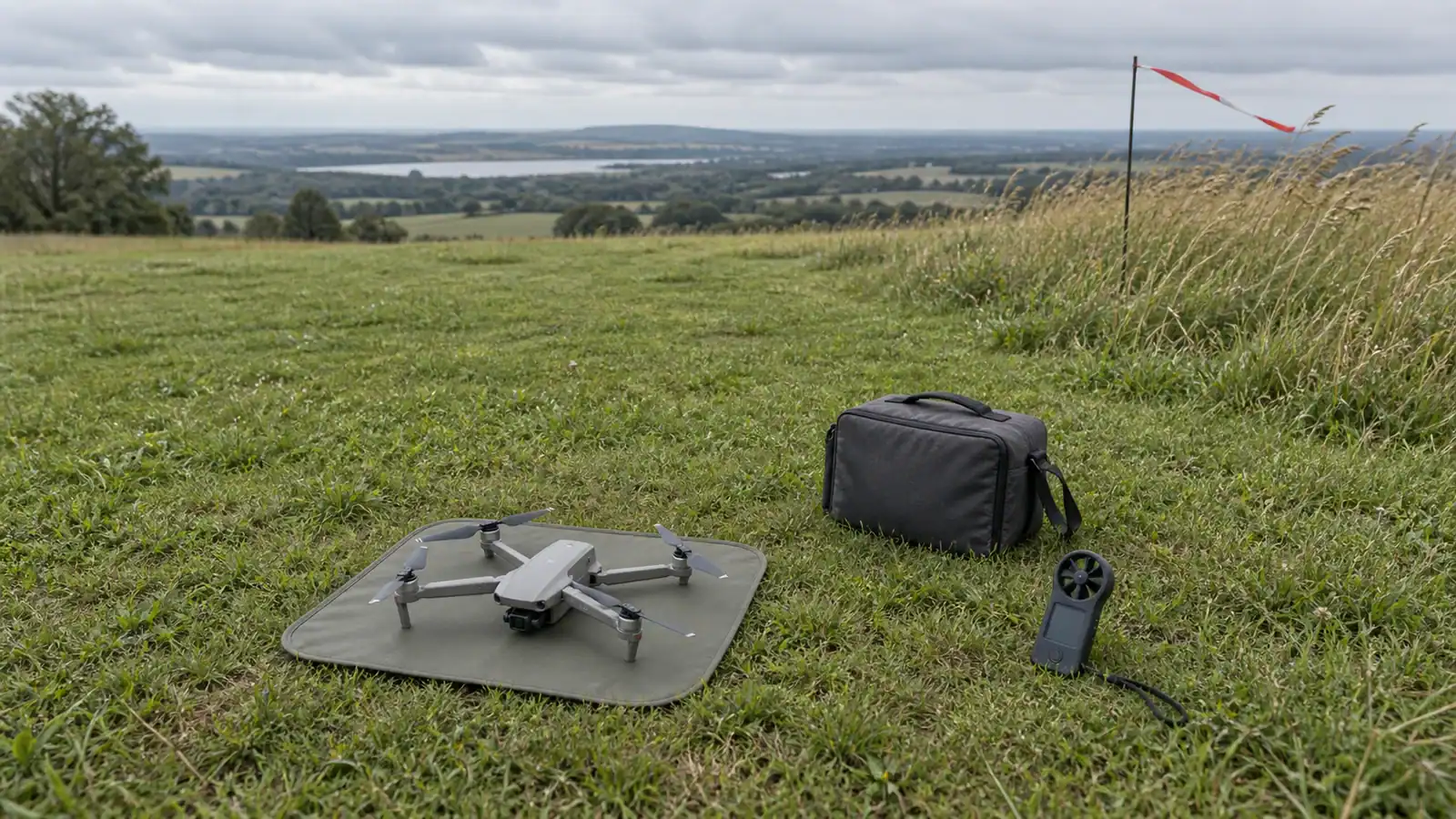
Holy Stone HS360S wind resistance is rated at a maximum of 5.5 m/s in manual V5.1, about 12.3 mph or 19.8 km/h. Leave room below that ceiling for gusts and the journey home. Beginners should start in calm conditions with short flights close to the launch area.

Featured gear
Holy Stone HS360S GPS Camera Drone
The Holy Stone HS360S is a 249 g beginner GPS camera drone with brushless motors, Return to Home, HS FLY smart modes, a 3 km manufacturer-rated link, and 4K/20 fps recording to a compatible…
The Holy Stone HS360S is a 249 g beginner GPS camera drone with brushless motors, Return to Home, HS FLY smart modes, a 3 km manufacturer-rated link, and 4K/20 fps recording to a compatible microSD card.
- Best for
- Best for a beginner who wants a low-cost 249 g GPS camera drone with…
- Skill level
- Beginner
- Product type
- Beginner Drones, Camera Drones, Drones, Under 249g Drones
- Best for
- A beginner who wants a low-cost 249 g GPS camera drone with brushless motors,…
- Skill level
- Beginner
- Product type
- Foldable GPS Camera Drone
What the wind rating actually tells you
The HS360S V5.1 manual gives the numerical rating on printed page 49. The current HS360S product page instead describes light-wind performance without publishing a numerical wind limit. Match the manual revision to your aircraft; do not substitute an online wind-level label for model-specific instructions.
The conversions use 5.5 × 3.6 = 19.8 km/h and 5.5 × 2.23694 ≈ 12.3 mph. Those are the same speed in different units, not three different operating limits. Neither document establishes that every flight below the maximum will be safe.
The product page promotes brushless motors, but it supplies no measured gust-recovery time or guaranteed upwind return distance. Our recommendation is to leave a meaningful margin rather than launch whenever an app displays a number just below the ceiling. If a location routinely demands flying near that figure, wait for better conditions.
Read the gusts and the terrain
A forecast's sustained wind is only part of the decision. National Weather Service guidance explains that wind can change with height, and that buildings and uneven terrain create eddies. A sheltered launch spot can therefore feel much calmer than the air above or beyond it. Check the forecast gusts as well as the average, and assess the exposed area you intend to fly through. See the NWS explanations of local wind behavior and mechanical turbulence.
A practical planning example: a modest average accompanied by gusts reaching the manual's maximum is a reason to postpone. Averaging the two numbers would conceal the condition you need to avoid. Likewise, a low reading behind a building does not clear a flight over its roof.
| What you find | Practical decision |
|---|---|
| Calm conditions, open ground, clear landing area | Consider a short familiarization flight after the aircraft checks pass. |
| Gusts approaching the documented ceiling | Postpone; do not use the lower average as permission. |
| Sheltered takeoff with an exposed route | Reassess the route's conditions before launch. |
| Erratic airflow around buildings or a ridge | Choose another location or day instead of testing the boundary. |
| Drift or poor progress toward the landing area | End the flight and use a clear reachable landing area. |
A stable hover does not prove you can get home
Ground speed measures movement across the landscape. Airspeed measures movement relative to the surrounding air. As NASA's relative-velocity explanation shows, wind direction changes the relationship between them: a headwind reduces ground progress for a given airspeed, while a tailwind increases it.
That creates an easy planning mistake. A quick downwind outbound leg can leave a slow upwind trip back. A hover proves only that the aircraft is holding its present position under the present conditions. It does not demonstrate spare speed for a return leg after the wind changes.
Keep early flights close enough that landing remains a straightforward option. Avoid planning a downwind excursion that relies on a difficult return. If the drone is making poor progress, abandon the shot; repeatedly commanding a return does not change the air it must fly through.
Holy Stone's HS360S battery guidance describes up to 20 minutes under ideal conditions and identifies wind, temperature and flying style as variables. Do not schedule a 20-minute route or assume half the advertised duration is a safe outbound allowance. Allow for positioning, the return and a controlled landing; stronger wind can consume the margin that made the outward leg look easy.
Prepare for the flight you can safely finish
The manual calls for charged batteries, secured propellers and battery, unfolded arms, unobstructed motors and removal of the camera cover. Follow its compass procedure and confirm GPS operation before relying on return-to-home. Avoid heavy wind, precipitation and fog.
Review the intended route and landing alternatives before launch. Set the return height to clear relevant obstacles without unnecessary climbing. Our HS360S altitude and return-height guide explains those settings. A software boundary does not measure the weather along its edge.
The aircraft has no automatic obstacle avoidance, according to the manual. Keep the return path clear and the transmitter powered on. Do not wait for low-battery automation to decide when to come back.
V5.1 says aircraft firmware cannot be upgraded; app updates use app stores. An HS FLY update does not establish higher wind resistance. Resolve differing instructions with Holy Stone before changing operating assumptions.
End the flight when the margin disappears
Use a simple stop rule: if staying in place or moving toward a clear landing area becomes difficult, stop pursuing the planned flight. Do not climb or fly farther away just to see whether conditions improve. A short uneventful landing is a better result than discovering the aircraft's limit over an inaccessible area.
Before launching, make sure the route leaves room for changing wind, a slower return and landing. Choose calm practice conditions, keep the aircraft close, and cancel when the answer is uncertain.
Sources
- Holy Stone HS360S Instructions for Use V5.1: wind rating, preparation, return functions and software limitations.
- Holy Stone HS360S product documentation: current light-wind description and published specifications.
- National Weather Service: Prevailing Winds: local and vertical wind variation.
- National Weather Service: Turbulence: effects of obstacles and terrain on airflow.
- NASA: Relative Velocity: airspeed, wind and ground-speed relationships.
- Holy Stone HS360S battery guidance: qualified endurance claim and environmental variables.
Last checked: September 10, 2026.