The HOTA D6 Pro is a strong choice for FPV pilots who want one compact charger for two conventional 2S to 6S packs, at home or from a suitable DC power source. Its two independent channels, built-in AC supply, storage functions, and direct balance connections solve the needs of a mixed FPV battery fleet well. It is less compelling for pilots who charge only 1S tiny-whoop batteries, want a completely automatic appliance, or expect the advertised 650W DC ceiling from a wall outlet.
Review basis: This is a research-based HOTA D6 Pro charger review. No hands-on test notes were supplied. The analysis uses the published D6 Pro manual, current distributor specifications, FPV charging guidance, and specifically attributed long-term reviewer feedback. Specifications and package contents can change, so confirm the current listing before ordering.
Quick verdict
Best for
Pilots maintaining several 2S to 6S LiPo or LiHV packs who value two independent channels and both AC and DC input.
Biggest advantage
It can charge two different compatible packs with separate settings while remaining a self-contained wall-powered charger.
Main limitation
AC charging is limited to 200W total, while the 650W headline requires a capable high-voltage DC source and suitable wiring.
Skip it if
Your fleet is almost entirely 1S whoop packs, or you do not want to verify chemistry, cell count, current, connectors, and pack condition for every charge.
Featured charger
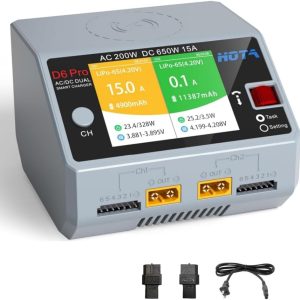
Featured gear
HOTA D6 Pro Dual Battery Charger
The HOTA D6 Pro is a dual-channel AC/DC balance charger for conventional FPV and RC battery packs, with two outputs and support for multiple battery chemistries. Best for: Pilots managing several 2S–6S FPV batteries.…
The HOTA D6 Pro is a dual-channel AC/DC balance charger for conventional FPV and RC battery packs, with two outputs and support for multiple battery chemistries.
- Best for
- A versatile dual-channel AC/DC charger for conventional FPV and RC packs; buyers must verify…
- Product type
- Battery Chargers
- Best for
- A versatile dual-channel AC/DC charger for conventional FPV and RC packs; buyers must verify…
- Product type
- Dual-Channel Balance Charger
What the HOTA D6 Pro is
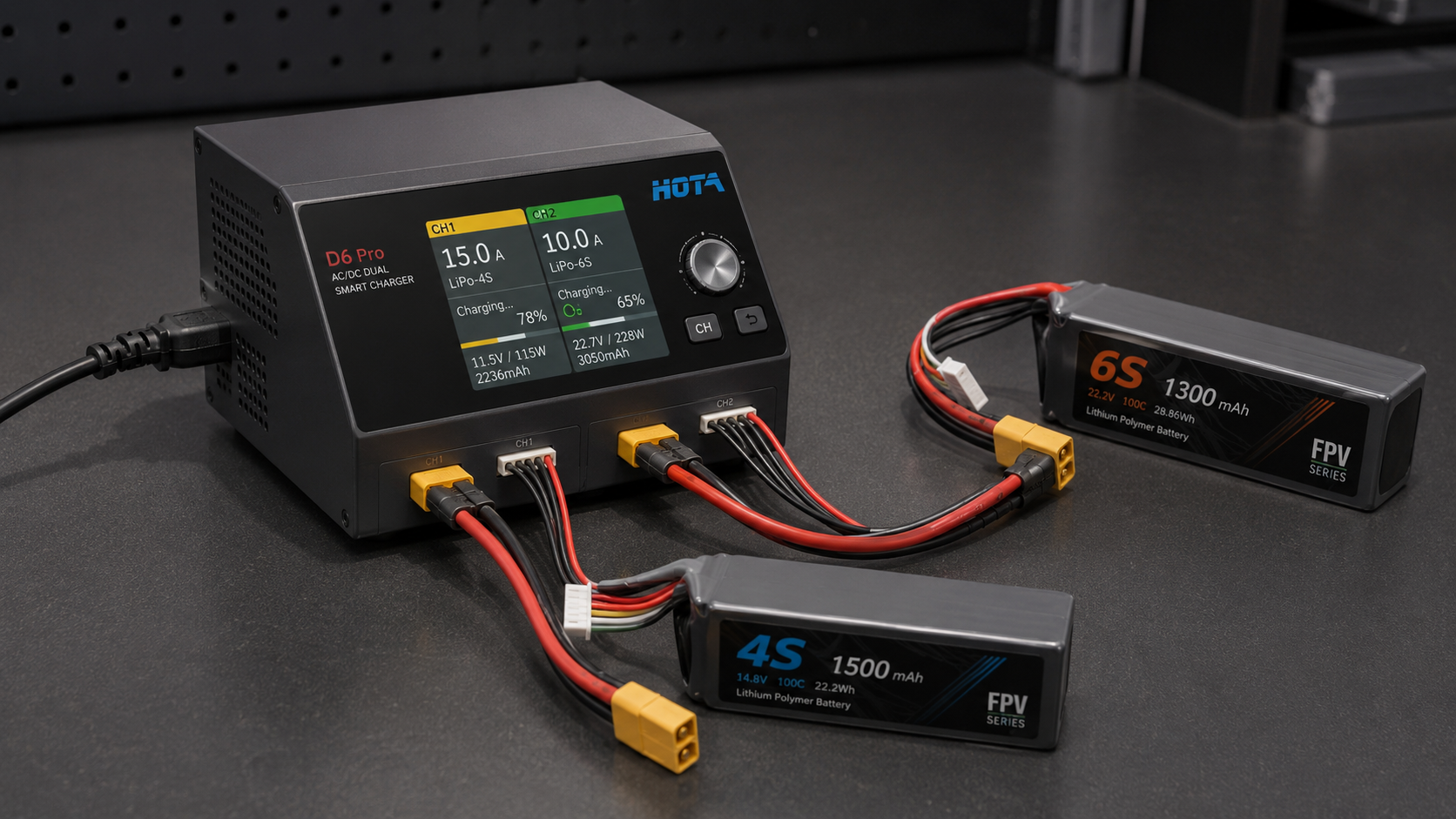
The HOTA D6 Pro is a two-channel AC/DC balance charger built for hobby batteries rather than one specific drone. Each channel has its own main XT60 output and balance connection, so two compatible batteries can be managed at the same time with separate settings. One channel can be charging a 4S LiPo while the other works with a different supported pack, provided the selected chemistry, cell count, current, and power allocation are correct.
The “Pro” distinction matters because this version has an internal AC power supply. At home, an AC cable is enough to operate the charger. In the field or on a higher-output bench setup, the rear XT60 DC input accepts a suitable external source. That dual-input design is the practical reason to choose the D6 Pro over a small DC-only charger: it avoids a separate power supply for ordinary wall use without giving up the option of greater DC output.
It is also a battery-management tool, not just a fast charger. The published interface supports charging, balancing, storage work, and discharging, while the display reports overall voltage, individual cell voltages, current, added capacity, elapsed time, and other channel data. A 5V/2.1A USB output and top-panel wireless charging area are useful extras, but neither should outweigh the core battery and power requirements.
The short version: Buy the D6 Pro for the two independent channels, integrated AC supply, and broad 1S to 6S lithium support. Do not buy it merely because “650W” appears in the name of a listing. That figure belongs to a properly supplied DC setup, not normal AC operation.
HOTA D6 Pro specifications that matter
| Specification | Published value | Buyer implication |
|---|---|---|
| Channels | Two independent channels | Two compatible packs can run different tasks or settings at the same time. |
| AC input | 100 to 240V AC | The internal power supply makes ordinary wall operation self-contained. |
| DC input | 6.5 to 30V DC | A suitable external source is required to approach the maximum DC output. |
| Charge power | 200W total on AC; up to 325W per channel, 650W total, on DC | AC is convenient and sufficient for many FPV packs, but the two channels share a lower total ceiling. |
| Charge current | 0.1 to 15A per channel | The actual available current also depends on pack voltage, input power, and the charger's power limit. |
| Lithium support | LiPo, LiHV, Li-ion, LiFe, and related lithium modes, 1S to 6S | Chemistry must be selected correctly. LiPo and LiHV charge targets are not interchangeable. |
| Other chemistries | NiZn, NiCd, NiMH, Eneloop, smart battery, and lead-acid modes | Useful for a mixed RC bench, but FPV buyers will mainly care about lithium modes. |
| Balance current | Up to 1600mA per channel | Relatively strong balancing hardware can help finish multi-cell packs without a very long balance phase. |
| Internal discharge | 15W per channel | Storage-discharging a large, full pack can take much longer than charging it. |
| Main outputs | XT60 on both channels | XT30, EC3, Deans, and other battery connectors need a correctly wired adapter lead. |
| Size and weight | 108 × 105 × 76mm; approximately 555g | Compact for a dual-channel charger with an internal AC supply, but not a pocket-size 1S charger. |
The table shows why the charger works well for FPV. A typical fleet can include small 2S cinewhoop packs, 4S freestyle packs, and 6S packs for a five-inch quad. The D6 Pro covers those cell counts without forcing both channels to use identical settings. It also offers enough AC power for common one-pack-at-a-time or moderate two-pack workflows.
The specification that deserves the most caution is internal discharge power. A 15W discharge ceiling per channel is normal for this class, but it means a large, fully charged 6S pack will not return to storage voltage quickly. Storage mode is valuable, but the best habit is still to charge close to the time you plan to fly and avoid leaving many large packs full unnecessarily.
AC versus DC power: the 200W and 650W numbers explained
The D6 Pro has two very different power personalities. Plugged into a wall outlet, its internal supply provides up to 200W total and distributes that power between the channels. Fed from an adequate DC source, the charger is rated for up to 325W per channel and 650W total. A DC input above 24V is commonly specified for reaching the full rating.
Power, current, and battery voltage are connected. A charger cannot deliver 15A to a high-voltage pack if doing so would exceed the available wattage. Near full charge, a 6S LiPo is approximately 25.2V. Delivering 5A at that voltage is already about 126W before conversion losses. Two such channels would require more than the built-in 200W AC supply can provide, so the charger must reduce or redistribute output.
| Example pack | 1C current | Approximate power near full voltage | AC takeaway |
|---|---|---|---|
| 4S 1500mAh LiPo | 1.5A | About 25W | Two packs are comfortably within the 200W total ceiling. |
| 6S 1300mAh LiPo | 1.3A | About 33W | Two packs at 1C leave substantial AC headroom. |
| 6S 5000mAh LiPo | 5A | About 126W | Two packs would exceed 200W before losses, so output must be shared or reduced. |
For ordinary freestyle packs, 200W AC is more capable than the headline difference suggests. Two 6S 1300mAh packs charged conservatively at 1C need only a fraction of the available power. The DC advantage becomes more relevant with large long-range packs, high charge rates specifically permitted by the pack manufacturer, several packs on approved parallel equipment, or a field setup designed around a high-output source.
What a full-power DC setup requires
The charger does not create 650W from a small battery or undersized bench supply. The source, leads, connectors, and fusing must all be rated for the planned load. At 24V, 650W is roughly 27A before conversion losses. At a lower input voltage, required current rises further. That is a serious power system, not a casual cigarette-lighter connection.
Buyer implication: Most FPV pilots can treat the D6 Pro as a convenient 200W dual charger and regard the 650W DC mode as expansion headroom. Only plan around maximum DC output if you already understand source sizing, connector ratings, wire gauge, fusing, and input-voltage limits.
Battery and connector compatibility
The D6 Pro's published battery list is broad, but “supports 1S to 6S” does not mean every battery plugs in directly. Compatibility has three separate layers: chemistry, cell count, and physical connections. All three must be correct.
LiPo versus LiHV matters
A standard LiPo and a LiHV pack can have the same cell count while requiring different end voltages. Select the chemistry printed on the battery label. Do not choose LiHV mode for an ordinary LiPo just to add more voltage. The D6 Pro provides the modes, but the operator remains responsible for selecting the correct one.
Main connector and balance lead
Each charging channel uses an XT60 main output. A battery with an XT60 main lead can connect directly to the corresponding channel, while an XT30 pack needs a sound XT60-to-XT30 charge lead. Packs with Deans, EC3, EC5, or another connector need the correct adapter. Avoid loose, damaged, reverse-polarity, or improvised adapters.
For a multi-cell lithium pack, connect the main lead and the balance lead to the same channel. The balance connection lets the charger monitor individual cells and bring them to the correct relationship during a balance charge. Before starting, confirm that the cell count detected through the leads matches the pack label and the setting on screen.
Why it is not the best 1S whoop charger
The D6 Pro specification includes 1S lithium support, but tiny-whoop packs usually use PH2.0, BT2.0, A30, or similar small connectors. They do not plug directly into the charger's XT60 output, and charging one little pack at a time wastes the advantages of a dual 325W-capable platform. A purpose-built six-channel unit is simpler for that job.
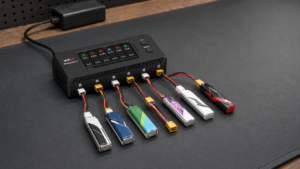
If your battery box is mostly whoop packs, see the best 1S LiPo charger guide. The VIFLY WhoopStor 3, for example, is designed around individual 1S channels and common tiny-whoop connectors. The HOTA becomes the better fit when the fleet moves into conventional 2S to 6S packs with main and balance leads.
What the HOTA D6 Pro is like to manage
The front-panel workflow uses a channel button and HOTA's rotary “Speed Shuttle Key.” Select the channel, choose the task and battery chemistry, confirm the cell count and target voltage, set current, and start. During a charge, the color display can show pack voltage, current, added capacity, elapsed time, and individual cell readings.
That interface is compact and efficient once the menu logic is familiar. It is not foolproof. The charger can detect useful information and raise warnings, but it cannot verify every detail printed on a battery label or decide whether a damaged pack is safe. New users need to slow down and read every setting instead of treating the wheel as a one-button start control.
The independent channels are the strongest daily-use feature. You do not have to wait for two matching batteries or apply one shared chemistry and current setting to both. This is especially useful when an FPV collection spans several quad sizes or when one pack needs a storage task while another receives a normal balance charge.
Long-term reviewer experience adds useful context. Joshua Bardwell lists the D6 Pro as a long-running daily-driver charger and highlights its balance of compact size, integrated AC power, and two-channel output. He also notes that the 200W built-in supply is shared across the channels. That is a specific owner's favorable experience, not a guarantee that every unit will have the same service life.
The USB output and wireless phone pad are convenient bench extras. They do not replace a modern high-power USB-C charger, and placing a phone on top can occupy space that might otherwise remain clear for airflow and cable management. Treat them as bonuses rather than reasons to choose the charger.
HOTA D6 Pro strengths and limitations
Two genuinely useful channels
Separate tasks and settings make the charger more flexible than a single-output model or a device that only handles matched packs.
AC convenience
The integrated 100 to 240V supply removes the need to buy and carry a separate power supply for normal home charging.
Useful DC expansion
A properly engineered DC setup can supply much more power when large packs or demanding field workflows justify it.
Broad pack support
Common FPV LiPo and LiHV packs from 1S through 6S fit within the published electrical range.
AC power is shared
The two channels do not each receive 200W on wall power. Large packs or aggressive settings can hit the total limit.
Adapters are often necessary
XT30 and other main connectors require correctly wired charge leads, adding cost and another connection to inspect.
Slow internal discharge
The 15W-per-channel internal limit can make storage-discharging large full packs a lengthy process.
Operator knowledge is essential
Powerful manual settings increase flexibility, but the wrong chemistry, cell count, current, or connector can create a serious hazard.
The D6 Pro's value is not that it eliminates charging decisions. It consolidates a capable two-channel charger and an adequate AC supply into one compact unit. That is a meaningful improvement for a pilot who would otherwise buy a DC charger, a bench supply, and a second channel separately.
It is also mature rather than cutting-edge. You do not get a modern USB-C power-delivery input, a phone app that makes LiPo charging automatic, or unlimited AC output. For its intended role, those omissions are less important than predictable power limits, direct controls, and battery-management functions.
Check the exact listing before buying. Confirm the included AC cable for your region and budget for any XT60-to-battery adapter leads your packs require.
A safe HOTA D6 Pro charging workflow
A balance charger adds protective checks, but it cannot make a damaged pack or incorrect setting safe. Fire and Rescue NSW advises charging compatible batteries on noncombustible surfaces, away from flammable materials and exits, without leaving them unattended or charging overnight. It also advises against using swollen, leaking, overheated, or mechanically damaged batteries.
Use the D6 Pro only after reading the manual and the instructions for the battery. The site's broader FPV drone battery guide explains cell voltage, connectors, storage, and LiPo safety in more detail.
- Inspect the pack. Do not charge a swollen, punctured, crushed, leaking, unusually hot, or wire-damaged battery.
- Prepare the area. Use a stable noncombustible surface away from paper, carpet, solvents, exits, direct sun, and other combustible material. Keep the area monitored.
- Check the power source. Use the correct AC cord or a properly rated DC source, input lead, connector, and fuse. Keep the charger's vents clear.
- Verify the adapter. Confirm polarity and connector condition before attaching an XT30 or other adapter to the XT60 output.
- Connect one channel correctly. Attach the pack's main lead and, for a multi-cell lithium pack, its balance lead to the same channel.
- Select the exact chemistry. Match LiPo, LiHV, LiFe, Li-ion, or another mode to the battery label. Similar-looking packs can require different voltage limits.
- Confirm cell count. The on-screen count must agree with the battery label. Stop and investigate any mismatch.
- Set an approved current. Use the battery manufacturer's charge-rate instruction. When 1C is permitted, divide capacity in mAh by 1000 to get current in amps, such as 1.3A for 1300mAh.
- Use balance charging. For a conventional multi-cell LiPo, monitor individual cell voltages and do not bypass warnings to force a start.
- Stay present. Watch the pack and charger. Stop if either behaves abnormally, becomes unusually hot, swells, smells odd, hisses, smokes, or reports a persistent fault.
- Finish appropriately. Disconnect after completion. If the pack will not be used soon, follow its manufacturer's storage guidance rather than leaving it fully charged.
Important: The charger's over-temperature, over-current, voltage, time, and connection protections are backups, not permission to charge unattended. Correct settings, compatible hardware, pack inspection, and supervision remain the operator's responsibility.
Who should buy the HOTA D6 Pro?
| Your battery workflow | Fit | Why |
|---|---|---|
| Several 4S and 6S freestyle packs | Excellent | Two independent channels, direct balance connections, and sufficient AC power for common conservative charge rates. |
| Mixed 2S, 4S, and 6S fleet | Excellent | Separate channel settings suit different pack sizes and tasks. |
| Home and field charging | Very good | Built-in AC operation is convenient, while DC input supports a properly designed field source. |
| Large long-range packs | Good with planning | Charging capability is strong, but two large packs can exceed the shared AC ceiling and storage discharge can be slow. |
| Only 1S tiny-whoop packs | Poor | A dedicated multi-channel 1S charger offers better connectors, workflow, and space efficiency. |
| First charger with no LiPo knowledge | Conditional | The interface is manageable, but safe use requires learning chemistry, cell count, current, balance leads, and fire precautions. |
| Maximum DC power from an improvised source | Not recommended | The source and wiring must be engineered for the voltage, current, connectors, and protection required. |
The ideal D6 Pro buyer has already outgrown a single-port charger or expects to do so soon. Two channels reduce queueing, and the AC supply keeps the bench setup simple. The ability to use DC later means the charger can remain useful if pack size or charging volume increases.
A true beginner can still use it, but “beginner-friendly” should not be confused with automatic. If you cannot identify a pack's chemistry, cell count, capacity, main connector, balance connector, and allowed charge rate, learn those basics before connecting it. The charger is a good long-term tool for a careful learner, not a shortcut around LiPo knowledge.
When another charger fits better
Choose a dedicated 1S charger for tiny whoops
A six-channel 1S charger with native PH2.0, BT2.0, or A30 connections is faster to organize and less adapter-dependent for whoop batteries. It can also place each small pack on its own channel instead of using a large two-channel charger for one tiny battery at a time. Start with the current tiny-whoop charger comparison if that describes your fleet.
Choose a smaller DC-only charger if portability comes first
A DC-only model can be lighter and smaller because it omits the internal AC supply. That trade makes sense if you already own a suitable bench supply, always charge from a field battery, or value the smallest possible travel kit. Include the external source, leads, and adapters when comparing total cost and packed size.
Choose more AC capacity for repeated large-pack charging
If your normal workflow is two large 6S packs at high current, a charger with more built-in AC power may be a cleaner solution than adding a high-output external DC supply to the D6 Pro. Compare continuous AC output, channel sharing, connector layout, discharge capability, and the actual rate permitted by your batteries. A larger advertised wattage is not useful if the wall-powered mode cannot deliver it.
The HOTA D6 Pro remains the balanced option in the middle: more self-contained than a DC-only unit, more flexible than a 1S charger, and compact compared with many high-output bench systems.
Final verdict: is the HOTA D6 Pro worth buying?
Yes, for the right battery fleet. The HOTA D6 Pro is a practical long-term charger for FPV pilots who use conventional 2S to 6S packs and want two independent channels without building a separate AC power system. The 200W wall-power limit is enough for many common FPV packs at manufacturer-approved conservative rates, and the higher DC ceiling provides useful expansion room.
Its compromises are straightforward. Wall power is shared, storage discharge is relatively slow, non-XT60 batteries need adapters, and safe operation depends on the user's settings and inspection habits. A 1S-only whoop pilot should buy a dedicated 1S charger instead. A pilot with a mixed freestyle, cinewhoop, or long-range fleet will get much more value from the D6 Pro's flexibility.
Best match: Buy it if you want a compact dual-channel AC/DC charger for a growing 2S to 6S FPV battery collection and are prepared to use it with the correct leads, settings, and fire precautions.
Frequently asked questions
Can the HOTA D6 Pro charge two batteries at once?
Yes. It has two independent channels with separate main outputs, balance connections, and settings. On AC power, both channels share the charger's 200W total output. The combined load therefore matters even though the channels are controlled independently.
Can it charge a 6S LiPo?
Yes. The published lithium range is 1S to 6S. Connect the main lead and balance lead to the same channel, select the exact chemistry, confirm 6S on the pack and screen, and use a charge current allowed by the battery manufacturer.
Does the HOTA D6 Pro need an external power supply?
Not for normal AC use. The Pro model includes an internal 100 to 240V AC power supply rated for 200W total output. A separate 6.5 to 30V DC source is optional and is required only when using DC input or pursuing output beyond the AC limit.
Can it really deliver 650W?
The published maximum is 325W per channel and 650W total on a sufficient DC input. It cannot deliver 650W from its internal AC supply, which is rated at 200W total. Reaching the DC ceiling also requires a source and wiring capable of safely supplying the necessary voltage and current.
Does it work with XT30 batteries?
Yes, electrically compatible packs can be charged with a correctly wired XT60-to-XT30 charge lead. The adapter does not change battery chemistry or cell count, so those settings and the balance connection must still be correct. Inspect adapter polarity and condition before every use.
Is the HOTA D6 Pro good for 1S tiny-whoop batteries?
It can support 1S lithium charging with appropriate connections, but it is usually the wrong workflow. Tiny-whoop packs use small connectors and benefit from a dedicated multi-channel 1S charger with native ports and individual controls.
What charge current should I use?
Use the battery manufacturer's specified rate. If the label or documentation permits 1C, divide capacity in mAh by 1000 to get amps: 850mAh becomes 0.85A, 1300mAh becomes 1.3A, and 1500mAh becomes 1.5A. Do not assume every pack permits faster charging.
Sources
- HOTA D6 Pro AC/DC Dual Channel Smart Charger instruction manual copy, specifications, ports, controls, operating steps, and protection features.
- iFlight Europe HOTA D6 Pro listing, current published input, output, battery, balance, discharge, size, and package specifications.
- Joshua Bardwell's FPV charger recommendations, specifically attributed long-term D6 Pro use and AC power-sharing context.
- Fire and Rescue NSW battery charging safety guidance, charging location, supervision, charger compatibility, and damaged-battery precautions.
Last checked: July 24, 2026.