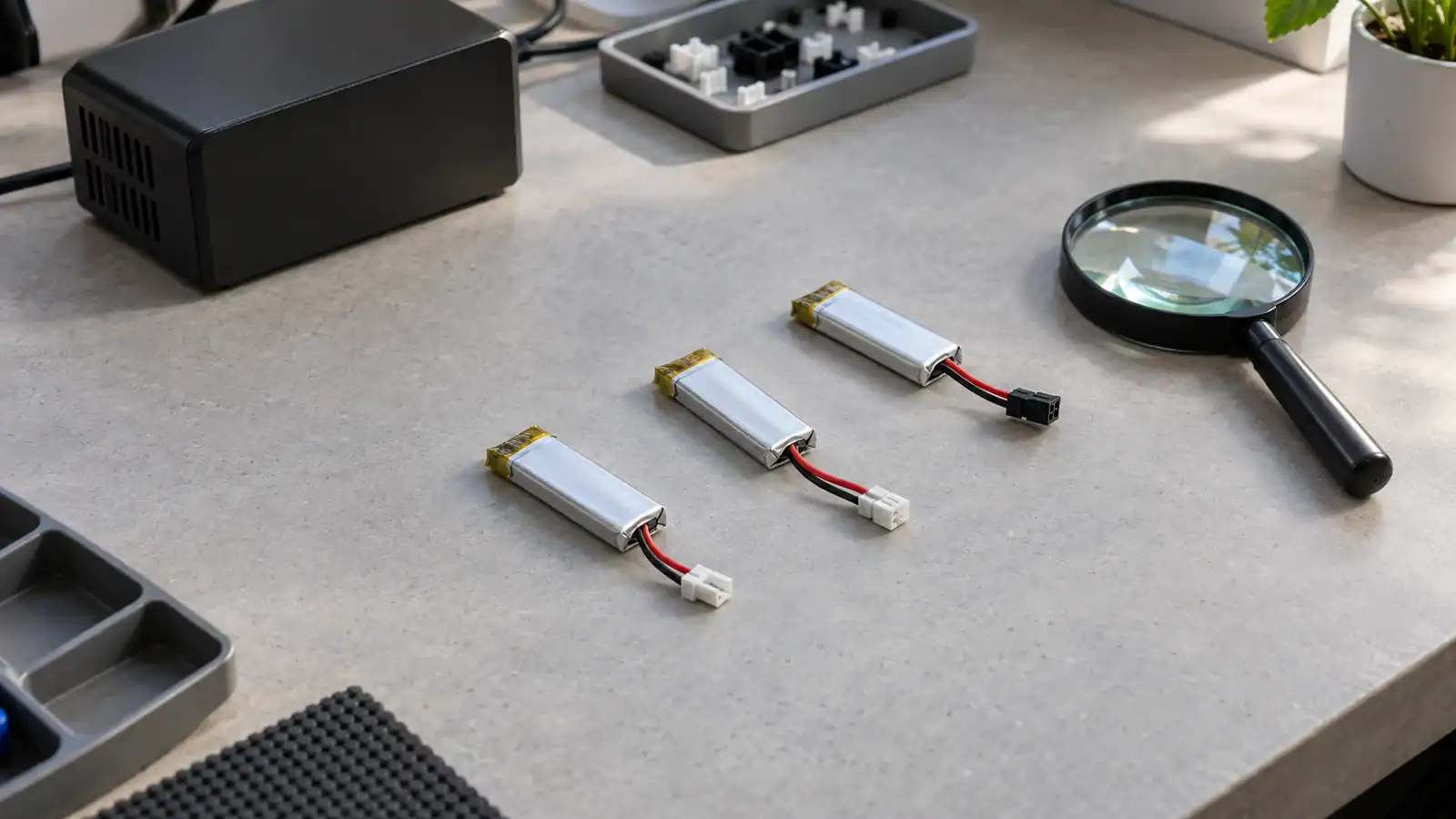
A 1S LiPo battery is a lithium-polymer battery with one cell in series. A conventional 1S LiPo is nominally 3.7V and charges to 4.20V; a LiHV cell may permit 4.35V. The WhoopStor 3 charges individual 1S whoop batteries, but compatibility also requires the correct connector, polarity, voltage target and charge current. “1S” alone is not enough.

Featured gear
VIFLY WhoopStor 3 1S Battery Charger
The VIFLY WhoopStor 3 charges or storage-charges as many as six 1S LiPo or LiHV tiny-whoop batteries through independent PH2.0 and BT2.0 channels. Best for: Pilots managing multiple 1S tiny-whoop batteries. Not ideal for:…
The VIFLY WhoopStor 3 charges or storage-charges as many as six 1S LiPo or LiHV tiny-whoop batteries through independent PH2.0 and BT2.0 channels.
- Best for
- A specialized six-channel charger and storage discharger for 1S PH2.0 and BT2.0 tiny-whoop batteries;…
- Product type
- Battery Chargers
- Best for
- A specialized six-channel charger and storage discharger for 1S PH2.0 and BT2.0 tiny-whoop batteries;…
- Product type
- 1S Battery Charger and Storage Discharger
Read the battery label before choosing a setting
The S number describes the series cell count, not capacity, connector shape or charge speed. A higher mAh number describes greater rated charge capacity; it does not change a 1S pack into a higher-voltage pack. Likewise, the battery's nominal voltage names its voltage class, rather than the voltage you should select to finish charging.
The Onyx charger manual's battery-parameter table distinguishes nominal, maximum-charge and storage voltages. For this charger, use the battery maker's explicit chemistry and maximum-charge instructions to choose between LiPo and LiHV. Never infer permission to use 4.35V from a connector or a familiar-looking wrapper.
Charging compatibility and aircraft compatibility are separate checks. A battery that charges correctly may still exceed your whoop's permitted voltage, fail to fit its holder or use different connector wiring. Match the aircraft's battery requirements before flying; a charger completing its cycle does not verify that match.
Which batteries fit the WhoopStor 3?
VIFLY documents PH2.0 and BT2.0 outputs for 1S LiPo and LiHV batteries. There are six numbered channels, each offering two connector choices. Connect one battery per numbered channel, using either socket. The paired sockets do not create twelve independent charging positions.
| Battery or situation | Decision | What controls the choice |
|---|---|---|
| 1S LiPo rated for 4.20V | Use 4.20V for a full charge | Matching PH2.0 or BT2.0 connection, correct polarity and permitted current are still required. |
| 1S LiHV explicitly rated for 4.35V | Use 4.35V for its specified full charge | The battery documentation must authorize that endpoint. |
| 2S or higher pack | Do not connect to a charging output | The output channels are for 1S packs, even though a larger pack can power the input. |
| Different connector or uncertain polarity | Do not treat it as a direct fit | A plug that can be forced into place is not verified compatibility. |
| Battery requires less than 0.3A charging | Choose a charger with a suitable lower setting | WhoopStor 3's specified adjustment range starts at 0.3A. |
| Unreadable label or damaged battery | Do not start charging | Confirm identity and condition before selecting a program. |
For shopping questions beyond an existing battery's fit, the tiny-whoop battery charger guide explains how to compare the features that matter. Here, the deciding question is whether your particular battery can safely use the available settings.
Choose current from the battery, not the charger's maximum
The battery's permitted charge rate controls the setting. Horizon Hobby's battery safety guidance says to follow the label and not exceed 1C unless the manufacturer documents another rate. VIFLY's general suggestion of 2C does not establish that every battery permits it. A prominent discharge C rating is not a charge-rate instruction.
Charge current in amperes = capacity in mAh ÷ 1,000 × permitted charge rate in C.
For an illustrative 300mAh battery whose maker permits 1C, the calculation is 300 ÷ 1,000 × 1 = 0.30A. For a 450mAh battery at the same rate, it is 0.45A. If the exact permitted value falls between available settings, select a lower setting rather than rounding above the limit. These are capacity examples, not recommendations for unnamed battery models.
The six channels track batteries separately, but the displayed current limit and voltage target are shared. Batteries may start at different voltages, yet every connected battery must accept the selected settings. For example, pairing a smaller pack with a larger one does not let you select a current that exceeds the smaller pack's limit. Separate batches by chemistry and current requirement when that is easier to verify. Do not select 4.35V while a conventional 4.20V LiPo remains connected.
Independent channels are useful for a mixed collection, but shared controls still require attention. The VIFLY WhoopStor 3 review considers that tradeoff in the broader ownership decision.
Power it correctly, then check the screen
The manual lists 6–26V through XT60 or the DC input, and 9–20V through USB-C. Its DC socket is 5.5 × 2.1mm, center-positive. VIFLY specifies at least 40W input power; a USB-C connector alone does not prove a supply is suitable, and ordinary 5V USB is unsupported. Check the supply's output profiles, cable and polarity before connecting it.
The manual also says a USB source limited to 9V restricts maximum charge current to 0.6A. If the charger will not provide an expected current, examine the negotiated input and power supply before blaming the battery. An XT60 supply battery is an energy source for the charger, not a pack being charged by it.
- Inspect batteries and leads. Remove batteries from the aircraft, let hot packs cool, and keep charging away from combustible material. Use appropriate fire-resistant battery containment without covering the charger's ventilation.
- Power the charger with a supported supply. Check its input-voltage display and the saved settings before attaching batteries.
- Use a short press of the left button to select current and a short press of the right button to select the target voltage. Match both to every battery in the batch.
- Connect one compatible battery to each channel you need, then hold the left button to start. Check the displayed channel readings and remain present during charging or discharging.
- Remove completed batteries when the screen indicates completion. Holding the left button stops operation; a stopped cycle is not proof of a full battery.
Settings memory is convenient only when you check what it remembers. Swapping from LiHV to conventional LiPo is a reason to review the target, even if the previous batch charged successfully. If a pack swells, becomes abnormally hot or shows damage, stop safely and discontinue its use. Do not try to revive a pack below its manufacturer's safe starting voltage.
Storage mode and firmware have separate jobs
For storage, the WhoopStor offers 3.80V and 3.85V targets; select the target appropriate to the battery maker's instructions. It can raise or lower battery voltage toward the selected storage setting. Storage is therefore useful after a session with both used packs and unused charged packs.
Do not expect discharge to match charge speed. VIFLY rates discharge power at 1.1W per channel, and the manual says discharge current is not user-adjustable. A higher selected charging current does not promise faster storage discharge. Keep the unit ventilated and attended throughout the process, then disconnect the batteries.
As checked September 9, 2026, the VIFLY Download Center lists WhoopStor V3 firmware V1.17 separately from the V2 download. Its brief release note describes an algorithm improvement, without establishing a new battery chemistry or connector capability. Use the V3-specific instructions if updating; do not treat a firmware version as permission to exceed a battery's limits.
If you own the older charger, the WhoopStor V2 and V3 comparison helps distinguish hardware changes before you decide whether an upgrade solves your actual problem.
Before connecting your next battery
Confirm four things: the pack is 1S, the chemistry permits your chosen endpoint, the connector and polarity match, and the selected current stays within the battery's charge limit. If any answer is unknown, leave that battery disconnected until its documentation resolves it. For a verified match, the WhoopStor 3 provides a practical way to charge and storage-condition individual whoop packs without treating every small battery as interchangeable.
Sources
- VIFLY WhoopStor 3 product specifications: manufacturer documentation for supported batteries, connectors, current range, storage targets and power requirements.
- VIFLY WhoopStor 3 manual: manufacturer instructions hosted by Colin's Radio Control, covering paired sockets, controls, display, power limits and operating precautions.
- Onyx charger instruction manual: battery terminology and the distinction between nominal, full-charge and storage voltages; not evidence of WhoopStor-specific features.
- Horizon Hobby lithium battery safety guidelines: charge-rate calculation, label requirements, inspection and charging precautions.
- VIFLY Download Center: current V3 firmware listing and separation from V2 firmware.
Last checked: September 9, 2026.