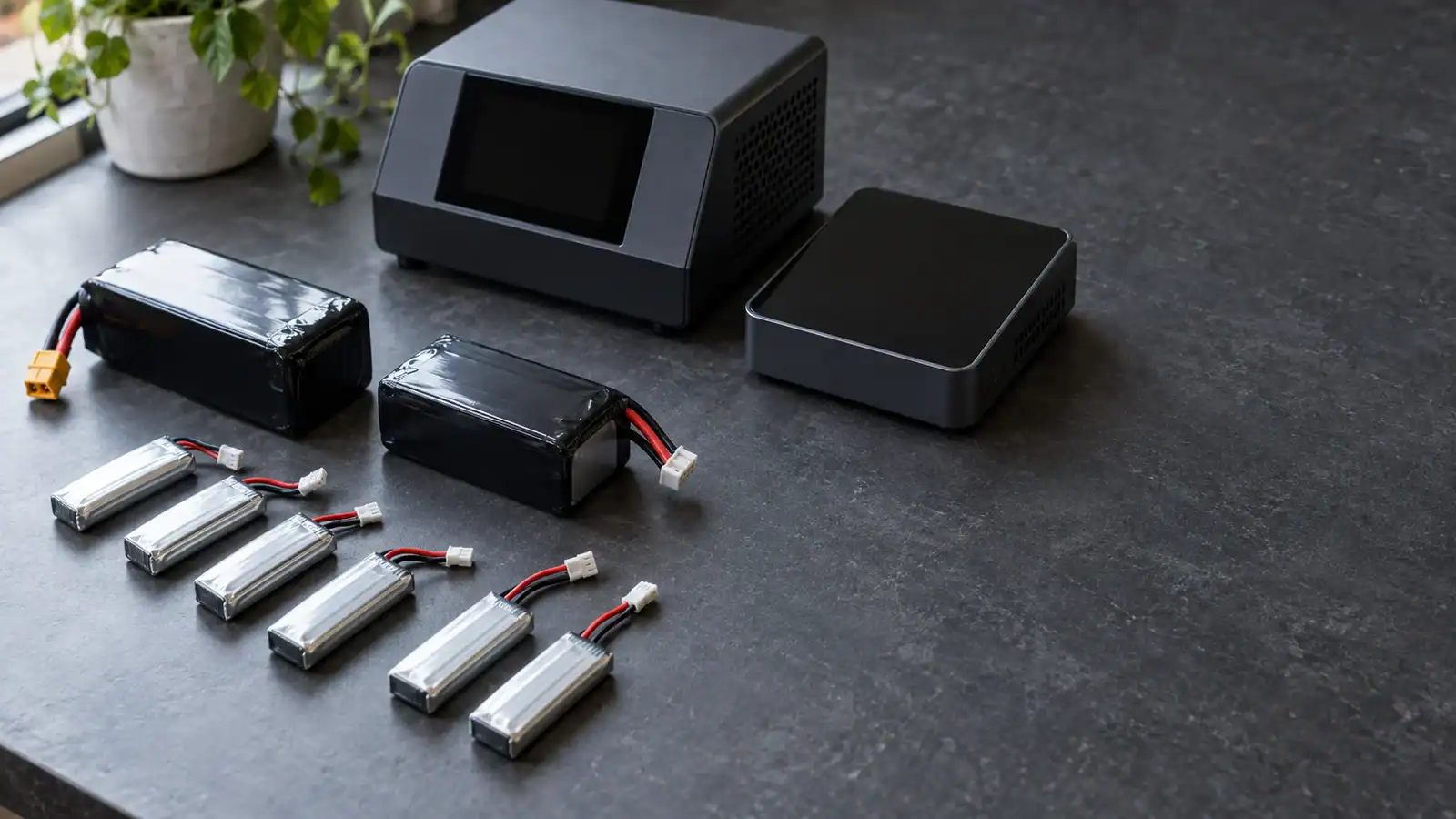
Choose the VIFLY WhoopStor 3 for a collection of individual 1S whoop batteries with PH2.0 or BT2.0 connectors. Choose the HOTA D6 Pro for conventional 2S–6S FPV packs, two separately configured charging channels and wall-outlet operation, after checking the pack chemistry and charging connections. A mixed fleet can justify both, but buying a second charger can wait until you have batteries that need it.
The important difference is what each output accepts. WhoopStor’s six channels serve six separate single-cell batteries. D6 Pro’s two channels each support compatible packs containing up to six lithium cells in series. The comparison below uses manufacturer specifications and manuals; its power examples are calculations, not measured charging results.
The two chargers compared

Featured gear
HOTA D6 Pro Dual Battery Charger
The HOTA D6 Pro is a dual-channel AC/DC balance charger for conventional FPV and RC battery packs, with two outputs and support for multiple battery chemistries. Best for: Pilots managing several 2S–6S FPV batteries.…
The HOTA D6 Pro is a dual-channel AC/DC balance charger for conventional FPV and RC battery packs, with two outputs and support for multiple battery chemistries.
- Best for
- A versatile dual-channel AC/DC charger for conventional FPV and RC packs; buyers must verify…
- Product type
- Battery Chargers
- Best for
- A versatile dual-channel AC/DC charger for conventional FPV and RC packs; buyers must verify…
- Product type
- Dual-Channel Balance Charger

Featured gear
VIFLY WhoopStor 3 1S Battery Charger
The VIFLY WhoopStor 3 charges or storage-charges as many as six 1S LiPo or LiHV tiny-whoop batteries through independent PH2.0 and BT2.0 channels. Best for: Pilots managing multiple 1S tiny-whoop batteries. Not ideal for:…
The VIFLY WhoopStor 3 charges or storage-charges as many as six 1S LiPo or LiHV tiny-whoop batteries through independent PH2.0 and BT2.0 channels.
- Best for
- A specialized six-channel charger and storage discharger for 1S PH2.0 and BT2.0 tiny-whoop batteries;…
- Product type
- Battery Chargers
- Best for
- A specialized six-channel charger and storage discharger for 1S PH2.0 and BT2.0 tiny-whoop batteries;…
- Product type
- 1S Battery Charger and Storage Discharger
HOTA D6 Pro vs WhoopStor 3 at a glance
Start with the batteries you actually own. Higher wattage cannot compensate for the wrong output connector or unsupported cell count.
| Decision point | HOTA D6 Pro | VIFLY WhoopStor 3 |
|---|---|---|
| Lithium battery scope | 1–6S, including LiPo and LiHV modes | Individual 1S LiPo or LiHV batteries only |
| Outputs | Two channels, with separate task settings | Six independent outputs, with common current and target-voltage settings |
| Battery connection | XT60 main output and balance connection per channel; verify any required charging lead | PH2.0 or BT2.0 for each numbered channel; one battery per pair |
| Selectable charging current | 0.1–15A per channel, subject to power limits | 0.3–1.3A per channel, subject to input limits |
| Power source | 100–240V AC, or 6.5–30V DC | External supply: 6–26V through DC/XT60, or 9–20V USB-C |
| Power qualification | 200W shared on AC; up to 325W per channel on suitable DC above 24V | Manufacturer specifies at least 40W input; a 9V USB source limits charging current to 0.6A |
| After flying | Storage task can charge or discharge the selected pack | 3.80V or 3.85V storage targets; can charge or discharge toward the selected target |
Both are battery-management tools. The choice is between serving more small packs directly and managing fewer, more varied packs with separate settings.
| Compare | HOTA D6 Pro Dual Battery Charger | VIFLY WhoopStor 3 1S Battery Charger |
|---|---|---|
| Product |
View HOTA D6 Pro Dual Battery Charger |
View VIFLY WhoopStor 3 1S Battery Charger |
| Best for | A versatile dual-channel AC/DC charger for conventional FPV and RC packs; buyers must verify connectors, included leads and the conflicting DC power description. | A specialized six-channel charger and storage discharger for 1S PH2.0 and BT2.0 tiny-whoop batteries; it does not charge larger packs and requires a compatible power source. |
| Product type | Battery Chargers | Battery Chargers |
| Product page | View product | View product |
| Retailer | Check Price | Check Price |
Check cell count, connector and charging current together
A 1S pack contains one cell; a 6S pack contains six cells in series. WhoopStor’s XT60 socket is a power input. Its support for a 2S–6S input battery does not let it charge that battery through its 1S outputs. The VIFLY manual’s connector diagram distinguishes these connections.
D6 Pro supports 1S lithium charging, but a PH2.0 or BT2.0 battery does not plug directly into its XT60 output. Verify a correctly wired charging connection before treating it as a whoop solution. For a multi-cell pack, the main lead and balance lead belong to the same channel. HOTA’s manual explains the connection and setup requirements; its broad chemistry list is not approval for every proprietary drone battery.
Current is a separate compatibility check. Use the battery maker’s charging limit, not the charger’s maximum setting or the pack’s discharge C-rating. The Horizon Hobby battery safety sheet explains the capacity-based calculation and manufacturer exceptions. Our LiPo charge-rate guide works through that current-setting decision in more detail.
Charge current in amps = capacity in mAh ÷ 1,000 × permitted charging C-rate.
For a hypothetical 300mAh battery approved for 1C charging, that is 0.3A. A 250mAh battery limited to 1C permits only 0.25A, below WhoopStor 3’s 0.3A minimum. Do not round that limit up. D6 Pro’s lower current range may help, but the correct connection and battery settings are still required.
For either charger, use 4.20V per cell for a standard LiPo and 4.35V only when the battery specifically permits LiHV charging. iFlight’s charging guidance makes that distinction explicit. Connector shape does not identify the correct end voltage.
Six outputs do not mean six separate settings
WhoopStor can manage six individual batteries without requiring identical starting voltages. However, its manual shows one charge-current setting and one target-voltage setting. Choose a combination suitable for every connected pack. In particular, do not mix ordinary LiPo batteries into a batch set to 4.35V.
The two sockets beside each channel number are alternatives. Connecting one PH2.0 battery and one BT2.0 battery to the same numbered pair violates the manual’s one-battery-per-pair rule. There are six usable channels, despite twelve physical battery sockets.
D6 Pro lets you configure its two channels separately. That helps when two supported packs need different charging currents or different tasks. It does not make a two-channel charger equivalent to six independent whoop outputs, and this comparison does not assume an additional series or parallel board.
If your normal session involves cycling several small packs through one compatible setting, the WhoopStor 3 review expands on that workflow. For a varied battery box, the HOTA D6 Pro review examines the broader ownership tradeoffs.
Choose the power source before chasing maximum watts
D6 Pro’s built-in AC supply makes it self-contained for wall use. The 650W DC headline describes two channels rated at up to 325W each with adequate input above 24V. It is not the output available from a wall socket: both channels share the 200W AC budget. Those conditions come from HOTA’s specification table.
For perspective, suppose two conventional 6S 1500mAh LiPo packs each allow 1C charging. Each current setting would be 1.5A. Using the 4.20V-per-cell endpoint gives 25.2V per pack, so the sizing calculation is 25.2V × 1.5A = 37.8W per channel, or 75.6W for two. That is below the shared 200W ceiling.
This is an output-power estimate, not a wall-consumption measurement or a completion-time prediction. Actual voltage and current change during charging. Size from your own packs and permitted current; the 6S charger selection guide covers that next step.
WhoopStor needs an external power source. Its published input specification lists 40W minimum and excludes ordinary 5V USB charging. Check the USB power profile as well as the wattage printed on an adapter. The manual limits current to 0.6A when the negotiated input is only 9V, so a USB-C connector alone does not establish full charging capability.
Before ordering, account for the supply and charging leads your setup actually needs. For a high-power DC setup, the source, leads and connectors must all handle the intended load within the charger’s input range. A larger power budget is useful only if your batteries permit enough charging current to use it.
Storage work and firmware affect everyday use
Both chargers can bring a compatible pack toward a storage target by charging or discharging. WhoopStor offers 3.80V and 3.85V targets and lists only 1.1W maximum discharge power per port. D6 Pro’s manual lists 15W internal discharge per channel. Neither figure should be confused with charging power or converted into an unsupported promise about how quickly a full battery will reach storage voltage.
Match storage settings to the battery instructions. Let packs cool after flying, inspect them for damage and swelling, charge on a nonflammable surface away from combustible materials, and stay present. Keep charger ventilation clear. These are practical requirements in the manuals and iFlight’s battery guidance.
Firmware must match the exact model. On September 9, 2026, the D6 Pro archive linked by HOTA’s support page contained a V1.0.53 firmware file. The VIFLY Download Center listed V1.17 for WhoopStor V3, separately from its V2 download. These are download checks, not claims about the firmware installed on your charger. Check the displayed version and follow the model-specific update instructions; a version number alone establishes no speed or compatibility improvement.
Choose for your present battery box
- Only compatible 1S PH2.0/BT2.0 packs: WhoopStor 3 is the more direct fit, provided its current range and shared settings suit every pack and you have a suitable power source.
- Conventional 2S–6S packs: D6 Pro is the relevant choice between these two. Verify main and balance connections, then calculate the power required at the battery’s allowed current.
- A real mix of whoops and larger quads: both can serve distinct jobs. Add the second only when your actual charging workload warrants it.
- An existing charger already covers your packs: keep it unless a specific missing capability, such as more direct 1S channels or separate multi-cell tasks, justifies a change.
Match the charger to the job
Confirm the exact model, required leads and power source before choosing.
HOTA D6 Pro
Two separately configured channels and built-in AC power for a varied compatible battery collection.
VIFLY WhoopStor 3
Six direct 1S channels for batteries that suit its connectors and common settings.
Sources
- HOTA D6 Pro specifications: manufacturer ratings and AC/DC power conditions.
- HOTA D6 Pro Operating Instructions, Ver 1.1.8: manufacturer manual hosted by Rotorama, covering connections, tasks and operating limits.
- VIFLY WhoopStor 3 specifications: manufacturer documentation for supported batteries, inputs and storage targets.
- VIFLY WhoopStor 3 manual: manufacturer instructions hosted by Colin’s Radio Control, including connector pairs, controls and the 9V input restriction.
- HOTA support downloads: model-specific firmware download.
- VIFLY Download Center: separate WhoopStor V3 and V2 firmware listings.
- iFlight Europe battery charging and storage guidance: chemistry targets, pack inspection and charging precautions.
- Horizon Hobby lithium battery safety guidelines: battery-specific charging limits and current selection.
Last checked: September 9, 2026.