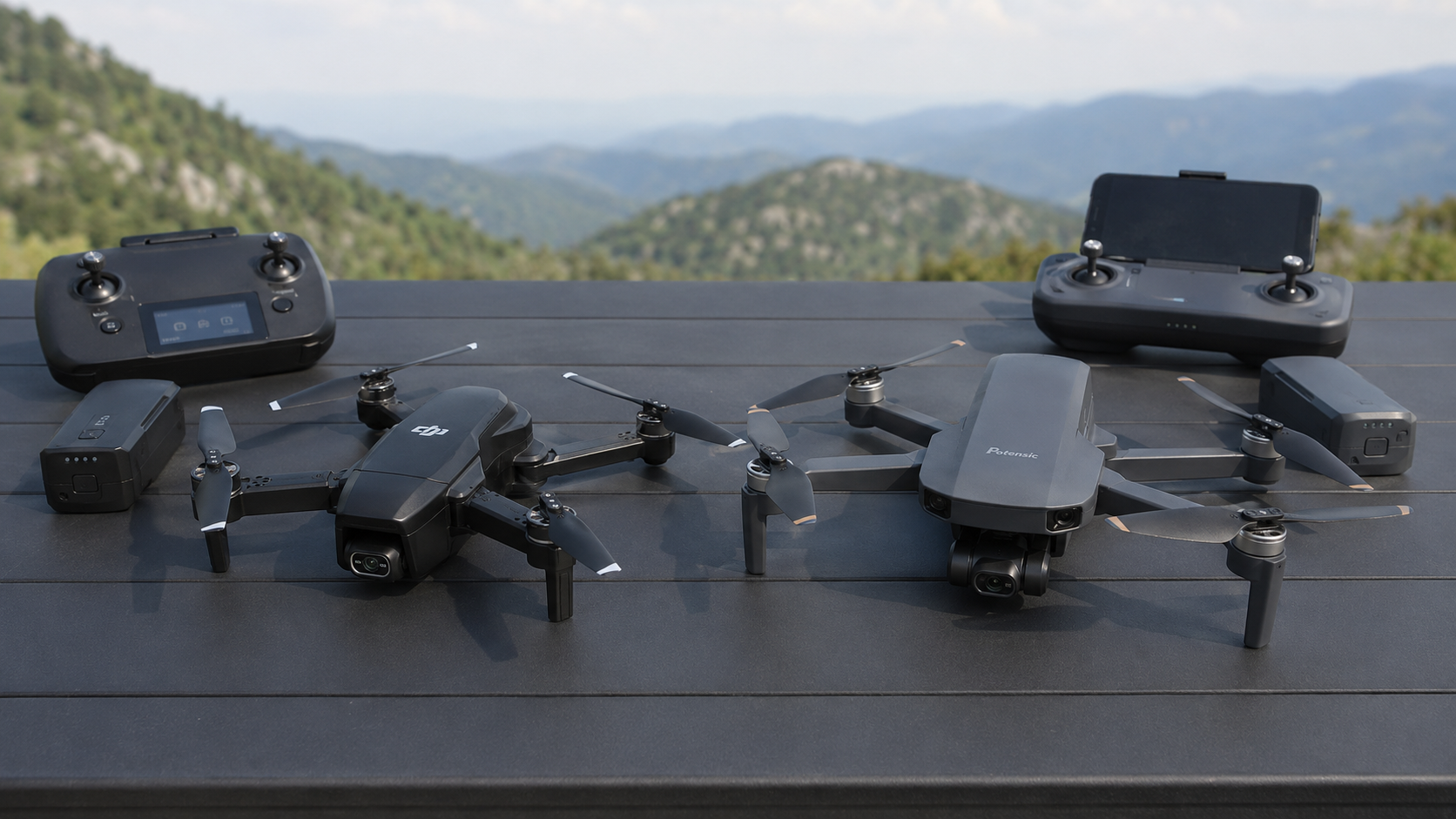
The Potensic ATOM SE is the better budget GPS drone for most buyers. It records 4K video at up to 30 fps with electronic image stabilization, captures DNG RAW photos, carries a 31-minute manufacturer flight-time rating, and is commonly sold in multi-battery kits. Choose the Holy Stone HS360S if its exact package is substantially cheaper or you specifically prefer its controller screen, narrower 85-degree camera view, and creative modes such as Spiral Up, Catapult, and One-Key Ascension. Neither drone has a three-axis gimbal or directional obstacle avoidance, so the ATOM SE is the less compromised camera drone, not a cinematic one.
This Holy Stone HS360S vs Potensic ATOM SE comparison is based on current manufacturer specifications, official support documentation, United States regulator guidance, and attributed hands-on reviews. No original FPV Drone flight test was supplied, so performance and image-quality judgments below are specification-based analysis or clearly attributed reviewer observations.
Quick verdict
Best overall: Potensic ATOM SE
Buy it for 4K/30 fps recording, ShakeVanish EIS, DNG RAW photos, a longer per-battery rating, and stronger flight-performance specifications.
Best low-cost entry: Holy Stone HS360S
Consider it when the verified package costs meaningfully less and you mainly want GPS-assisted flying, casual daylight photos, and easy automated camera moves.
Best creative mode list: HS360S
Its HS Fly app adds Gesture Selfie, Time-Lapse, Tap Fly, Follow Me, Point of Interest, Spiral Up, Catapult, and One-Key Ascension.
Important limitation: both
Neither has a three-axis camera gimbal or forward obstacle avoidance. Use automated modes only in a wide, inspected area with a clear flight path.
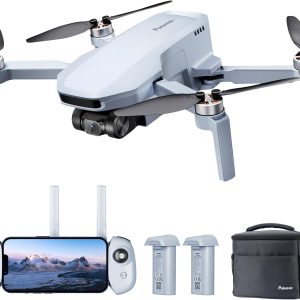
Potensic ATOM SE GPS Camera Drone
Featured gear
Potensic ATOM SE GPS Camera Drone
The Potensic ATOM SE is an under-249 g GPS camera drone with 4K/30 fps EIS video, 12 MP RAW photos, Return to Home, a 4 km manufacturer-rated transmission system, and two batteries rated for…
The Potensic ATOM SE is an under-249 g GPS camera drone with 4K/30 fps EIS video, 12 MP RAW photos, Return to Home, a 4 km manufacturer-rated transmission system, and two batteries rated for up to 31 minutes each.
- Best for
- Best for a beginner or traveler who wants an under-249 g GPS camera drone…
- Skill level
- Beginner
- Product type
- Beginner Drones, Camera Drones, Drones, Under 249g Drones
- Best for
- A beginner or traveler who wants an under-249 g GPS camera drone with 4K…
- Skill level
- Beginner
- Product type
- Foldable GPS Camera Drone
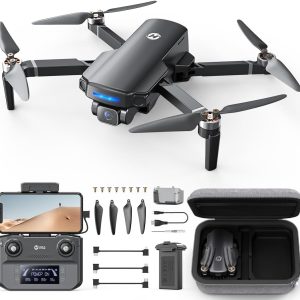
Holy Stone HS360S GPS Camera Drone
Featured gear
Holy Stone HS360S GPS Camera Drone
The Holy Stone HS360S is a 249 g beginner GPS camera drone with brushless motors, Return to Home, HS FLY smart modes, a 3 km manufacturer-rated link, and 4K/20 fps recording to a compatible…
The Holy Stone HS360S is a 249 g beginner GPS camera drone with brushless motors, Return to Home, HS FLY smart modes, a 3 km manufacturer-rated link, and 4K/20 fps recording to a compatible microSD card.
- Best for
- Best for a beginner who wants a low-cost 249 g GPS camera drone with…
- Skill level
- Beginner
- Product type
- Beginner Drones, Camera Drones, Drones, Under 249g Drones
- Best for
- A beginner who wants a low-cost 249 g GPS camera drone with brushless motors,…
- Skill level
- Beginner
- Product type
- Foldable GPS Camera Drone
Holy Stone HS360S vs Potensic ATOM SE differences at a glance
The Holy Stone HS360S and Potensic ATOM SE target nearly the same buyer. Both are folding GPS camera drones in the 249 g class, both use brushless motors, both connect a phone to a conventional controller, and both offer Return to Home plus app-based automated flight modes. The meaningful differences appear in the camera, battery, transmission, speed, controller display, and bundle.
| Decision factor | Holy Stone HS360S | Potensic ATOM SE |
|---|---|---|
| Best reason to buy | Lower-cost GPS entry, controller screen, and broad creative mode list | Better camera specification, longer battery rating, RAW photos, and stronger performance |
| Published weight | 249 g | Under 249 g |
| Camera sensor | 1/3-inch GalaxyCore CMOS | 1/3-inch Sony CMOS, 12 MP |
| Maximum video | 3840 by 2160 at 20 fps to a TF card | 4608 by 2592 at 24, 25, or 30 fps |
| Stabilization | No EIS or mechanical gimbal listed | Single-axis camera tilt with ShakeVanish EIS |
| Lens field of view | 85 degrees | 118 degrees before the EIS crop |
| Photo formats | JPEG | JPEG and DNG RAW |
| Maximum rated flight time | 20 minutes per 1500 mAh battery | 31 minutes per 2500 mAh battery |
| Maximum rated transmission | Up to 3 km outdoors and unobstructed | PixSync 2.0, up to 4 km with 720p live view |
| Maximum published speed | Not stated on the current official specifications page | 16 m/s in Sport mode |
| GPS flight modes | Follow Me, Tap Fly waypoints, Point of Interest, and creative presets | GPS Follow Me, Waypoint Flight, and Circle Flight |
| Obstacle avoidance | No directional obstacle avoidance; optical-flow positioning is listed | No directional obstacle avoidance; downward vision and ToF positioning |
| Controller distinction | Built-in status screen and wired phone connection | Wired phone connection and conventional status display through the app |
| App | HS Fly | PotensicPro |
The key difference: The HS360S is a GPS-equipped entry drone with an unstabilized 4K/20 camera. The ATOM SE gives the buyer more recording headroom and electronic stabilization, plus 11 additional rated minutes per battery. That is enough to make the ATOM SE the stronger all-round purchase unless the price gap is large.
| Compare | Potensic ATOM SE GPS Camera Drone | Holy Stone HS360S GPS Camera Drone |
|---|---|---|
| Product |
Potensic ATOM SE GPS Camera Drone |
Holy Stone HS360S GPS Camera Drone |
| Best for | Best for a beginner or traveler who wants an under-249 g GPS camera drone with 4K EIS video, RAW photos, Return to Home, and two included batteries. The main limitations are single-axis stabilization, GPS-based rather than visual tracking, and no obstacle avoidance. | Best for a beginner who wants a low-cost 249 g GPS camera drone with brushless motors, Return to Home, automated app modes, and a portable kit. Its major limitations are one included battery, 4K recording at 20 fps, no listed EIS or gimbal, and no obstacle avoidance. |
| Skill level | Beginner | Beginner |
| Product type | Beginner Drones, Camera Drones, Drones, Under 249g Drones | Beginner Drones, Camera Drones, Drones, Under 249g Drones |
| Product page | View product | View product |
| Retailer | Check Price | Check Price |
Camera quality and stabilization
The ATOM SE wins the camera category. Both drones advertise 4K, but the label conceals meaningful differences in frame rate, stabilization, still-photo format, and lens behavior.
ATOM SE: 4K/30, EIS, and RAW photos
Potensic lists a 1/3-inch Sony CMOS sensor, 12 MP stills, 4K recording at up to 30 fps, and ShakeVanish electronic image stabilization. The camera can tilt remotely from 20 degrees upward to 90 degrees downward. Photos can be saved as JPEG or DNG RAW, which gives an editor more latitude to adjust exposure, color, and white balance than a processed JPEG alone.
EIS is still a compromise. It crops and shifts the image to reduce visible shake, but it cannot physically keep the camera level as the drone rolls into wind or changes direction. Space.com's hands-on ATOM SE review found good sharpness near the center of the frame but softer edges, visible image noise, and a horizon that could tilt when the aircraft rolled to hold position. Those observations are consistent with the hardware: the camera tilts on one axis, while stabilization for roll and yaw is electronic.
The 118-degree lens captures a wide scene but makes distant subjects look smaller. Treat the result as casual daylight footage with some shake reduction, not as a replacement for a three-axis gimbal.
HS360S: 4K/20 with no listed stabilization
Holy Stone lists a 1/3-inch GalaxyCore CMOS sensor, an 85-degree field of view, remote camera adjustment through 90 degrees, 3840 by 2160 JPEG photos, and 3840 by 2160 video at 20 fps when recording to a compatible TF card. Video saved to the phone is listed at 720p/20 fps, so owners who want the highest available resolution need to install and use the card.
The current HS360S specifications do not list EIS or a mechanical gimbal. Holy Stone separately markets the newer HS360E as the EIS-equipped upgrade, which reinforces the distinction. In a hands-on Space.com review, the HS360S was described as having no image stabilization, heavy image processing, reduced fine detail, and distortion when the camera was tilted down. Its 20 fps maximum at 4K can also make motion look less fluid than 30 fps.
The narrower 85-degree view makes distant scenery appear larger than the ATOM SE's very wide lens. The limitation is motion: without stabilization, gentle inputs and calm air matter much more.
What the camera difference means in practice
Either camera can document a flight in bright conditions, but the ATOM SE produces more editable footage. Its EIS cannot guarantee a level horizon, yet it provides stabilization the HS360S lacks.
Neither is ideal for polished real-estate, cinematic, or low-light work. The site's Potensic ATOM SE vs DJI Mini 4K comparison explains what changes when an entry camera drone adds a three-axis gimbal.
Camera winner: Potensic ATOM SE. Its 4K/30 recording, ShakeVanish EIS, RAW support, and higher-resolution still specification give it the more useful camera package. The HS360S is suitable for casual daylight capture when expectations are modest.
Flight time and bundle value
The ATOM SE has the decisive per-battery advantage. Potensic rates each 2500 mAh battery for up to 31 minutes, while Holy Stone rates the HS360S 1500 mAh battery for up to 20 minutes. The 11-minute difference is 55 percent of the HS360S rating, so this is more than a minor specification gap.
Why the longer ATOM SE rating matters
A new pilot spends part of every battery checking the home point, practicing movements, framing the camera, and returning with a safe reserve. A longer battery leaves more useful time after those fixed tasks. Wind, cold, acceleration, and battery age reduce both advertised maximums.
Bundle names do not guarantee a battery count
Holy Stone documents one-battery and two-battery HS360S kits. Potensic currently displays two-battery and three-battery options while also referencing a one-battery Standard Kit. Marketplace packages can differ again.
Count the batteries in the exact offer. A two-battery HS360S package carries up to 40 minutes of summed manufacturer time, versus up to 62 minutes for two ATOM SE batteries. Every battery swap requires a landing and restart.
| Offer being compared | Rated total across batteries | Buyer implication |
|---|---|---|
| HS360S, one battery | Up to 20 minutes | Lowest entry cost can be attractive, but one outing feels short |
| HS360S, two batteries | Up to 40 minutes | More practical than the base kit, but still below two ATOM SE batteries |
| ATOM SE, two batteries | Up to 62 minutes | Strong balance of practice time and package value |
| ATOM SE, three batteries | Up to 93 minutes | Best for longer outings if the package includes the charging hub you need |
The HS360S battery takes about three hours to charge from the specified 5V/2A input. Holy Stone also states that a fully charged battery left unused for more than three days automatically discharges to roughly 70 to 75 percent for storage protection. That behavior is intentional, but an owner who charges several days early may mistake it for a fault. Top up the battery close to the planned flight and follow the manufacturer's storage guidance.
GPS, Return to Home, and smart modes
Both drones offer meaningful GPS assistance. Each can hold position outdoors, record a home point, return after a control-link interruption or low-battery event, circle a subject, follow a connected phone's location, and fly an app-defined route. The HS360S adds more preset creative moves, while the ATOM SE pairs its simpler mode list with stronger camera and battery hardware.
HS360S has the broader creative menu
Holy Stone lists Gesture Selfie, Time-Lapse, Tap Fly, Follow Me, Point of Interest, Spiral Up, Catapult, and One-Key Ascension. The last three automate reveal or pull-away movements that can be difficult for a new pilot to fly smoothly.
Tap Fly accepts up to 16 points on the app map. Holy Stone warns that the actual path may not align perfectly with the drawn route and specifically tells pilots to avoid people, animals, branches, power lines, glass, and water. That warning matters because the HS360S does not have directional obstacle avoidance.
ATOM SE covers the core GPS tasks
Potensic lists GPS Follow Me, Circle Flight, and Waypoint Flight. Follow Me tracks the connected phone's GPS position rather than recognizing a person through the camera. It is not visual subject tracking and cannot route around a tree or wire. The ATOM SE's EIS can improve footage from these modes, although aircraft roll may still tilt the horizon.
Return to Home is an aid, not obstacle avoidance
GPS Return to Home can recover the drone after a link loss, low battery, or manual command, but it does not make the route safe automatically. Wait for a confirmed home point, set an RTH altitude that clears the tallest nearby obstacle, maintain visual line of sight, and keep enough battery to return against the wind.
Optical-flow, downward-vision, and ToF sensors help estimate movement and height near the ground. They do not provide forward, rear, or side collision avoidance, especially during automated modes.
Smart-mode winner: Holy Stone HS360S for variety, tie for core GPS functions. Both cover Follow Me, routes, orbiting, and Return to Home. Holy Stone adds more one-tap shot patterns, but those modes do not overcome its weaker camera and shorter battery rating.
Compare Current Packages
Match the battery count, carrying case, charging hardware, memory-card requirements, seller, and return policy before comparing the two offers.
Range, wind, and flight performance
Potensic publishes the stronger flight-performance specification set. The ATOM SE is rated for up to 4 km of PixSync 2.0 transmission, 720p live video, a maximum 16 m/s speed in Sport mode, and Level 5 wind resistance up to 38 km/h. Holy Stone rates the HS360S control and image-transmission distance at up to 3 km outdoors without obstructions and promotes brushless motors for light-wind performance, but the current specification page does not state an equivalent maximum speed or formal wind rating.
Manufacturer range is not a practical destination
The published 3 km and 4 km figures are controlled-condition maximums. Trees, terrain, interference, antenna orientation, weather, battery reserve, and regional radio rules can reduce usable distance. A longer rating can add link margin, but it is not permission to fly several kilometers away.
In the United States, recreational pilots generally need to keep the aircraft within visual line of sight and comply with airspace and operating rules. Local requirements vary outside the United States. Plan the flight around the safe return distance, not the number printed on the product page.
ATOM SE has more headroom, but neither is a heavy-wind drone
The ATOM SE's 16 m/s maximum speed offers useful reserve against moderate wind, but a Level 5 claim does not make a 38 km/h forecast sensible. Wind increases with altitude, and a sub-249 g aircraft has limited mass and battery reserve.
The HS360S can be enjoyable in calm conditions and light wind, but its shorter battery rating leaves less room for a slow return. For either model, start by flying into the wind so the return leg benefits from a tailwind, keep the aircraft close, and land early if the ground-speed or battery trend becomes unfavorable.
Both are beginner-friendly only when used conservatively
GPS position hold, brushless motors, multiple speed modes, and Return to Home make both drones easier to manage than a basic toy quadcopter. They do not remove the need to calibrate when instructed, confirm satellite reception, inspect the propellers, understand the app's warnings, and practice manual control in an open area.
The ATOM SE's longer battery and stronger published speed make it the more capable outdoor platform. The HS360S remains approachable, but its appeal is simplicity and price rather than performance reserve.
Apps, controllers, and setup
Both drones use a physical controller and a wired phone connection for the live camera view. That is preferable to controlling a drone only through a touchscreen, and it avoids the extra Wi-Fi pairing step common on cheaper models. The apps are not interchangeable: the HS360S uses HS Fly, while the ATOM SE uses PotensicPro.
HS360S controller and HS Fly
The HS360S controller has a built-in daylight-readable status screen for key flight information, while the connected phone supplies the live video, map, camera settings, and intelligent flight modes. For a new owner, the display is useful because basic status does not depend entirely on the phone screen.
Holy Stone has used several different apps across its catalog, so downloading the app by brand name alone can lead to the wrong software. The site's Holy Stone drone app guide maps the HS360S to HS Fly and explains the connection process. Use the QR code or download link in the current HS360S manual rather than a third-party APK.
ATOM SE controller and PotensicPro
The ATOM SE controller connects to a phone by cable and uses PotensicPro for flight data, camera view, GPS modes, firmware, maps, and settings. Potensic currently requires iOS 13 or later, or Android 7 or later with a 64-bit processor and at least 4 GB of memory.
Check those requirements before buying an ATOM SE for an older or inexpensive Android phone. Also confirm that the package includes the cable matching the phone. Follow Me depends on the connected device's location data, so phone GPS quality and permission settings directly affect that mode.
Storage and preflight details
Holy Stone specifies a Class 10 or faster TF card up to 128 GB, formatted FAT32, for the HS360S. The card is not included in the documented kit. Potensic also records original media to removable storage. Check the current manual for supported cards and format the card in the aircraft or app when instructed.
For either drone, install the official app, charge every battery, update firmware at home, format the card, inspect the propellers, remove the camera cover, confirm the home point, and test RTH nearby.
Which budget GPS drone should you buy?
Buy the Potensic ATOM SE for the best overall value
The ATOM SE is the better default recommendation because its advantages affect every flight. The battery is rated 11 minutes longer, the camera records at a more conventional 30 fps, EIS reduces some visible shake, RAW files provide editing flexibility, and the transmission and speed claims are stronger.
It is the right choice for a buyer who wants to practice GPS drone flying, capture casual travel or landscape footage, and avoid an immediate battery upgrade. A verified two-battery kit is especially compelling. Accept that the EIS camera can still show a tilted horizon and that there is no obstacle avoidance.
Buy the Holy Stone HS360S for the lowest sensible entry cost
The HS360S makes sense when the actual package is substantially cheaper than an ATOM SE package and the main goal is learning, casual photos, or experimenting with automatic flight modes. The controller screen, wired phone connection, GPS and GLONASS positioning, Return to Home, Tap Fly, Spiral Up, Catapult, and One-Key Ascension make it more capable than a basic toy drone.
Do not choose it expecting smooth 4K aerial video. The 20 fps rate and lack of listed stabilization are fundamental limits. A second battery also becomes important quickly because the 20-minute rating includes the entire takeoff-to-landing session.
Skip both if smooth cinematic footage is the priority
The ATOM SE wins this comparison, but neither camera is mechanically stabilized across three axes. If the purpose of the purchase is consistently level scenic video, compare a gimbal-equipped model before checkout. The ATOM SE can be a good budget learning platform; it is not a cheaper version of a full gimbal camera drone.
| Your priority | Recommended drone | Why |
|---|---|---|
| Best camera of these two | Potensic ATOM SE | 4K/30, EIS, and DNG RAW support |
| Longest rated flight per battery | Potensic ATOM SE | 31 minutes versus 20 minutes |
| Lowest initial spend | Holy Stone HS360S, if the verified one-battery offer is clearly cheaper | One-battery configurations can reduce the checkout cost |
| Most preset creative moves | Holy Stone HS360S | Spiral Up, Catapult, One-Key Ascension, gesture capture, and time-lapse |
| RAW photo editing | Potensic ATOM SE | Saves DNG RAW as well as JPEG |
| Controller flight-data screen | Holy Stone HS360S | Built-in daylight-readable status display |
| Smooth gimbal footage | Neither | Neither has a three-axis mechanical gimbal |
| Flying around trees or structures | Neither | No directional obstacle avoidance |
Buying checklist before choosing either drone
Retail listings can combine different battery counts, bags, charging accessories, and seller-added extras. Complete this check before deciding which offer is the better value.
- Count the batteries. Do not assume every HS360S has one battery or every ATOM SE has two. Use the package contents shown by the exact seller.
- Compare total flight sessions. One ATOM SE battery is rated for 31 minutes; one HS360S battery is rated for 20 minutes. Real flights will be shorter.
- Confirm the charging hardware. Check whether the package includes only USB cables or also a multi-battery hub and suitable power adapter.
- Add the correct memory card. Verify capacity, speed class, and file-system requirements in the current manual.
- Check phone compatibility. Confirm operating system, processor, memory, connector, physical size, and free storage before relying on either app.
- Verify the app. HS360S uses HS Fly; ATOM SE uses PotensicPro. Download from the manufacturer link or official app store.
- Inspect the seller and return policy. Manufacturer, authorized retailer, marketplace seller, imported unit, and renewed listing are not equivalent offers.
- Price replacement batteries. A cheaper one-battery kit can cost more overall if you immediately need a second battery.
- Accept the camera limit. ATOM SE uses EIS and single-axis tilt; HS360S lists no stabilization. Neither offers a three-axis gimbal.
- Do not assume obstacle avoidance. Downward positioning sensors do not detect a branch, wall, wire, or person in the flight path.
- Check current flight rules. The FAA says aircraft under 250 g can qualify for a registration exception only when flown under the recreational exception. Part 107 aircraft must be registered regardless of weight, and other operating, airspace, and visual-line-of-sight rules still apply.
Final verdict
The Potensic ATOM SE is the better budget GPS drone for most buyers. Its 4K/30 recording, ShakeVanish EIS, DNG RAW photos, 31-minute battery rating, 4 km transmission claim, and 16 m/s maximum speed give it more useful headroom than the HS360S. A multi-battery ATOM SE package is particularly strong for a beginner who wants enough time to practice and still capture footage.
The Holy Stone HS360S remains worth considering when the exact package is substantially cheaper. Its controller screen and creative modes make it an approachable GPS drone, and its wired phone connection avoids Wi-Fi pairing. Its 20-minute battery rating and unstabilized 4K/20 camera are the tradeoffs.
Buy the ATOM SE for the better all-round aircraft and camera package. Buy the HS360S only when lower entry cost or its specific creative features matter more than stabilized footage and longer flights. If smooth cinematic video is the goal, skip both and move to a three-axis-gimbal drone.
Choose Your Budget GPS Drone
Verify the exact battery count, charging accessories, storage requirements, phone compatibility, seller, and return policy before checkout.
Frequently asked questions
Is the Potensic ATOM SE better than the Holy Stone HS360S?
Yes, for most buyers. The ATOM SE records 4K at up to 30 fps with EIS, captures DNG RAW photos, and has a 31-minute manufacturer flight-time rating. The HS360S is rated for 4K at 20 fps without listed stabilization and up to 20 minutes per battery. The HS360S can still be the better purchase when its exact bundle is substantially cheaper.
Which drone has the better camera?
The Potensic ATOM SE has the better camera specification. It combines 4K/30 recording, ShakeVanish electronic stabilization, 12 MP stills, and JPEG plus DNG RAW capture. The HS360S records 4K at 20 fps, saves JPEG photos, and does not list EIS or a gimbal.
Does either drone have a three-axis gimbal?
No. The ATOM SE has single-axis camera tilt and electronic image stabilization. The HS360S has remote camera tilt but no listed EIS or mechanical gimbal. Buyers who prioritize consistently level, smooth footage should consider a three-axis-gimbal drone.
Can the HS360S and ATOM SE follow you?
Both list a Follow Me function. These budget GPS modes follow the position of the connected phone rather than using advanced visual subject recognition. Use them only in a large, open area because neither drone can detect and avoid obstacles ahead.
Which drone flies longer?
The ATOM SE has the longer manufacturer rating at up to 31 minutes per battery, compared with up to 20 minutes for the HS360S. Battery count also matters. Compare the exact bundle, then expect less than the maximum rating in normal use.
Which drone has better range?
Potensic rates the ATOM SE for up to 4 km of PixSync 2.0 transmission, while Holy Stone rates the HS360S for up to 3 km outdoors without obstructions. These are controlled-condition maximums, not safe or legal target distances. Maintain visual line of sight and follow local rules.
Do either of these drones avoid obstacles?
No. Both have downward positioning technology, but neither has forward, rear, or side obstacle avoidance. The pilot must keep every manual and automated route clear.
Which app does the Holy Stone HS360S use?
The HS360S uses the HS Fly app. Holy Stone uses several apps across its catalog, so install the version linked from the current HS360S manual or official product page rather than choosing an app only by brand name.
Do you need to register these drones in the United States?
Both are marketed in the 249 g class. The FAA says drones weighing less than 250 g are exempt from registration only when flown under the Exception for Limited Recreational Operations. Part 107 aircraft must be registered regardless of weight. Recreational pilots must still complete TRUST and follow current airspace and operating rules.
Sources
- Holy Stone HS360S official product and specifications page: weight, camera, video, range, battery, controller, smart modes, storage, and documented kit contents.
- Holy Stone HS360S official store page: GPS, optical-flow positioning, controller connection, HS Fly app, current feature claims, and channel-dependent offer context.
- Potensic ATOM SE official product and package page: camera, EIS, flight time, transmission, GPS modes, speed, wind claim, positioning sensors, and current package options.
- Potensic official download center: ATOM SE app requirements, manuals, maintenance guidance, and tutorial links.
- Space.com Holy Stone HS360S hands-on review: attributed observations about stabilization, image processing, camera detail, distortion, and 4K/20 footage.
- Space.com Potensic ATOM SE hands-on review: attributed observations about electronic stabilization, horizon behavior, sharpness, image noise, and camera controls.
- FAA drone registration guidance: current United States registration and Remote ID applicability by weight and operating purpose.
Last checked: July 24, 2026.