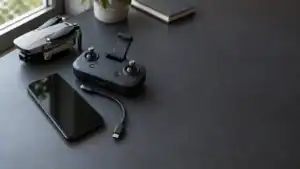
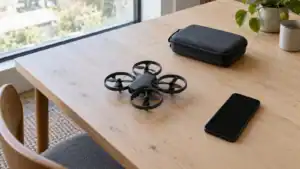
The Holy Stone HS360S is a good first GPS drone for learning outdoor flight controls, practicing Return to Home, and experimenting with automated modes without spending heavily. Its 249 g folding body, wired phone connection, brushless motors, and up-to-3 km manufacturer transmission claim make it more capable than a basic toy drone.
It is much harder to recommend as a camera drone. The HS360S records 4K at only 20 frames per second, offers no electronic or mechanical image stabilization, saves JPEG rather than RAW photos, and carries a short 20-minute maximum flight-time rating. Buy it as an inexpensive GPS flight trainer, not as a bargain cinematic drone.
Review basis: This independent Holy Stone GPS drone review combines current manufacturer specifications, the latest available manual, regulator guidance, and attributed third-party flight tests. It does not claim original FPV Drone hands-on testing.
Quick Verdict
Our verdict: The HS360S is a sensible entry point when the verified package is substantially cheaper than an EIS-equipped or gimbal-equipped alternative and includes enough batteries for useful practice. Its GPS functions and straightforward controller give beginners room to learn, but the unstabilized camera and short battery life impose limits that no “4K” label can overcome.
Best for
First-time pilots who want an affordable, portable GPS trainer for open-field practice and casual daylight photos.
Not ideal for
Buyers expecting smooth 4K video, reliable low-light results, long sessions from one battery, or obstacle avoidance.
Strongest features
GPS Return to Home, wired phone connection, compact 249 g body, controller status display, and varied smart modes.
Biggest limitations
No image stabilization, 4K limited to 20 fps, JPEG-only stills, and a 20-minute maximum battery rating.
Featured Product

Featured gear
Holy Stone HS360S GPS Camera Drone
The Holy Stone HS360S is a 249 g beginner GPS camera drone with brushless motors, Return to Home, HS FLY smart modes, a 3 km manufacturer-rated link, and 4K/20 fps recording to a compatible…
The Holy Stone HS360S is a 249 g beginner GPS camera drone with brushless motors, Return to Home, HS FLY smart modes, a 3 km manufacturer-rated link, and 4K/20 fps recording to a compatible microSD card.
- Best for
- Best for a beginner who wants a low-cost 249 g GPS camera drone with…
- Skill level
- Beginner
- Product type
- Beginner Drones, Camera Drones, Drones, Under 249g Drones
- Best for
- A beginner who wants a low-cost 249 g GPS camera drone with brushless motors,…
- Skill level
- Beginner
- Product type
- Foldable GPS Camera Drone
Holy Stone HS360S Key Specifications
The HS360S specification sheet combines useful flight hardware with a basic camera. The table below separates the headline numbers from the practical effect each one has on the buying decision.
| Specification | Published figure | Why it matters |
|---|---|---|
| Takeoff weight | 249 g with battery and microSD card | Compact and below an important US recreational registration threshold in its stock configuration. |
| Folded size | 141 by 94 by 56 mm | Small enough for a compact case or day bag. |
| Camera | 1/3-inch GalaxyCore CMOS, 85-degree field of view | A relatively narrow view for a budget drone, with automatic point-and-shoot controls. |
| Maximum video | 4K at 20 fps to microSD; 2.7K at 30 fps also available | 4K supplies resolution, but 20 fps motion is less fluid than conventional 30 fps recording. |
| Stabilization | No EIS or mechanical gimbal | Aircraft movement, corrections, and wind can appear directly in the footage. |
| Camera tilt | Remotely adjustable through 90 degrees | Useful for reframing from forward to downward views, but tilt control does not stabilize the image. |
| Photos | 3840 by 2160 JPEG | Suitable for casual daylight use, with no RAW file for deeper editing. |
| Maximum flight time | 20 minutes per 1,500 mAh battery | Short for this category, making a second battery highly desirable. |
| Maximum transmission | Up to 3 km outdoors and unobstructed | Provides useful link margin, but is not a safe or legal target distance. |
| Positioning | GPS, GLONASS, optical flow, barometer, and compass | Supports outdoor position holding, Return to Home, and low-altitude assistance. |
| App | HS Fly | Supplies live view, mapping, camera functions, smart modes, and settings. |
Sources: Holy Stone HS360S product page and manual, supported by published test specifications from Space.com and The Gadgeteer. Maximum flight time and transmission distance depend on conditions, battery state, interference, and regional rules.
The main information gap in a retailer headline is stabilization. “4K” sounds competitive until it is paired with 20 fps recording and no EIS or gimbal. The HS360S has enough flight technology to teach useful skills, but its camera belongs to a lower performance tier than its resolution alone suggests.
Design, Portability, and Controller
A practical folding airframe
The dark gray HS360S uses the familiar folding layout of a compact camera drone. Four brushless motors provide quieter, more durable propulsion than the brushed motors commonly found on toy-class aircraft. At 249 g and only 141 mm long when folded, the aircraft is easy to carry and less intimidating to set up in a large open field.
Published hands-on reviews generally describe the build as good for the price. Space.com called the kit well-built and complete, while also noting that it does not match the finish of more expensive camera drones. That is the right expectation: practical and portable rather than premium.
The wired phone connection is a genuine convenience
The controller holds a smartphone and connects to it with a data cable. The aircraft-to-controller link still uses radio, but the phone does not require a separate Wi-Fi pairing process with the controller. This removes one setup step and can make the live-view workflow feel more dependable than inexpensive drones that rely on a direct phone Wi-Fi connection.
A small controller display keeps basic flight information visible outside the app, while the phone handles the camera view, map, and smart modes. The control sticks can be removed for storage, and packages normally include several short phone cables. Confirm the connector supplied for your specific phone before ordering.
Buyer takeaway: The airframe and controller are stronger reasons to buy the HS360S than its camera. It feels like a real GPS training platform even though its image system remains entry level.
Flight Performance, GPS, and Safety
GPS makes learning less stressful
With a good outdoor satellite lock, the HS360S can hold position when the sticks are centered, record a home point, and use Return to Home. Beginner Mode can limit early flights while a new pilot learns orientation, stick movement, and the difference between flying nose-out and nose-in.
Optical-flow positioning helps near the ground when the downward camera can recognize a well-lit, textured surface. It is less reliable over water, reflective surfaces, repeating patterns, very dark ground, or surfaces without detail. When satellite reception or optical flow is weak, the aircraft may drift more than a beginner expects.
Published tests show useful flight ability, but not perfect hovering
Space.com's test found the HS360S useful for learning and described its overall flight features as reasonably effective. FirstQuadcopter reached a more mixed conclusion, reporting wobble, drift, and altitude changes while hovering. The difference is a reminder that a low-cost GPS drone remains sensitive to wind, calibration, satellite geometry, surface texture, and firmware behavior.
Start in calm weather over a clear field. Wait for the app and controller to confirm the home point, verify the map location, test a short manual hover, and practice a nearby Return to Home before extending the flight. A successful automatic return on one flight does not remove the need to monitor the aircraft on the next.
The 3 km range claim is about link margin
Holy Stone publishes up to 3 km of control and FPV transmission in open, unobstructed conditions. Trees, buildings, terrain, antennas, radio interference, battery reserve, and weather can reduce that distance. A stronger link is useful even at short range because it provides margin, but the advertised maximum should not become a destination.
US recreational pilots must keep the aircraft within visual line of sight, complete the free TRUST safety test, follow airspace restrictions, and give way to other aircraft. The FAA generally exempts a stock drone below 250 g from registration only when it is flown solely under the recreational exception. Part 107 operations require registration regardless of this weight threshold, and accessories can push the takeoff weight above 250 g.
No obstacle avoidance: Optical flow is downward positioning assistance, not forward, rear, or side collision detection. The HS360S cannot see a tree, cable, wall, person, or vehicle in its route.
Camera Quality: What the 4K Label Leaves Out
4K at 20 fps is an awkward headline mode
The HS360S records 3840 by 2160 video at 20 frames per second to a compatible microSD card. That provides more pixels than 1080p, but 20 fps can make motion look less fluid than the 30 fps buyers commonly expect from a camera drone. The available 2.7K/30 mode may look smoother during turns and forward movement even though it records fewer pixels.
Original full-resolution media is recorded to the aircraft's card. Published specifications indicate that the mobile device receives lower-resolution video, so a phone copy should not be used to judge the source file. Use a compatible Class 10 or faster card, confirm the supported capacity and file system in the current manual, and format it as instructed.
No stabilization is the defining limitation
The camera is shock mounted and can tilt remotely, but the HS360S does not have EIS or a stabilizing gimbal. Shock isolation can reduce high-frequency vibration. It cannot keep the horizon level when the aircraft rolls into wind, pitches forward, brakes, or corrects its position.
Space.com's reviewer found the camera extremely basic and pointed to the unstabilized 4K/20 output as a major weakness. FirstQuadcopter likewise recommended skipping it as an entry-level camera drone because of the low frame rate and lack of stabilization. The Gadgeteer found the drone enjoyable for occasional use but identified camera stability as one of the clearest differences from a more expensive DJI model.
| Use case | Expected result | Recommendation |
|---|---|---|
| Daylight still photos | Acceptable for casual sharing when the aircraft is steady | Reasonable use |
| Slow, straight flight in calm air | Usable video with visible aircraft movement | Use 2.7K/30 if smoother motion matters |
| Turns or gusty wind | Tilted horizon and abrupt corrections can appear | Not ideal |
| Low-light scenes | Small sensor and automatic controls leave limited margin | Avoid when image quality matters |
| Polished travel or property footage | No gimbal to isolate the camera from aircraft movement | Choose a gimbal-equipped drone |
| Learning aerial composition | Live view and remote tilt teach framing at low cost | Good training use |
FPV Drone editorial assessment based on the published camera design and attributed flight observations. Results vary with light, wind, pilot inputs, card performance, and processing.
The HS360S can teach where to place a drone and how to frame a scene. It cannot teach a buyer to expect cinematic results from an unstabilized camera. If finished video is the purpose of the purchase, the camera limitation should override the attractive GPS-mode list.
Check the current HS360S package
Compare the battery count, carrying case, charging accessories, phone cables, memory-card requirements, and seller terms before judging the offer.
HS Fly App and Smart Modes
The HS360S uses the HS Fly app for live video, mapping, camera settings, flight configuration, media functions, and automated modes. Holy Stone uses several different apps across its drone catalog, so installing an app based on the brand name alone can lead to the wrong software. The Holy Stone drone app guide maps the HS360S to HS Fly and explains the model-specific connection process.
Follow Me and Tap Fly use location data
Follow Me tracks the location of the connected phone rather than visually recognizing a person through the camera. Tap Fly accepts a route drawn in the app. Point of Interest directs the aircraft around a selected center. These modes can make a first GPS drone more interesting, but they do not provide visual subject recognition or obstacle avoidance.
Phone GPS accuracy, app location permission, satellite reception, map alignment, and the physical flight area all matter. Use these functions only in a wide, inspected space where the entire route is clear and the drone remains visible.
Creative presets are fun, not cinematic guarantees
Holy Stone lists Gesture Shooting, Time-Lapse, Spiral Up, Catapult, and One-Key Ascension alongside the core GPS modes. They automate movements that may be difficult for a new pilot to coordinate manually. The resulting shot still passes through the same unstabilized camera, so an automated path does not guarantee smooth footage.
First-app setup checklist
- Install HS Fly from the current manual or official app-store link.
- Confirm that the supplied data cable matches the phone.
- Allow required location permissions before using Follow Me.
- Complete firmware updates at home with fully charged devices.
- Set conservative distance and altitude limits for early flights.
- Check the home point and Return to Home altitude before takeoff.
- Test automated modes only in an open area with a clear route.
Battery Life, Charging, and Bundle Value
One battery is not enough for most beginners
Holy Stone rates the 1,500 mAh battery for up to 20 minutes. That figure includes the entire takeoff-to-landing session, and a responsible pilot must reserve power for a controlled return and landing. Space.com's reviewer saw roughly 15 minutes in cool spring conditions before automatic Return to Home began.
A beginner also spends part of every battery waiting, checking settings, practicing a hover, and recovering from imperfect framing. With one battery, the useful learning session can end just as the pilot becomes comfortable. A two-battery package provides up to 40 minutes only as the sum of two separate manufacturer ratings, with a landing and battery swap between them.
Charging deserves attention
HS360S battery and controller charging use USB-C ports, but USB-C does not guarantee compatibility with every Power Delivery charger. The Gadgeteer reported that higher-power PD chargers were not recognized by the tested unit and used a conventional lower-power charger instead. Follow the charging input in the current manual and keep the supplied cable rather than assuming a laptop adapter will work.
Charging can take much longer than one flight. If several batteries are included, check whether they charge separately, sequentially, or through a hub. A three-battery listing is not automatically convenient if every pack needs its own long charging window.
Package names and contents vary
Holy Stone has documented one-battery, two-battery, and three-battery HS360S configurations. Depending on the seller and region, a package may also include a carrying case, spare propellers, camera cover, screwdriver, cables, and other accessories. Count the actual items shown in the listing instead of relying on “Standard,” “Combo,” or a promotional image.
Bundle checklist before checkout
- Choose at least two batteries unless the single-battery price is exceptionally low.
- Verify whether a carrying case is included.
- Confirm the charging cables and supported power input.
- Check for USB-C, Lightning, or Micro-USB phone cables as needed.
- Add a compatible microSD card if the package does not include one.
- Compare replacement-battery availability and cost.
- Review the seller, warranty, and return policy.
The HS360S Value Test
The HS360S is good value when it solves a narrow problem: providing an inexpensive step from toy drones into GPS-assisted outdoor flight. Its controller, wired phone workflow, Return to Home, mapping, and automated routes give a beginner meaningful systems to learn.
Its value collapses when the purchase is judged primarily as a camera. The HS360S now sits beside the newer Holy Stone HS360E, which adds EIS, and competitors such as the Potensic ATOM SE, which combines EIS with 4K/30 recording, RAW photos, and a longer battery rating. Gimbal-equipped drones cost more but solve the fundamental horizon and aircraft-movement problem.
| Your priority | Buy or skip? | Reason |
|---|---|---|
| Lowest-cost credible GPS training | Buy at a strong price | Position holding, RTH, physical controls, and mapping create real learning value. |
| Smooth aerial video | Skip | No EIS or gimbal isolates the camera from aircraft movement. |
| Casual daylight photos | Consider buying | JPEG stills can be useful when the aircraft is steady and expectations are modest. |
| Long sessions from one battery | Skip | The 20-minute maximum rating is short, and usable time is lower. |
| Experimenting with automated modes | Consider buying | Follow Me, Tap Fly, Point of Interest, and creative presets provide variety in open spaces. |
| Growing into serious aerial photography | Spend more | JPEG-only stills, automatic controls, and no stabilization leave little imaging headroom. |
| Flying near obstacles | Skip | The aircraft has no directional obstacle avoidance. |
FPV Drone editorial decision framework based on the sourced hardware, battery, camera, and flight-feature limitations above. Compare exact bundles rather than volatile headline prices.
The correct price test is relative, not absolute. Compare the exact HS360S package with the battery count and accessories you need against an HS360E, Potensic ATOM SE, and entry-level gimbal drone. If the step up is modest, the newer or better-stabilized model will usually be the smarter one-time purchase.
Better HS360S Alternatives
Holy Stone HS360E: the newer in-brand option
Holy Stone describes the HS360E as an enhanced HS360S. It adds a 4K EIS camera and a longer published transmission specification while retaining a lightweight GPS platform, brushless motors, Return to Home, Follow Me, waypoints, and circle flight. EIS still is not a three-axis gimbal, but it directly addresses one of the HS360S's largest weaknesses. If the prices are close, the HS360E is the more current Holy Stone choice.
Potensic ATOM SE: a stronger budget flight-and-camera package
The Potensic ATOM SE adds 4K/30 video with EIS, DNG RAW photos, a 31-minute maximum battery rating, and stronger published flight specifications. It still lacks a three-axis gimbal and obstacle avoidance, but it is a more rounded beginner camera drone. Our HS360S versus Potensic ATOM SE comparison shows when the Holy Stone's lower entry cost can still win.
DJI Mini 4K: the better choice for video
The DJI Mini 4K costs more than a heavily discounted HS360S, but its three-axis mechanical gimbal changes the quality of nearly every recorded flight. It also provides 4K/30 recording, GPS Return to Home, QuickShots, and a more established camera-drone ecosystem. The Holy Stone HS360S versus DJI Mini 4K guide separates the low-cost training case from the camera-quality case.
Upgrade priority: Choose EIS before paying for extra theoretical range, and choose a three-axis gimbal before paying for advanced shooting modes. Stabilization improves more of the footage you actually bring home.
Who Should Buy the Holy Stone HS360S?
Buy it if:
- You want an inexpensive first GPS drone for learning in open areas.
- The verified package is substantially cheaper than newer EIS or gimbal models.
- You can get at least two batteries without erasing the price advantage.
- You value Return to Home, mapping, physical controls, and automated routes more than camera quality.
- You mainly want casual daylight photos and practice footage.
- You understand that the 3 km claim is link margin, not a flight target.
Skip it if:
- Smooth, level video is the reason you want a drone.
- You expect 4K/30 recording, EIS, RAW photos, or manual camera control.
- You want a long practice session from one battery.
- You need obstacle avoidance for automated or close-proximity flying.
- The newer HS360E or Potensic ATOM SE costs only a little more.
- You already know that aerial photography will become a serious hobby.
The HS360S can be a low-risk way to find out whether you enjoy flying. That is different from being a long-term camera investment. Buyers who already care about footage quality should skip the intermediate purchase and start with a mechanically stabilized drone.
Final Verdict: A Useful Trainer With a Weak Camera
The Holy Stone HS360S succeeds as a basic GPS flight platform. Its folding 249 g airframe, brushless motors, wired phone connection, controller display, GPS Return to Home, and varied HS Fly modes make it more instructive and reassuring than a toy drone. A well-priced two-battery package can provide genuine beginner value.
The camera prevents a broader recommendation. Unstabilized 4K/20 video, JPEG-only photos, automatic controls, and short usable battery sessions make the HS360S a poor fit for buyers whose main goal is aerial content. Newer EIS models reduce some of that compromise, while a three-axis gimbal changes the result much more substantially.
Bottom line: Buy the HS360S when you want the least expensive credible GPS trainer and accept that the camera is for learning and casual use. If the total package price approaches an HS360E, Potensic ATOM SE, or DJI Mini 4K, choose the newer or better-stabilized drone instead.
See the current Holy Stone HS360S package
Verify the battery count, included case, charging method, phone cable, memory-card requirements, and seller support before ordering.
Frequently Asked Questions
Is the Holy Stone HS360S good for beginners?
Yes, when used as an outdoor GPS training drone. Position holding, Return to Home, Beginner Mode, a physical controller, and a wired phone connection make it approachable. It has no obstacle avoidance, so early flights should stay in a large, clear area.
Does the Holy Stone HS360S have image stabilization?
No. The camera is shock mounted and tilts remotely, but the HS360S does not have electronic image stabilization or a mechanical gimbal. Aircraft roll, pitch, corrections, and wind can appear in the video.
Which app does the Holy Stone HS360S use?
The HS360S uses the HS Fly app. Install it through the current manual, Holy Stone's official app link, or the official device app store because other Holy Stone models use different applications.
How long does an HS360S battery last?
Holy Stone publishes up to 20 minutes per battery under suitable conditions. Real usable time is lower after allowing for wind, temperature, battery condition, takeoff, Return to Home, and a safe landing reserve. A published hands-on test saw about 15 minutes in cool conditions before automatic return began.
Can the Holy Stone HS360S follow you?
It has a GPS-based Follow Me mode that follows the connected phone's location. It does not visually recognize a person through the camera and cannot avoid obstacles along the route.
Does the HS360S have obstacle avoidance?
No. Its optical-flow sensor helps with low-altitude positioning over suitable surfaces. It does not detect obstacles in front of, behind, or beside the aircraft.
Does the HS360S need FAA registration?
For a US pilot flying solely under the recreational exception, the stock 249 g configuration is generally below the FAA registration threshold. All Part 107 drones must be registered, accessories can increase the takeoff weight, and recreational pilots still need TRUST and must follow airspace, visual-line-of-sight, and safety rules.
Is the HS360E better than the HS360S?
The HS360E is the more current camera option because Holy Stone adds electronic image stabilization and a longer published transmission specification. Neither EIS nor extra range replaces a three-axis gimbal, but the HS360E is usually the better choice when its total package price is close to the HS360S.
Sources
- Holy Stone HS360S product page, manufacturer weight, camera, range, and smart-mode information.
- Holy Stone HS360S store page, manufacturer sensor, controller, transmission, portability, and current product-positioning information.
- Holy Stone HS360S user manual, manufacturer operating, setup, app, flight-mode, and safety guidance.
- Holy Stone HS360E store page, manufacturer description of the newer EIS-equipped model.
- Space.com HS360S review, independent design, flight-time, camera, and handling observations.
- FirstQuadcopter HS360S review, independent camera, hovering, range, and charging observations.
- The Gadgeteer HS360S review, independent package, charging, controller, camera, and flight observations.
- FAA recreational flyer guidance, US registration threshold, TRUST, visual-line-of-sight, and operating requirements.
Last checked: July 27, 2026. Product specifications, app requirements, bundles, and operating rules can change. Confirm the current manual, package contents, and local requirements before purchase and flight.