Choose a 6S LiPo battery charger by checking five things: explicit 6S LiPo support, enough output power for your pack capacity and charge rate, balance charging, the right main connector, and an input source that can actually supply the advertised wattage. For most FPV pilots charging 6S packs between 1,050 and 2,200mAh at 1C, roughly 50 to 75 watts per active channel provides useful headroom. Dual independent channels become valuable when you regularly prepare more than one pack.
This is a research-based buying guide built from published charger specifications, battery-manufacturer guidance, and charger safety documentation. It does not represent hands-on testing by FPV Drone.
Quick answer: Do not buy from the largest wattage printed on the box. First calculate the power your own 6S packs require, then compare that requirement with the charger's output on the input source you will actually use. A charger with 200 watts available from a wall outlet can be more useful at home than a smaller field charger advertising a much higher DC maximum that requires a separate high-output power supply.
Good everyday target
6S LiPo balance support, at least 75 watts per channel for common FPV packs, storage mode, and one or two independent channels.
Best convenience feature
Built-in AC power for home charging, with DC input available if you later build a higher-output field setup.
Main specification trap
A charger's DC maximum is not necessarily available from its AC input or from an undersized external power supply.
Featured 6S Charger

Featured gear
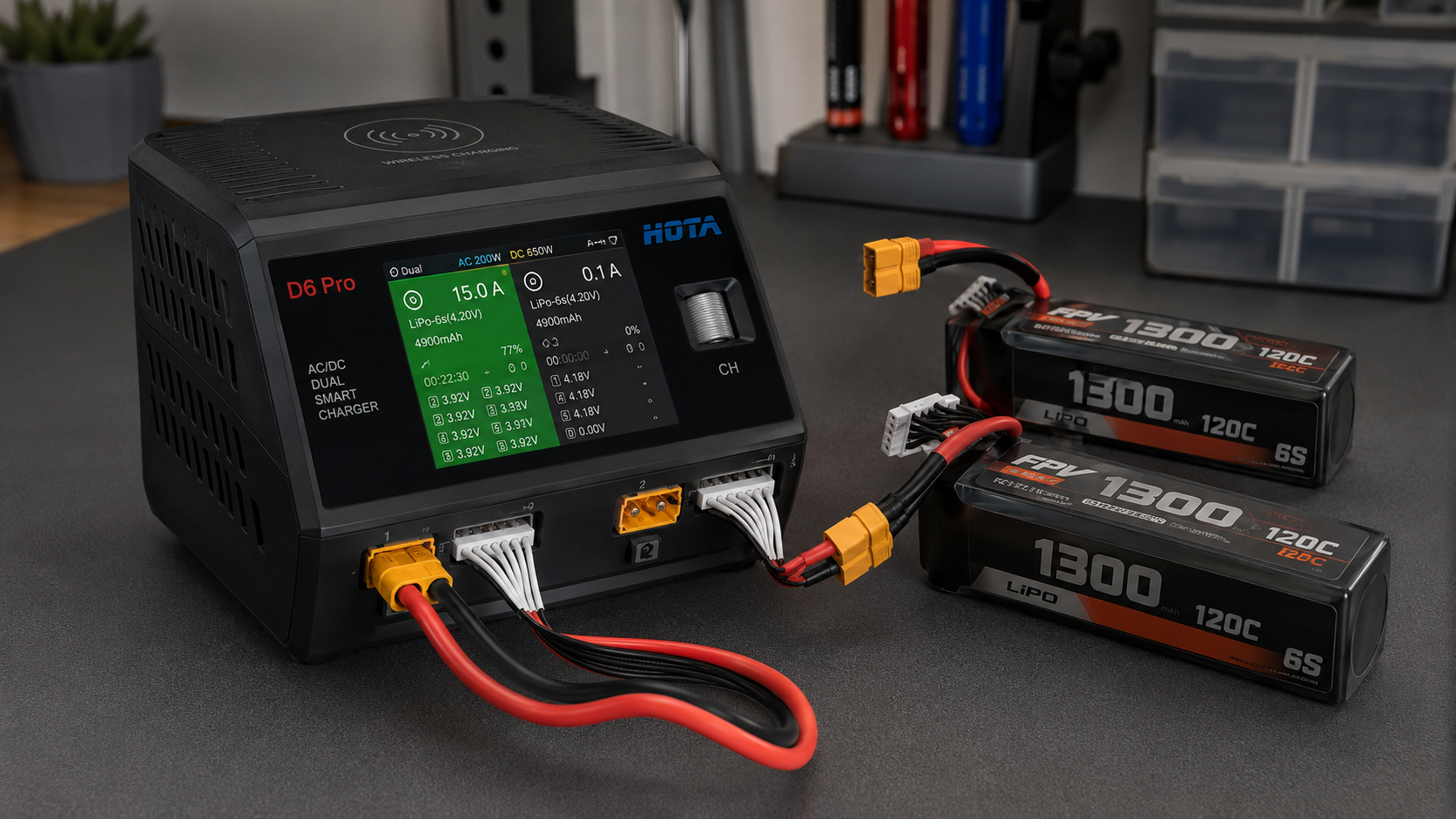
HOTA D6 Pro Dual Battery Charger
The HOTA D6 Pro is a dual-channel AC/DC balance charger for conventional FPV and RC battery packs, with two outputs and support for multiple battery chemistries. Best for: Pilots managing several 2S–6S FPV batteries.…
The HOTA D6 Pro is a dual-channel AC/DC balance charger for conventional FPV and RC battery packs, with two outputs and support for multiple battery chemistries.
- Best for
- A versatile dual-channel AC/DC charger for conventional FPV and RC packs; buyers must verify…
- Product type
- Battery Chargers
- Best for
- A versatile dual-channel AC/DC charger for conventional FPV and RC packs; buyers must verify…
- Product type
- Dual-Channel Balance Charger
What a Good 6S LiPo Charger Must Have
A 6S pack contains six cells in series. Conventional LiPo cells are commonly listed at 3.7 volts nominal, so a 6S LiPo is 22.2 volts nominal and reaches 25.2 volts at 4.2 volts per cell. That higher pack voltage matters because charger power is measured in watts, and watts equal voltage multiplied by current.
The first requirement is simple: the charger must explicitly support 6S LiPo packs. A charger limited to 4S cannot safely become a 6S charger through a cable or adapter. Chemistry matters too. LiPo, LiHV, LiFe, and lithium-ion modes use different voltage targets. Select the mode printed on the pack rather than assuming every six-cell battery uses the same program.
| Feature | What to verify | Why it matters |
|---|---|---|
| Cell support | LiPo charging and balancing through 6S | The charger must measure and manage all six cells. |
| Output power | Enough watts per active channel on your intended input | Current alone does not show whether the charger can sustain your selected rate at 25.2 volts. |
| Balance function | A compatible 6S balance port and balance-charge mode | Per-cell monitoring helps prevent one cell from reaching its limit before the others. |
| Main connector | A direct lead or correctly rated adapter for the pack connector | The main lead carries charging current. Physical fit alone does not confirm polarity or current capacity. |
| Channel count | One channel for occasional use or two independent channels for regular multi-pack charging | Independent channels handle two packs without requiring a parallel board. |
| Input power | Built-in AC, external DC, or both | The input determines convenience, portability, and how much of the charger's rated output is available. |
| Battery care modes | Storage charge, discharge, and cell-voltage display | Storage mode is more useful for routine pack care than a large headline discharge number. |
The practical takeaway is that compatibility comes before speed. A modest charger that correctly supports your chemistry, cell count, connector, and balance lead is a better purchase than a high-output charger that does not fit your actual charging workflow.
How Many Watts Does a 6S Charger Need?
Start with the battery's capacity and permitted charge rate. Battery capacity in milliamp-hours converts to amp-hours by dividing by 1,000. At a 1C charge rate, a 1,300mAh pack charges at 1.3 amps, a 1,500mAh pack at 1.5 amps, and a 2,200mAh pack at 2.2 amps.
Charge-current formula: capacity in amp-hours × selected charge rate in C = charge current in amps.
Approximate charger-output formula: 25.2 volts × charge current = watts required near the top of a conventional 6S LiPo charge.
Use the battery manufacturer's stated maximum charge rate. When the pack or its documentation does not authorize a faster rate, 1C is the conservative default used in the safety guidance from Gens Ace and Tattu. A high discharge C rating printed on the pack is not permission to charge at the same C rate.
| 6S pack capacity | 1C charge current | Calculated output at 25.2V | Practical per-channel target |
|---|---|---|---|
| 1,050mAh | 1.05A | 26.5W | 35W or more |
| 1,300mAh | 1.3A | 32.8W | 45W or more |
| 1,500mAh | 1.5A | 37.8W | 50W or more |
| 1,800mAh | 1.8A | 45.4W | 60W or more |
| 2,200mAh | 2.2A | 55.4W | 75W or more |
| 4,000mAh | 4.0A | 100.8W | 130W or more |
A single common 6S freestyle pack does not require several hundred watts at 1C. The reason to buy more output is usually to charge larger packs, use a manufacturer-approved faster rate, run two channels at once, or preserve room for a future battery collection.
Double the active load, not just the channel count
If two 6S 1,500mAh packs charge simultaneously at 1C, their combined theoretical output requirement near full voltage is about 75.6 watts. Two 2,200mAh packs need about 110.9 watts. A dual charger rated for 200 watts total on AC therefore has ample theoretical capacity for either example at 1C, before accounting for how the charger distributes power between channels.
If you intend to charge two large packs at a manufacturer-approved 2C rate, repeat the calculation using 2C. That may move the requirement beyond the charger's AC capability even when its DC headline rating appears sufficient.
AC Versus DC Charger Power
An AC charger plugs directly into a wall outlet because it contains its own power supply. A DC charger requires an external source such as a suitable bench supply or field battery. Some chargers support both, but the output rating may be very different in each mode.
This is where buyers commonly compare the wrong numbers. The HOTA D6 Pro, for example, is rated at 200 watts total on AC with power distribution and up to 325 watts per channel on DC. The larger DC figure requires a DC source with enough voltage, current, cabling, and connector capacity to support it. Plugging the same charger into AC does not produce 650 watts.
- Choose built-in AC when you want a simple home or workbench setup with no separate power supply.
- Choose DC capability when you need field charging or expect to build a higher-output charging station.
- Choose AC/DC when convenience now and expansion later are both valuable.
- Check total power distribution when both channels will operate simultaneously.
- Check the external source because its output can become the system's real limit.
At 650 watts, a 24-volt DC source would need to deliver more than 27 amps even before conversion losses are considered. That is not a casual power adapter. High-output DC charging requires a properly sized source, leads, connectors, ventilation, and fusing appropriate to the equipment. Pilots who only charge ordinary 6S FPV packs at 1C may never need the charger's maximum DC rating.
Channels, Connectors, and Balance Charging
One channel or two?
A single-channel charger is sufficient if you own only a few packs and can prepare them one at a time. A dual-channel charger becomes worthwhile when you regularly arrive home with several depleted packs or want to charge two different packs independently.
Independent channels are easier to manage than parallel charging. Each channel can monitor its own main lead and balance connector, and the two packs do not have to share one charging program. This does not remove the need to verify every pack's chemistry, cell count, condition, and permitted current before starting.
Parallel charging can increase throughput, but it also combines packs electrically and adds setup requirements. Beginners should not buy a parallel board as a substitute for understanding pack voltage, matching, connector condition, and the charger's total limits. Two independent channels are the more straightforward upgrade for most pilots.
Match both battery connections
A balance charge normally uses the pack's main power connector and its balance connector. Many 6S FPV packs use XT60 main connectors, and the HOTA D6 Pro provides XT60 channel outputs. If your pack uses XT30, a different connector, or a nonstandard lead, verify that the required charging lead is included or obtain a correctly wired and appropriately rated lead.
Never assume an adapter is safe because the connectors physically mate. Check polarity before connecting a pack, keep exposed contacts from shorting, and replace damaged or loose leads. The balance connector is for per-cell monitoring and balancing, not a substitute for the pack's main current connection unless the charger and battery documentation explicitly define a different method.
Balance current and storage mode
Balance current affects how quickly a charger can correct cell differences near the end of a cycle. It does not replace pack inspection or make a damaged pack healthy. The HOTA D6 Pro manual lists up to 1,600mA of balance current per channel and supports balance, storage, charge, and discharge functions for compatible chemistries.
Storage mode is especially useful for an FPV battery collection. If packs will not be flown soon, use the battery and charger manufacturers' storage instructions rather than leaving them fully charged indefinitely. The broader FPV drone battery guide explains cell count, voltage, connectors, storage, and disposal in more detail.
Where the HOTA D6 Pro Fits
The HOTA D6 Pro is a strong match for an FPV pilot who wants one charger for common 1S through 6S lithium packs, two independent channels, and both home and field power options. According to the official HOTA product listing and published manual, it supports LiPo and LiHV packs from 1S through 6S, charges at up to 15 amps per channel, and accepts AC 100 to 240 volts or DC 6.5 to 30 volts.
| Specification | Published value | Buyer implication |
|---|---|---|
| Lithium support | LiPo, LiHV, LiFe, Li-ion, and related modes from 1S to 6S | Supports conventional 6S FPV LiPo packs when the correct chemistry is selected. |
| Channels | Two independent channels | Two packs can be managed separately without a parallel board. |
| AC charging power | 200W total with automatic distribution | Enough for two common 6S FPV packs at 1C in the examples above. |
| DC charging power | Up to 325W per channel, 650W total | Higher output requires a capable external DC source and appropriate wiring. |
| Charge current | 0.1A to 15A per channel | The battery's allowed rate and available wattage usually limit a 6S session before the 15A control range does. |
| Balance current | Up to 1,600mA per channel | Provides meaningful balancing capability for multi-cell packs. |
| Inputs | AC 100 to 240V and DC 6.5 to 30V | Works as a self-contained bench charger and can support a separate DC field setup. |
The D6 Pro is more charger than a pilot with one or two small packs strictly needs. Its value comes from workflow: built-in AC power, two channels, storage functions, and room to support larger or faster charging later. The separate HOTA D6 Pro charger review covers its broader buyer fit, limitations, and ownership considerations.
Check the complete charger setup before buying.
Confirm the included AC cord, the output leads required by your packs, and whether you plan to use the built-in AC supply or a separate DC source.
When a different charger makes more sense
A smaller single-channel charger can be a better value if you charge one pack at a time and do not need field power. A higher-AC-output charger may be more appropriate for large 6S packs or frequent manufacturer-approved fast charging without a separate DC supply.
If nearly all your batteries are tiny-whoop 1S packs with PH2.0 or BT2.0 connectors, a dedicated multi-port unit is usually more convenient. The 1S LiPo charger guide explains why channel count, connector support, and storage capability matter more than 6S power for that use case.
A Safer 6S Charging Workflow
A capable charger cannot compensate for a damaged pack, incorrect settings, reversed polarity, or unattended charging. HOTA's manual tells users to keep the charger away from heat and moisture, provide ventilation, set the battery parameters correctly, keep the charger in sight while operating, and disconnect the battery and input power after use.
- Inspect the pack. Do not charge a pack that is swollen, punctured, crushed, leaking, unusually hot, or has damaged wiring or connectors.
- Let the battery cool. A pack that is still hot after a flight should return to an appropriate temperature before charging.
- Verify the label. Confirm chemistry, cell count, capacity, maximum charge rate, and connector polarity.
- Use the correct program. Select 6S LiPo balance charge for a conventional 6S LiPo. Do not select LiHV unless the pack is explicitly labeled for it.
- Connect correctly. Attach the proper main charging lead and the six-cell balance lead without forcing either connector.
- Check the charger's detection. Stop if the detected cell count, pack voltage, or individual cell readings do not agree with the battery.
- Set an authorized current. Follow the pack manufacturer's documentation. Do not infer charge rate from discharge C rating.
- Charge in a suitable location. Use an open, ventilated area away from combustible materials, and remain present throughout the cycle.
- Review the completed pack. Disconnect it after charging and investigate unusual heat, odor, swelling, voltage drift, or repeated balance problems.
The National Park Service lithium-ion battery fire-prevention guidance reinforces the importance of inspection, supervision, hard charging surfaces, ventilation, and separation from flammable materials. Follow the specific instructions supplied with your battery and charger whenever they are more restrictive.
Final Buying Decision
For common 6S FPV packs, buy enough power for your real charging routine rather than the largest advertised maximum. A pilot charging one 1,300 to 1,800mAh pack at 1C can work comfortably with roughly 45 to 60 watts per channel. A pilot charging two packs should size both channels together and verify the charger's power on AC or on the exact DC source being used.
The HOTA D6 Pro is the practical choice featured here because it combines two independent 6S-capable channels, 200 watts of distributed AC output, higher potential DC output, balance charging, and storage functions. It is best suited to pilots who expect their battery collection or charging workflow to grow. It is unnecessary for someone who only needs a basic single-pack charger, and its full DC rating is irrelevant without a suitably sized external source.
Ready to compare the HOTA D6 Pro?
Verify the current package contents, output leads, and seller before ordering.
Frequently Asked Questions
How many watts are needed to charge a 6S 1,300mAh LiPo?
At 1C, the charge current is 1.3 amps. Multiplying 1.3 amps by the pack's 25.2-volt full-charge voltage gives approximately 32.8 watts of output. A charger offering at least 45 watts on that channel provides reasonable purchasing headroom.
Can a 4S charger charge a 6S LiPo with an adapter?
No. An adapter cannot add cell-monitoring or voltage capability that the charger does not have. The charger must explicitly support 6S LiPo charging and balancing.
Is a dual-channel charger worth buying for FPV?
It is worthwhile when you regularly charge two or more packs. Independent channels let two batteries use separate settings and monitoring. If you fly occasionally and charge one pack at a time, a quality single-channel charger may be sufficient.
Can the HOTA D6 Pro charge 1S batteries too?
Its published lithium support includes 1S through 6S, but tiny-whoop packs often use PH2.0 or BT2.0 connectors and are easier to manage with a dedicated multi-port 1S charger. Confirm the required lead and charging method before connecting a 1S pack to a general-purpose charger.
Sources
- HOTA D6 Pro official product page: manufacturer product identification and current model reference.
- HOTA D6 Pro user manual: supported battery types, input ranges, channel output, balancing, operating guidance, and safety instructions.
- Gens Ace and Tattu LiPo battery guide: cell voltage, capacity conversion, 1C charging guidance, pack inspection, and charging precautions.
- National Park Service lithium-ion battery fire-prevention guidance: charging supervision, inspection, ventilation, and separation from combustible materials.
Last checked: July 27, 2026.