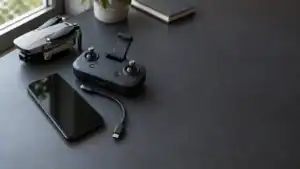
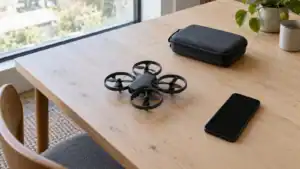
The headline DJI Neo 2 specs include a 151 g aircraft, a 12 MP 1/2-inch camera, a two-axis gimbal, 49 GB of fixed storage, omnidirectional sensing, and up to 19 minutes of flight time. The important qualification is that several capabilities depend on extra hardware. 4K/100 slow motion needs a remote or motion controller, 4:3 recording and stabilization-off capture need goggles, and O4 transmission needs the detachable Digital Transceiver.
This is a research-based technical reference built from DJI's published specifications and support documentation. FPV Drone did not perform original flight or camera testing for this guide. Manufacturer maximums are test-condition figures, not guaranteed field performance.
Quick answer
Neo 2 is best understood as three related systems. The base aircraft supports palm, gesture, automated, and phone-controlled filming. Adding the Digital Transceiver and a compatible remote unlocks O4 control and controller-dependent recording. Adding compatible goggles unlocks the 4:3 camera modes and the option to turn electronic stabilization off for a Gyroflow workflow.
Strongest specifications
Two-axis mechanical stabilization, 4K/60 video, 2.7K vertical capture, 49 GB internal storage, 12 m/s tracking, and omnidirectional sensing.
Main limitations
No microSD slot, no RAW photos, no flat color profile, a short rated battery window, and feature availability that changes with the controller and goggles configuration.
Featured gear

Featured gear
DJI Neo 2 Follow-Me Camera Drone
The DJI Neo 2 is a 151 g follow-me camera drone with palm takeoff and return, gesture control, ActiveTrack, omnidirectional sensing, a two-axis gimbal, 4K/60 fps video, vertical capture, and 49 GB of internal…
The DJI Neo 2 is a 151 g follow-me camera drone with palm takeoff and return, gesture control, ActiveTrack, omnidirectional sensing, a two-axis gimbal, 4K/60 fps video, vertical capture, and 49 GB of internal storage.
- Best for
- Best for beginners and solo creators who want a compact controller-free follow-me drone with…
- Skill level
- Beginner
- Product type
- Beginner Drones, Camera Drones, DJI Drones, DJI flying camera, Drones, Under 249g Drones
- Best for
- Beginners and solo creators who want a compact controller-free follow-me drone with stabilized 4K/60…
- Skill level
- Beginner
- Product type
- Follow-Me Camera Drone
Key DJI Neo 2 Specifications at a Glance
The table below separates the aircraft's core hardware from the conditions attached to DJI's maximum figures. That distinction matters because adding the Digital Transceiver changes the weight and control system, while installing the removable propeller guards reduces DJI's quoted endurance.
| Specification | Published value | What it means in practice |
|---|---|---|
| Takeoff weight | 151 g without Digital Transceiver; 160 g with it | The O4 controller and goggles configuration adds 9 g but remains below 250 g before other additions. |
| Dimensions | 147 × 171 × 41 mm without transceiver; 167 × 171 × 54 mm with it | A case must fit the selected transceiver and guard configuration, not only the bare aircraft. |
| Camera | 12 MP 1/2-inch sensor; 119.8° field of view; 16.5 mm equivalent; f/2.2 | The very wide view suits close-range self-filming, but 12 MP JPEG output is not a high-resolution still-photo workflow. |
| Video | Up to 4K/60 normally; 4K/100 with a compatible remote or motion controller; 2.7K/60 vertical | The largest frame-rate number is not available in every control setup. |
| Stabilization | Two-axis mechanical gimbal for tilt and roll, plus RockSteady | Roll is mechanically stabilized, but this is not a three-axis camera gimbal. |
| Storage | 49 GB internal; no microSD expansion | Capacity is useful for short sessions, but footage must be transferred and managed instead of moving to a larger card. |
| Sensing | Omnidirectional monocular vision, forward LiDAR, and downward infrared sensing | The coverage is much broader than downward positioning alone, but sensing remains condition-dependent. |
| Maximum horizontal speed | 8 m/s Normal; 12 m/s Sport; 12 m/s tracking | The 12 m/s figure is about 26.8 mph. Sensing capability and braking margin do not remain identical across modes. |
| Wind resistance | 10.7 m/s, Level 5 | This is about 23.9 mph and is a resistance rating, not a recommendation to launch in sustained wind at that limit. |
| Maximum flight time | About 19 minutes; about 17 minutes with propeller guards | The test runs to forced landing with a fresh battery. Normal planning needs a reserve and usually produces less usable filming time. |
| Standard transmission | Optimized Wi-Fi; 500 m FCC-rated effective range in an open, unobstructed environment | Phone performance, interference, obstacles, and regional radio limits can reduce the usable link. |
| Optional transmission | O4 through the Digital Transceiver; up to 10 km FCC or 6 km CE, SRRC, and MIC | These are ideal communication ratings. They require compatible hardware and do not override battery, visual-line-of-sight, or local operating limits. |
The central buying point is simple: the base aircraft contains the camera, gimbal, storage, sensing, and phone link, but the maximum recording and transmission capabilities are spread across different control configurations.
Camera Modes: Resolution Is Only Half the Specification
Neo 2 uses a 12 MP 1/2-inch sensor with a fixed-focus f/2.2 ultra-wide lens. It records MP4 video in the Normal color mode at up to 80 Mbps and saves still photos as JPEG. DJI does not list RAW photo capture or a flat video profile, so the camera is designed around fast capture and sharing rather than a deep color-grading workflow.
The following matrix is the most useful way to read the camera specification because it identifies the hardware dependency attached to each mode.
| Recording option | Published format | Control or hardware requirement |
|---|---|---|
| Standard horizontal video | 4K 16:9 at 60, 50, or 30 fps; 1080p 16:9 at 60, 50, or 30 fps | Core recording modes. Availability within individual automated shots can still vary by shooting feature. |
| High-frame-rate horizontal video | 4K or 1080p 16:9 at 100 fps | Requires a compatible remote controller or motion controller. Controller use also requires the Neo 2 Digital Transceiver. |
| Vertical video | 2.7K 9:16 at 60, 50, or 30 fps | Designed for vertical delivery without reducing the maximum output to 1080p. |
| Horizontal 4:3 video | 4K at 3840 × 2880 or 1080p at 1440 × 1080, each at 60, 50, or 30 fps | Only supported while connected to compatible DJI Goggles. |
| Stabilization-off capture | Footage retains motion data for supported Gyroflow processing | The stabilization on/off control is available only with goggles connected. |
| Still photos | 12 MP JPEG at 4000 × 3000 in 4:3 or 4000 × 2250 in 16:9 | No RAW output is listed. Exposure flexibility is more limited than on a conventional photography-focused drone. |
Do not buy from the 4K/100 line alone.
If slow motion is a requirement, verify that the package includes or supports the complete controller path. A Drone Only listing may contain no remote and no Digital Transceiver, even though the aircraft specification sheet advertises 4K/100.
What the Two-Axis Gimbal Does, and What It Does Not Do
The mechanical gimbal stabilizes tilt and roll. Tilt controls the camera's up-and-down angle, while roll helps keep the horizon level when the aircraft banks or is disturbed. DJI lists a controllable tilt range from -90° to 70° and combines the mechanical system with RockSteady electronic stabilization.
Yaw is not the third mechanically stabilized axis. When the aircraft turns left or right, the camera system relies on aircraft movement and electronic processing rather than a three-axis gimbal isolating that motion. This is still a meaningful improvement for a small follow-me drone because roll correction addresses a common source of visibly tilted footage, but it does not turn Neo 2 into a Mini-series camera platform.
For ordinary users, leave RockSteady enabled. The stabilization-off option exists for a more specialized goggles and Gyroflow workflow. It should not be treated as a base-box camera setting because DJI makes the switch available only when compatible goggles are paired.
49 GB Storage: Useful Capacity With No Expansion Slot
The aircraft provides 49 GB of internal storage and does not accept microSD cards. That removes card-speed and compatibility decisions, but it also creates a fixed ceiling. Recording duration varies with resolution, frame rate, scene complexity, and bitrate, so a single “minutes of video” estimate can be misleading.
DJI provides two practical transfer paths:
- QuickTransfer to a phone: DJI lists up to 80 MB/s over Wi-Fi in a low-interference laboratory environment. It recommends keeping the phone and aircraft within 2 m with no obstruction for the best transfer experience.
- USB transfer to a computer: A data cable can be used to browse and copy files without powering the aircraft on.
For ownership, the fixed storage changes the habit rather than the image quality. Transfer important footage after each substantial session, verify the copy, and clear space before the next flight. A full internal drive cannot be solved by inserting another card in the field.
Obstacle Sensing Covers Every Direction, but Not Every Obstacle
DJI describes the system as omnidirectional monocular vision combined with forward-facing LiDAR and a downward infrared sensor. The vision system observes the front, rear, sides, top, and bottom when surfaces have enough visible texture and lighting. Forward LiDAR adds active distance measurement ahead, while the downward infrared system supports height and ground sensing.
In DJI Fly, the operator can set the avoidance response to Brake or Bypass in supported conditions. The official beginner guide also tells users to set Return to Home altitude higher than nearby objects. These settings help manage risk, but they do not make the aircraft collision-proof.
Objects and conditions that deserve extra clearance
- Wires, small branches, fences, and other thin obstacles
- Glass, water, highly reflective surfaces, and low-texture walls
- Poor light, rapidly changing light, fog, rain, or snow
- High speed or a route that leaves little braking distance
- Tracking paths where the subject can lead the aircraft behind an unseen object
DJI states that forward LiDAR is automatically disabled in Sport mode. The vision system also has direction-specific effective-speed limits, with DJI publishing 8 m/s for several horizontal directions and 3 m/s for upward and downward coverage. The practical implication is that the 12 m/s maximum speed and the strongest obstacle-avoidance behavior should not be assumed to occur together.
Use obstacle sensing as a second layer after route selection. For automated tracking, the safer plan is still a clear corridor with generous space around wires, branches, people, vehicles, and water.
Speed, Wind, and Battery Numbers Need Their Test Conditions
Speed and tracking
DJI lists 8 m/s in Normal mode and 12 m/s in Sport mode or tracking status. The 12 m/s tracking figure equals about 26.8 mph, but it is a maximum under controlled conditions, not a promise that Neo 2 will hold every subject at that speed through turns, wind, elevation changes, or clutter.
Wind resistance
The published wind-resistance value is 10.7 m/s, or about 23.9 mph. A lightweight aircraft can consume battery rapidly while fighting wind, and the return leg may face a stronger headwind than the outbound leg. Treat the value as an upper resistance rating. It does not establish a comfortable operating wind or guarantee stable footage at the limit.
Battery and endurance
The 1,606 mAh, 7.16 V battery stores 11.5 Wh. DJI quotes approximately 19 minutes of flight without the Digital Transceiver and approximately 17 minutes with propeller guards under its test method. Maximum hover time is approximately 18 minutes, or 16.5 minutes with the guards.
DJI's flight-time test runs from a full battery until a forced low-battery landing in controlled, windless conditions. A normal flight must preserve time for positioning, Return to Home or manual recovery, landing, and unexpected wind. Recording, tracking, repeated acceleration, cold temperature, guards, and the Digital Transceiver can all reduce usable time.
DJI also lists a 7 km maximum flight distance. That is the total distance traveled in an endurance test, not a 7 km radius and not the same measurement as 500 m Wi-Fi range or 10 km O4 transmission range. Flight distance, control-link distance, and lawful operating distance answer three different questions.
Control and Transmission Choices Change the Product
Neo 2 supports unusually varied control methods, but not every package includes the equipment needed for each method. DJI lists palm and gesture control, DJI Fly phone control, conventional remote control, motion control, and goggles-based flight.
| Control method | Transmission path | Required equipment and key consequences |
|---|---|---|
| Palm, gesture, and onboard modes | Aircraft's local sensing and controls | No conventional remote required. Remove the Digital Transceiver when it is not needed to reduce weight and power demand. |
| DJI Fly phone control | Optimized Wi-Fi | Uses a compatible phone. DJI lists a 500 m FCC-rated open-area operating range, but phone capability and interference matter. |
| Conventional remote | DJI O4 | Requires the Neo 2 Digital Transceiver plus a compatible DJI RC 2, RC-N3, or RC-N2. This path enables precise stick control and controller-dependent camera modes. |
| Motion or FPV control | DJI O4 through goggles | Requires the Digital Transceiver, compatible Goggles 3 or Goggles N3, and a supported RC Motion 3 or DJI FPV Remote Controller 3 configuration. |
| Goggles camera workflow | DJI O4 | Unlocks 4:3 recording and the stabilization on/off control used for offline Gyroflow stabilization. |
Before comparing packages, use the DJI Neo 2 bundle guide to separate Drone Only, Fly More, remote-controller, and Motion configurations. The package name matters because a low-cost listing may omit the Digital Transceiver, remote, goggles, charging hub, or extra batteries needed for the capability you expect.
Check the exact configuration
Confirm the included battery count, Digital Transceiver, controller, goggles, charging equipment, product region, and seller support before comparing offers.
DJI Neo 2 Specification Checklist Before Buying
- Camera workflow: Choose 4K/60 for ordinary high-quality capture. If 4K/100 is essential, budget for a compatible controller path and Digital Transceiver.
- Goggles-only features: Do not assume 4:3 recording or stabilization-off capture is available from the phone or a conventional remote alone.
- Storage: Accept the fixed 49 GB capacity and build a regular phone or computer transfer routine. There is no microSD fallback.
- Sensing: Expect broad coverage, not guaranteed detection of wires, glass, water, thin branches, or low-contrast surfaces.
- Flight time: Plan from a usable reserve, not the 19-minute forced-landing test. Extra batteries matter more than the one-minute advantage suggested by a simple comparison.
- Transmission: Separate Wi-Fi phone range from O4 range. O4 requires the Digital Transceiver and compatible control hardware.
- Bundle contents: Verify every included item in writing. Similar package names can contain very different controllers and battery kits.
- U.S. support: Review the current DJI Neo 2 U.S. availability and warranty guide before treating an imported or third-party listing like an ordinary U.S.-market product.
Final Takeaway: Read Neo 2 as a Configurable System
DJI Neo 2 has a strong specification set for a compact personal filming drone. Its two-axis gimbal, 4K/60 base recording, 2.7K vertical mode, 49 GB of storage, faster tracking, and omnidirectional sensing all improve the everyday self-filming experience.
The feature-dependency matrix is more important than any single maximum. The base aircraft handles controller-free filming, but 4K/100 requires a remote or motion controller, O4 requires the Digital Transceiver, and 4:3 or stabilization-off capture requires compatible goggles. Buy the configuration that unlocks the feature you actually intend to use.
For the broader ownership and buyer-fit decision, see the research-based DJI Neo 2 review. It covers where the camera, tracking, sensing, endurance, and U.S. support tradeoffs make sense as a complete package.
Sources
- DJI Neo 2 official specifications: Manufacturer specifications for aircraft weight, dimensions, flight performance, camera formats, gimbal, sensing, battery, storage, and transmission.
- DJI Neo 2 product support and FAQ: Official feature dependencies, compatible controllers and goggles, QuickTransfer, charging, intelligent modes, and Digital Transceiver guidance.
- DJI's beginner guide to Neo 2: Official setup, obstacle-avoidance settings, control methods, storage, operating time, and first-flight guidance.
- DJI forward-facing LiDAR overview: Official explanation of Sport-mode behavior, obstacle limitations, low-light operation, and Neo 2 LiDAR coverage.
Last checked: August 18, 2026. DJI can change feature availability, controller compatibility, and firmware behavior. Confirm the current specifications and support pages before purchasing equipment for a specific camera or control workflow.