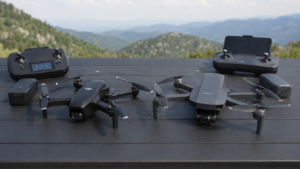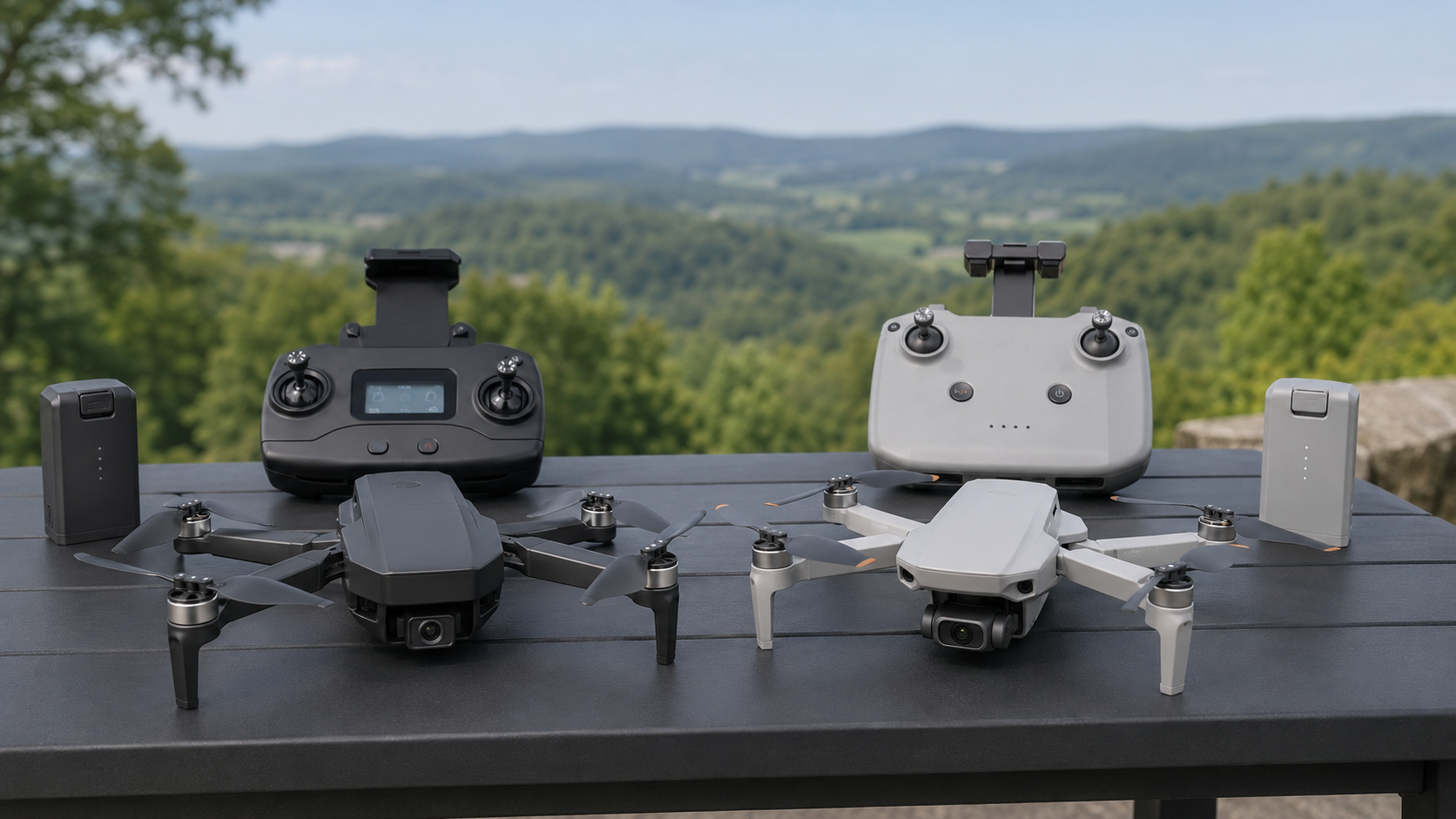
The DJI Mini 4K is the better beginner drone for most buyers. Its three-axis mechanical gimbal, 4K/30 fps video, RAW photos, 31-minute flight-time rating, DJI O2 transmission, and mature support ecosystem justify paying more when the camera is a primary reason for buying. Choose the Holy Stone HS360S when its exact package is substantially cheaper and you care more about learning GPS-assisted flight or trying Follow Me, Tap Fly, Spiral Up, Catapult, and other smart modes than recording consistently smooth video. Both are lightweight folding GPS drones, but only the DJI provides the stabilized camera experience most buyers expect from a modern camera drone.
This Holy Stone vs DJI comparison focuses specifically on the HS360S and DJI Mini 4K. It is based on current manufacturer specifications, official support documentation, regulator guidance, and attributed hands-on reviews. No original FPV Drone flight test was supplied, so performance and camera conclusions below are specification-based analysis or clearly attributed reviewer observations.
Quick verdict
Best overall: DJI Mini 4K
Buy it for smooth three-axis-gimbal footage, 4K/30 recording, RAW photos, longer rated flights, stronger transmission, and the broader DJI ownership ecosystem.
Best low-cost learner: Holy Stone HS360S
Consider it when the verified package is meaningfully cheaper and your priorities are GPS-assisted flying, a controller status screen, and automatic creative modes.
Best smart-mode variety: HS360S
Holy Stone offers Follow Me, Tap Fly waypoints, Point of Interest, Spiral Up, Catapult, One-Key Ascension, Gesture Selfie, and Time-Lapse.
Important limitation: both
Neither drone has forward, rear, or side obstacle avoidance. The pilot must inspect and monitor every manual or automated flight path.
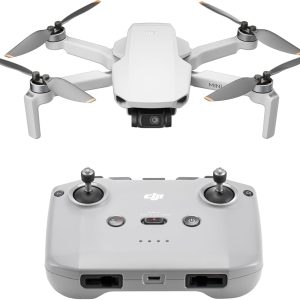
DJI Mini 4K Drone
Featured gear
DJI Mini 4K Drone: Beginner 4K Camera Drone Under 249g
The DJI Mini 4K is an entry-level DJI camera drone built for beginners who want stabilized 4K footage without jumping into the higher-priced Mini models. It weighs under 249 g, supports 4K/30fps video, uses…
The DJI Mini 4K is an entry-level DJI camera drone built for beginners who want stabilized 4K footage without jumping into the higher-priced Mini models. It weighs under 249 g, supports 4K/30fps video, uses a 3-axis gimbal, and includes GPS-assisted flight features like Return to Home.
- Best for
- Best for new pilots who want a lightweight DJI camera drone with stabilized 4K…
- Skill level
- Beginner
- Product type
- Beginner Drones, Camera Drones, DJI Drones, Drones, Under 249g Drones
- Best for
- New pilots who want a lightweight DJI camera drone with stabilized 4K video, GPS-assisted…
- Skill level
- Beginner
- Product type
- Camera Drone
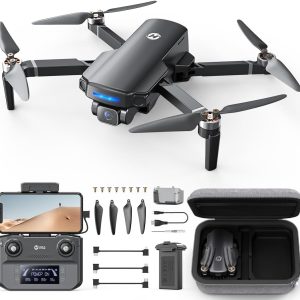
Holy Stone HS360S GPS Camera Drone
Featured gear
Holy Stone HS360S GPS Camera Drone
The Holy Stone HS360S is a 249 g beginner GPS camera drone with brushless motors, Return to Home, HS FLY smart modes, a 3 km manufacturer-rated link, and 4K/20 fps recording to a compatible…
The Holy Stone HS360S is a 249 g beginner GPS camera drone with brushless motors, Return to Home, HS FLY smart modes, a 3 km manufacturer-rated link, and 4K/20 fps recording to a compatible microSD card.
- Best for
- Best for a beginner who wants a low-cost 249 g GPS camera drone with…
- Skill level
- Beginner
- Product type
- Beginner Drones, Camera Drones, Drones, Under 249g Drones
- Best for
- A beginner who wants a low-cost 249 g GPS camera drone with brushless motors,…
- Skill level
- Beginner
- Product type
- Foldable GPS Camera Drone
What “Holy Stone vs DJI” means in this comparison
Holy Stone and DJI each sell several drones at different prices, so no single pair can settle every brand-level question. This article compares two closely matched beginner products: the 249 g Holy Stone HS360S and 246 g DJI Mini 4K. Both are conventional folding GPS camera drones with brushless motors, phone-connected controllers, Return to Home, and sub-250 g portability.
The comparison is commercially useful because the models promise similar beginner outcomes while taking different approaches. Holy Stone concentrates on a lower entry cost and a long menu of app-based flight modes. DJI concentrates on the camera, transmission system, flight-time headroom, documented workflow, and ownership ecosystem. Buyers considering other models can also browse FPV Drone's current Holy Stone coverage and DJI product guides.
Short answer: Holy Stone gives a beginner more automatic features for less money. DJI gives that beginner a much better chance of bringing home smooth, level, editable footage. For a camera drone, the DJI advantage is usually more important.
Holy Stone HS360S vs DJI Mini 4K differences at a glance
The Holy Stone HS360S and DJI Mini 4K are close in size and weight, but the DJI leads in most performance categories. The HS360S counters with a controller display and several automated modes the Mini 4K does not provide.
| Decision factor | Holy Stone HS360S | DJI Mini 4K |
|---|---|---|
| Best reason to buy | Lower-cost GPS learning and broad smart-mode selection | Three-axis stabilization and a stronger camera-drone ecosystem |
| Published takeoff weight | 249 g | 246 g standard aircraft |
| Camera sensor | 1/3-inch GalaxyCore CMOS | 1/2.3-inch CMOS, 12 MP |
| Maximum video | 3840 by 2160 at 20 fps to a TF card | 3840 by 2160 at 24, 25, or 30 fps |
| Maximum video bitrate | Not stated on the current official specifications page | 100 Mbps |
| Stabilization | No EIS or mechanical gimbal listed | Three-axis mechanical gimbal |
| Photo formats | JPEG | JPEG and DNG RAW |
| Maximum rated flight time | 20 minutes per battery | 31 minutes per battery |
| Maximum rated transmission | Up to 3 km outdoors and unobstructed | DJI O2, up to 10 km FCC or 6 km CE |
| Maximum horizontal speed | Not stated on the current official specifications page | 16 m/s in Sport mode |
| Wind resistance rating | No formal rating on the current official specifications page | Level 5, up to 10.7 m/s |
| Automated modes | Follow Me, Tap Fly, Point of Interest, Spiral Up, Catapult, One-Key Ascension, and more | Dronie, Helix, Rocket, Circle, Boomerang, and panoramas |
| Continuous Follow Me | Yes, using phone-position-based GPS following | No ActiveTrack or continuous Follow Me |
| Obstacle avoidance | No directional avoidance; optical-flow positioning is listed | No directional avoidance; downward positioning only |
| App | HS Fly | DJI Fly |
| Compare | DJI Mini 4K Drone: Beginner 4K Camera Drone Under 249g | Holy Stone HS360S GPS Camera Drone |
|---|---|---|
| Product |
DJI Mini 4K Drone: Beginner 4K Camera Drone Under 249g |
Holy Stone HS360S GPS Camera Drone |
| Best for | Best for new pilots who want a lightweight DJI camera drone with stabilized 4K video, GPS-assisted flight, Return to Home, and beginner-friendly controls. Skip it if you want true FPV freestyle, racing, obstacle avoidance, Follow Me, or a higher-end low-light camera. | Best for a beginner who wants a low-cost 249 g GPS camera drone with brushless motors, Return to Home, automated app modes, and a portable kit. Its major limitations are one included battery, 4K recording at 20 fps, no listed EIS or gimbal, and no obstacle avoidance. |
| Skill level | Beginner | Beginner |
| Product type | Beginner Drones, Camera Drones, DJI Drones, Drones, Under 249g Drones | Beginner Drones, Camera Drones, Drones, Under 249g Drones |
| Product page | View product | View product |
| Retailer | Check Price | Check Price |
Camera quality and stabilization
The DJI Mini 4K wins the camera comparison by a wide margin. The reason is not simply that it also says “4K.” Its three-axis gimbal, 30 fps frame rate, higher published bitrate, RAW photo support, larger sensor format, and broader camera controls work together to produce more consistent results.
Why DJI's three-axis gimbal is the deciding feature
A drone must lean to accelerate, brake, turn, and resist wind. The Mini 4K's gimbal mechanically stabilizes tilt, roll, and pan so the camera can remain level while the aircraft moves beneath it. That is what creates the floating aerial look buyers usually expect from travel, landscape, property, and family footage.
DJI publishes 4K recording at up to 30 fps, a 100 Mbps maximum bitrate, 12 MP JPEG and DNG RAW photos, automatic exposure bracketing, interval shooting, three panorama types, manual exposure controls, and digital zoom. The camera is still an entry-level 1/2.3-inch system with a standard color profile, so low light and demanding high-contrast scenes remain limitations. It nevertheless gives a beginner meaningful room to learn both flying and aerial photography.
TechRadar's hands-on Mini 4K review found that the gimbal produced smooth footage outside high wind or abrupt control inputs, especially in Cine mode. The review also rated the Mini 4K as a strong first drone while noting the normal limitations of its small sensor and lack of a flat video profile. The full DJI Mini 4K review explains those tradeoffs in more detail.
HS360S video is limited by motion, not resolution alone
Holy Stone lists a 1/3-inch GalaxyCore sensor, an 85-degree field of view, remote camera adjustment through 90 degrees, 3840 by 2160 JPEG photos, and 4K video at 20 fps when recording to a compatible TF card. Video saved to the phone is listed at 720p/20 fps.
The current HS360S specifications do not list EIS or a mechanical gimbal. Space.com's hands-on review reported no image stabilization, heavy processing that reduced fine detail, distortion with the camera tilted downward, and an unlevel horizon in some conditions. It also reported that 4K/20 footage was less fluid than 30 fps video. Gentle controls and calm air can help, but they cannot reproduce what DJI's mechanical gimbal does.
The HS360S camera is best understood as a documentation and learning camera. It can capture a high-angle view, a quick panorama, or a casual daylight memory. It is not the right purchase for buyers whose satisfaction depends on consistently smooth video.
Camera winner: DJI Mini 4K. The gimbal improves nearly every clip, while RAW photos and a 100 Mbps 4K/30 recording path give owners more useful source files. This is the largest difference between the two drones.
Flight time, range, and wind performance
DJI also has the stronger published flight platform. The Mini 4K is rated for up to 31 minutes per battery, up to 16 m/s in Sport mode, Level 5 wind resistance at 10.7 m/s, and up to 10 km of O2 transmission under FCC conditions. Holy Stone rates the HS360S for up to 20 minutes and 3 km outdoors without obstructions, while its current specification page does not provide a directly comparable maximum speed or formal wind rating.
Eleven rated minutes change a beginner session
A new pilot spends part of every battery waiting for satellites, confirming the home point, practicing takeoff and hovering, learning camera controls, and returning with a safe reserve. The Mini 4K's 31-minute rating leaves more usable time after those fixed tasks than the HS360S's 20-minute rating.
Both ratings are controlled-condition maximums. Wind, temperature, acceleration, recording, battery age, altitude, and a responsible landing reserve reduce real airtime. In Space.com's HS360S test, flights were closer to 15 minutes in cool spring conditions before automatic RTH. That result should not be treated as universal, but it illustrates why a second HS360S battery is important.
O2 provides more transmission headroom
DJI O2 uses 2.4 GHz and 5.8 GHz bands with automatic frequency behavior and a 720p/30 live view. DJI rates the system for up to 10 km under FCC conditions and 6 km under CE, SRRC, or MIC conditions. Holy Stone lists up to 3 km for both control and image transmission when outdoors and unobstructed.
Neither maximum is a recommended flying distance. Buildings, trees, terrain, interference, antenna orientation, regional radio limits, wind, and battery reserve reduce usable range. Maintain visual line of sight and follow local rules. The larger DJI number is valuable as link margin during an ordinary nearby flight, not as an invitation to fly out of sight.
DJI publishes clearer outdoor limits
The Mini 4K's Level 5 rating and 16 m/s maximum speed provide more planning information and additional return headroom. TechRadar reported that it handled a moderate breeze but advised against properly windy conditions. A 246 g aircraft can still be carried away by gusts, and wind often increases with altitude.
Holy Stone promotes the HS360S brushless motors for light-wind performance, but the lack of a formal current wind rating makes conservative decisions more important. For either drone, begin the outbound leg into the wind, stay close on early flights, and land if return speed or battery trend becomes unfavorable.
Flight-platform winner: DJI Mini 4K. The longer battery rating, stronger transmission specification, defined wind rating, and published speed give beginners more useful performance margin.
Smart modes and GPS features
The HS360S wins on mode variety. The DJI Mini 4K wins on how well its gimbal supports automated camera movement. Buyers should separate navigation automation from camera stabilization because a longer mode list does not guarantee better footage.
Holy Stone offers more ways to automate flight
Holy Stone lists Gesture Selfie, Time-Lapse, Tap Fly, Follow Me, Point of Interest, Spiral Up, Catapult, and One-Key Ascension. Tap Fly accepts up to 16 points on the app map. Spiral Up creates an ascending orbit, Catapult pulls away from a subject, and One-Key Ascension creates a vertical reveal.
Follow Me relies primarily on the connected phone's GPS position rather than advanced camera-based recognition. It can be useful for walking in a wide open field, but it does not understand obstacles or guarantee that a person remains perfectly framed. Holy Stone warns that an actual Tap Fly route may not align exactly with the map and tells users to avoid people, animals, branches, wires, glass, and water.
DJI focuses on QuickShots and panoramas
The Mini 4K provides Dronie, Helix, Rocket, Circle, and Boomerang QuickShots, plus Sphere, 180-degree, and Wide-Angle panoramas. QuickShots automate a short move around a selected subject. The three-axis gimbal gives these movements a much stronger visual foundation than an unstabilized camera.
The Mini 4K does not offer ActiveTrack or continuous Follow Me. A QuickShot can keep a selected subject in frame during its predefined maneuver, but it will not follow someone along an open trail. Buyers who specifically want ongoing phone-GPS following or mapped routes have a genuine reason to prefer the HS360S.
Both provide GPS Return to Home
Both drones use satellite positioning to hold position outdoors and return toward the recorded home point after a manual command, low-battery event, or link loss. RTH is a recovery aid, not collision avoidance. Wait for a confirmed home point, set an altitude that clears nearby obstacles, maintain visual contact, and keep enough battery to return against the wind.
Downward and optical-flow positioning sensors help with hovering and landing. They do not detect a branch, wall, wire, vehicle, or person ahead of the aircraft. Automated modes should be used only after inspecting the complete route.
Smart-mode winner: Holy Stone HS360S for variety. It is the better choice for Follow Me, waypoints, and one-tap creative moves. The Mini 4K is better when the goal is a smaller set of automated clips with much smoother footage.
Compare Current Packages
Match the battery count, carrying case, charging hub, memory-card requirements, seller, and return policy before comparing the two offers.
Apps, support, and ownership ecosystem
Both drones use a physical controller connected to a smartphone by cable. Holy Stone uses the HS Fly app, while DJI uses DJI Fly. The ownership difference is not that Holy Stone offers no support. It is that DJI provides a broader documented path from first flight through camera use, accessories, firmware, repair, and a future upgrade.
HS Fly and the HS360S controller
The HS360S controller includes a small daylight-readable screen for key flight status. The phone supplies the live view, map, camera settings, and smart modes. A wired connection avoids the additional Wi-Fi pairing step used by some low-cost drones.
Holy Stone publishes the HS360S manual, app links, battery guidance, product FAQ, tutorials, replacement parts, and support contact routes. That is adequate for a budget product. The complication is that Holy Stone uses different apps across its model range. The Holy Stone drone app guide confirms that the HS360S uses HS Fly and explains how to avoid installing the wrong app.
DJI Fly and the documented DJI workflow
DJI Fly handles activation, linking, firmware, flight limits, RTH settings, camera controls, QuickShots, panoramas, media, and tutorials. DJI's official support page provides specific first-flight, linking, propeller-guard, firmware-update, and QuickShots tutorials, plus manuals, specifications, accessory information, service requests, CHECKLISTS & NOTES, and phone support.
The Mini 4K also sits inside a large installed ecosystem of batteries, charging hubs, propellers, bags, controller accessories, tutorials, forums, editing workflows, and repair information. Compatibility still must be checked by exact model, but there are more documented paths for solving a problem or adding equipment later.
DJI wins support breadth, but app setup still matters
Before buying either drone, confirm that the intended phone fits the controller, uses a supplied cable, and supports the current app. Download DJI Fly or HS Fly only through the manufacturer's official page or the app-store link it provides. Complete activation and firmware updates at home where a stable internet connection is available.
DJI's ecosystem is the stronger long-term choice when the two packages are close in price. Holy Stone remains reasonable when the purchase is deliberately a lower-cost first step and the owner accepts a more limited camera platform.
Bundles, batteries, and total value
The HS360S often looks cheaper at checkout, but bundle names and battery counts vary by channel. Holy Stone's current product page documents a one-battery Standard Kit and a two-battery kit, both with a portable case. DJI's standard Mini 4K package includes one battery, while the official Fly More configuration adds two batteries for three total, a two-way charging hub, shoulder bag, and additional spares. Marketplace sellers may offer other combinations.
Compare equal packages, not only the headline price
One HS360S battery is rated for up to 20 minutes; one Mini 4K battery is rated for up to 31 minutes. Two HS360S batteries therefore carry up to 40 minutes of summed manufacturer time across two flights, while two DJI batteries carry up to 62 minutes. A three-battery DJI Fly More package carries up to 93 minutes across three rated flights.
Those totals are not continuous airtime and real flights will be shorter. They do show why counting batteries alone is incomplete. Battery capacity, per-flight rating, charging hardware, and the reserve needed to land all affect field use.
When the HS360S is the better value
Choose the HS360S when its verified package costs substantially less after matching battery count, case, charging accessories, and storage. It can be an economical way to learn orientation, coordinated turns, GPS hovering, Return to Home, and app-based automation before spending more on a camera platform.
When the Mini 4K is worth the premium
Choose the Mini 4K when the price gap is modest or when you expect to keep the drone after the first learning phase. The extra cost buys a gimbal, longer flight rating, stronger transmission, RAW photos, 100 Mbps 4K/30 video, manual camera settings, better documented wind performance, and the DJI support ecosystem. Those benefits continue to matter after basic piloting becomes familiar.
The site's DJI Mini 4K battery guide explains when one battery is sufficient and when a multi-battery package becomes the better purchase.
Which beginner drone should you buy?
Buy the DJI Mini 4K for photography, video, and long-term ownership
The Mini 4K is the correct choice if the reason you want a drone is to record landscapes, travel, family outings, property, or shareable aerial clips. Mechanical stabilization improves routine turns, braking, wind corrections, and automated shots. The longer battery rating and O2 link also provide more margin while learning.
It is the safer default when package prices are close, when RAW photos matter, when you want to learn manual exposure, or when you expect to buy accessories and seek troubleshooting help later. The DJI Mini 4K setup checklist covers activation, firmware, storage, RTH settings, airspace, and the first controlled flight.
Buy the Holy Stone HS360S for inexpensive learning and smart-mode experimentation
The HS360S makes sense when it is meaningfully cheaper and camera quality is secondary. GPS and GLONASS positioning, optical flow, Return to Home, the controller status screen, Follow Me, Tap Fly, Point of Interest, Spiral Up, and the other creative modes provide plenty to explore.
Accept its limits before buying: the 4K mode runs at 20 fps, stabilization is not listed, photos are JPEG only, and the per-battery rating is 20 minutes. A second battery should be included in the value calculation.
| Your priority | Recommended drone | Why |
|---|---|---|
| Smooth scenic or travel video | DJI Mini 4K | Three-axis gimbal keeps footage and the horizon steadier |
| Lowest sensible entry cost | Holy Stone HS360S, when the exact package is clearly cheaper | Basic GPS learning does not require DJI camera hardware |
| Longest rated flight per battery | DJI Mini 4K | 31 minutes versus 20 minutes |
| Phone-GPS Follow Me | Holy Stone HS360S | Mini 4K does not offer continuous Follow Me |
| Mapped waypoint-style routes | Holy Stone HS360S | Tap Fly supports app-defined points |
| RAW photo editing | DJI Mini 4K | Captures DNG RAW as well as JPEG |
| Broader tutorials, accessories, and support | DJI Mini 4K | Larger documented consumer ecosystem |
| Flying near obstacles | Neither | Neither has directional obstacle avoidance |
Buying checklist before choosing Holy Stone or DJI
- Count the batteries. Do not assume every HS360S has two batteries or every DJI bundle is the full three-battery Fly More configuration.
- Compare rated time per battery. Mini 4K is rated for 31 minutes; HS360S is rated for 20 minutes.
- Confirm the charging hardware. Check for a hub, suitable power adapter, cable count, and whether batteries charge together or sequentially.
- Add a compatible memory card. Neither buying decision is complete without reliable storage for the highest-quality original files.
- Check the camera hardware. Mini 4K has a three-axis gimbal; HS360S does not list EIS or a mechanical gimbal.
- Verify phone and app compatibility. Confirm operating system, connector, physical size, available storage, and the official download source.
- Inspect the seller and return policy. Manufacturer, authorized retailer, marketplace seller, renewed unit, and imported package are not equivalent offers.
- Price replacement parts. Check current availability for batteries, propellers, cables, charging hubs, bags, and service.
- Do not assume obstacle avoidance. Downward positioning does not protect either drone during forward, backward, or sideways flight.
- Check current flight rules. In the United States, aircraft under 250 g can qualify for a registration exception only when flown under the recreational exception. Part 107 aircraft must be registered regardless of weight, and other airspace, TRUST, operating, and visual-line-of-sight rules still apply.
Final verdict
The DJI Mini 4K is the better beginner drone for most people. Its three-axis gimbal is the decisive advantage because it improves almost every video, not just a special mode. The 4K/30 camera, RAW photos, 31-minute battery rating, O2 transmission, documented wind performance, DJI Fly workflow, tutorials, accessories, and support structure make it a more complete camera-drone purchase.
The Holy Stone HS360S is still a rational lower-cost learner. Its controller screen and broad smart-mode list are useful, and Follow Me or Tap Fly may matter more to some buyers than DJI QuickShots. Its 4K/20 camera, lack of listed stabilization, JPEG-only photos, and shorter battery rating are the tradeoffs.
Buy the Mini 4K if you want footage worth keeping and a platform with room to grow. Buy the HS360S if the verified package is substantially cheaper and your main goal is learning GPS flight or experimenting with automatic modes.
Choose Your Beginner Camera Drone
Verify the battery count, charging hardware, storage, phone compatibility, seller, and return policy before checkout.
Frequently asked questions
Is DJI better than Holy Stone for beginners?
DJI is better for most beginners who want a camera drone. The Mini 4K has a three-axis gimbal, longer battery rating, stronger transmission, RAW photos, and a broader support ecosystem. Holy Stone can be better when the budget is tighter and smart-mode variety matters more than smooth video.
Is the HS360S cheaper than the DJI Mini 4K?
The HS360S is generally positioned as the lower-cost option, but prices and bundles change. Compare the exact battery count, case, charging hardware, memory-card requirements, seller, and warranty instead of relying on the headline price.
Which drone has the better camera?
The DJI Mini 4K has the better camera system. It records 4K at up to 30 fps, captures DNG RAW photos, and uses a three-axis mechanical gimbal. The HS360S records 4K at 20 fps to a TF card, saves JPEG photos, and does not list image stabilization.
Can the DJI Mini 4K follow you?
No. The Mini 4K does not offer ActiveTrack or continuous Follow Me. Its QuickShots automate short movements around a selected subject, but they are not the same as ongoing subject tracking.
Can the Holy Stone HS360S follow you?
Yes. The HS360S offers a Follow Me mode that uses the connected phone's GPS position. It is not advanced visual tracking, and the drone cannot detect or avoid obstacles along the route.
Which drone flies longer?
DJI rates the Mini 4K for up to 31 minutes per battery. Holy Stone rates the HS360S for up to 20 minutes. Real flight times will be shorter, so compare bundle battery count and keep a landing reserve.
Which drone has better range?
DJI rates the Mini 4K O2 link for up to 10 km under FCC conditions or 6 km under CE conditions. Holy Stone rates the HS360S for up to 3 km outdoors without obstructions. These are controlled-condition maximums, not safe or legal target distances.
Do either of these drones avoid obstacles?
No. Both use downward positioning technology, but neither has forward, rear, or side obstacle avoidance. The pilot must keep manual, RTH, QuickShot, Follow Me, and waypoint paths clear.
Do the HS360S and Mini 4K require FAA registration?
Both are marketed under 250 g. The FAA says aircraft below 250 g are exempt from registration only when flown under the Exception for Limited Recreational Operations. Part 107 aircraft must be registered regardless of weight. Recreational pilots must still complete TRUST and follow current airspace and operating rules.
Sources
- DJI Mini 4K official specifications: aircraft, camera, gimbal, video, transmission, battery, sensing, storage, and controller specifications.
- DJI Mini 4K and Mini 2 SE official support page: tutorials, camera features, RTH, obstacle-sensing limits, transmission, charging, firmware, accessories, and support routes.
- DJI Fly official download center: current official application source and device-compatibility resources.
- Holy Stone HS360S official product and specifications page: weight, camera, video, range, battery, controller, smart modes, storage, and documented kit contents.
- Holy Stone HS360S official store page: GPS, optical-flow positioning, wired controller connection, HS Fly, and current feature claims.
- TechRadar DJI Mini 4K hands-on review: attributed observations about beginner usability, gimbal performance, wind handling, image quality, and DJI Fly.
- Space.com Holy Stone HS360S hands-on review: attributed observations about flight time, controller design, smart modes, stabilization, processing, and camera limitations.
- FAA drone registration guidance: current United States registration and Remote ID applicability by weight and operating purpose.
Last checked: July 24, 2026.