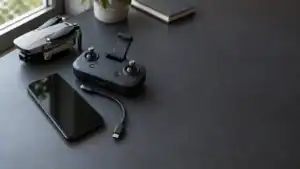
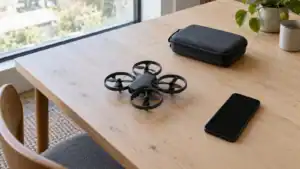
Choose the DJI Mini 4K for conventional aerial photography, a three-axis gimbal, longer flights, stronger wind resistance, and more predictable outdoor control. Choose the DJI Neo for palm launch, automatic subject tracking, close-range self-filming, built-in propeller guards, and the option to fly without a controller.
Neither drone is universally better because they solve different problems. The Mini 4K is a traditional folding camera drone. The original 135 g Neo is a compact flying camera built around people, automated shots, and flexible control methods. This comparison covers the first-generation DJI Neo, not the newer Neo 2.
This DJI Mini 4K vs DJI Neo comparison is a research-based analysis of current DJI specifications, product documentation, and support information. It is not presented as original FPV Drone side-by-side flight testing. Bundle contents, controller compatibility, firmware features, and availability can vary by seller and region.
Quick verdict
The Mini 4K is the better first drone for someone who imagines flying out over scenery and recording smooth aerial footage. The Neo is the better first drone for someone who wants the aircraft to film them while walking, hiking, cycling, or gathering with family. Decide whether the camera should primarily look out at the landscape or back at you.
Choose DJI Mini 4K
Best for landscapes, travel footage, deliberate compositions, longer outdoor flights, RAW photos, stronger wind resistance, and pilots who want a standard stick controller.
Choose DJI Neo
Best for palm-launched clips, automated subject tracking, controller-free use, close-range filming, guarded indoor practice, native vertical 1080p, and optional goggles control.
Verify before buying
Compare the exact battery count, controller, charging equipment, storage needs, app compatibility, seller, warranty region, and total setup cost rather than the aircraft-only headline price.
DJI Mini 4K

Featured gear
DJI Mini 4K Drone: Beginner 4K Camera Drone Under 249g
The DJI Mini 4K is an entry-level DJI camera drone built for beginners who want stabilized 4K footage without jumping into the higher-priced Mini models. It weighs under 249 g, supports 4K/30fps video, uses…
The DJI Mini 4K is an entry-level DJI camera drone built for beginners who want stabilized 4K footage without jumping into the higher-priced Mini models. It weighs under 249 g, supports 4K/30fps video, uses a 3-axis gimbal, and includes GPS-assisted flight features like Return to Home.
- Best for
- Best for new pilots who want a lightweight DJI camera drone with stabilized 4K…
- Skill level
- Beginner
- Product type
- Beginner Drones, Camera Drones, DJI Drones, Drones, Under 249g Drones
- Best for
- New pilots who want a lightweight DJI camera drone with stabilized 4K video, GPS-assisted…
- Skill level
- Beginner
- Product type
- Camera Drone
DJI Neo

Featured gear
DJI Neo Drone
The DJI Neo is a 135 g compact camera drone with palm takeoff, subject tracking, built-in propeller guards, 4K/30fps recording, and controller-free or optional remote and goggles control. Best for: Beginners, travelers, family clips,…
The DJI Neo is a 135 g compact camera drone with palm takeoff, subject tracking, built-in propeller guards, 4K/30fps recording, and controller-free or optional remote and goggles control.
- Best for
- Compact first-generation DJI flying camera for palm launch, subject tracking, short self-filming clips, and…
- Skill level
- Beginner
- Product type
- 135 g selfie drone, Beginner Drones, Camera Drones, DJI Drones, DJI flying camera, Drones,…
- Best for
- Compact first-generation DJI flying camera for palm launch, subject tracking, short self-filming clips, and…
- Skill level
- Beginner
- Product type
- Compact Camera and Selfie Drone
Compare both drones
| Compare | DJI Mini 4K Drone: Beginner 4K Camera Drone Under 249g | DJI Neo Drone |
|---|---|---|
| Product |
View DJI Mini 4K Drone: Beginner 4K Camera Drone Under 249g |
View DJI Neo Drone |
| Best for | Best for new pilots who want a lightweight DJI camera drone with stabilized 4K video, GPS-assisted flight, Return to Home, and beginner-friendly controls. Skip it if you want true FPV freestyle, racing, obstacle avoidance, Follow Me, or a higher-end low-light camera. | Compact first-generation DJI flying camera for palm launch, subject tracking, short self-filming clips, and optional controller or goggles use. Best when discounted enough below the Neo 2 and purchased in the correct bundle. |
| Skill level | Beginner | Beginner |
| Product type | Beginner Drones, Camera Drones, DJI Drones, Drones, Under 249g Drones | 135 g selfie drone, Beginner Drones, Camera Drones, DJI Drones, DJI flying camera, Drones, Under 249g Drones |
| Product page | View product | View product |
| Retailer | Check Price | Check Price |
DJI Mini 4K vs DJI Neo specifications comparison
The headline similarity is 4K/30fps video and a standard takeoff weight below 250 g. Almost everything around that camera is different. Mini 4K prioritizes conventional flight performance and mechanical stabilization. Neo prioritizes portability, subject-centered automation, protected propellers, and several ways to control the aircraft.
| Specification | DJI Mini 4K | DJI Neo | Buyer implication |
|---|---|---|---|
| Takeoff weight | 246 g | Approximately 135 g | Neo is 111 g lighter; both published standard configurations are below 250 g. |
| Design | Folding camera drone with exposed propellers | Compact non-folding flying camera with full-coverage guards | Mini 4K suits open-air aerial work; Neo is easier to deploy close to the subject. |
| Camera sensor | 1/2.3-inch CMOS, 12 MP | 1/2-inch image sensor, 12 MP | Sensor size alone does not decide the winner because stabilization, lens angle, processing, and format support differ. |
| Lens | 24 mm equivalent, f/2.8 | 14 mm equivalent, f/2.8 | Mini 4K has a more conventional aerial view; Neo is much wider for close self-filming. |
| Maximum video | 4K at 24, 25, or 30fps | 4K at 30fps | Both reach 4K/30fps, but their footage is designed for different shooting distances and movement. |
| Vertical video | No native portrait mode | 1080 x 1920 at up to 60fps | Neo is more convenient for direct vertical social output; Mini 4K footage must be cropped and reframed. |
| Photo format | JPEG and DNG RAW | JPEG | Mini 4K gives photographers more editing latitude. |
| Stabilization | Three-axis mechanical gimbal | Single-axis mechanical gimbal plus electronic stabilization | Mini 4K is the stronger platform for conventional smooth aerial compositions. |
| Maximum rated flight time | 31 minutes | Approximately 18 minutes, or 17 minutes with guards | Mini 4K has substantially more rated time per battery. |
| Wind resistance | 10.7 m/s, Level 5 | 8 m/s, Level 4 | Mini 4K has the higher published wind-resistance rating. |
| Maximum conventional speed | 16 m/s in Sport mode | 8 m/s in Sport mode | Mini 4K is faster with its normal controller setup; Neo can reach higher manual-mode speed only with a compatible FPV control setup. |
| Transmission | DJI O2 with RC-N1C | Wi-Fi phone control or DJI O4 with a compatible remote | Neo's range changes dramatically with the control method. |
| Maximum published FCC link rating | 10 km | 10 km with compatible remote; 50 m effective Wi-Fi range | Do not compare Neo's phone control with its optional remote-controller specification. |
| Subject tracking | No general Follow Me or ActiveTrack | Follow and subject-centered automatic modes | Neo is the clear choice for self-filming. |
| Obstacle avoidance | No | No | Neo's guards reduce exposed-propeller risk but do not detect or route around obstacles. |
| Storage | No internal media storage; microSD required | 22 GB internal; no microSD expansion | Mini 4K offers removable capacity; Neo is ready to record but requires regular transfers. |
| Control options | RC-N1C phone controller | Palm, phone, voice, compatible remote, or compatible goggles and motion controls | Neo provides more ways to operate one aircraft. |
Fastest way to decide: Mini 4K is the aerial camera; Neo is the automated personal camera. Their overlapping 4K label matters less than how each aircraft is stabilized, controlled, and positioned around the subject.
Camera quality and stabilization favor different shooting styles
The Neo technically has the slightly larger published sensor: 1/2 inch compared with 1/2.3 inch in the Mini 4K. That does not automatically make it the better camera drone. Mini 4K pairs its sensor with a three-axis mechanical gimbal, DNG RAW photos, a 24 mm equivalent lens, and up to 100 Mbps video. Neo uses a single-axis tilt gimbal, electronic stabilization, a much wider 14 mm equivalent lens, JPEG photos, and up to 75 Mbps video.
Mini 4K is better for deliberate aerial compositions
A three-axis gimbal mechanically corrects tilt, roll, and pan movement. That is especially useful when the aircraft is moving across a landscape, turning in wind, or holding a composed horizon. The narrower 24 mm equivalent view also looks more familiar for scenery, buildings, coastlines, and elevated establishing shots.
Mini 4K records 4K at 24, 25, or 30fps, 2.7K up to 60fps, and Full HD up to 60fps. It also captures JPEG and DNG RAW photographs, automatic exposure brackets, and panoramas. Those options make it the more flexible choice for someone who wants to plan a shot and edit the result afterward. Our DJI Mini 4K specifications guide explains the complete camera and recording modes.
Neo is better when the camera needs to include you
Neo's 14 mm equivalent field of view is dramatically wider. At close range, that makes it easier to keep a person and the surrounding activity inside the frame. RockSteady and HorizonBalancing electronic stabilization then correct the recorded image while the single-axis gimbal manages vertical camera movement.
The tradeoff is that electronic stabilization needs room around the frame to perform its corrections, and it does not provide the same three-axis mechanical foundation as Mini 4K. Neo is optimized for quick social clips and personal-videographer angles rather than slow, carefully framed aerial camera moves.
Vertical video is a Neo advantage, with a resolution limit
Neo records native 1080 x 1920 portrait video at up to 60fps. Mini 4K has no native vertical recording mode, so portrait edits must be cropped from its horizontal footage. A 4K horizontal source gives the Mini 4K editor room to create a vertical crop, but composition must be planned around the narrower final frame.
Neo's vertical mode is more direct, while Mini 4K's crop-based workflow can preserve more editing control. Neither rotates its camera like the DJI Mini 3, and neither records native vertical 4K.
| Output | Better choice | Why |
|---|---|---|
| Scenery and travel landscapes | DJI Mini 4K | Three-axis gimbal, 24 mm equivalent view, RAW photos, and longer flight time support deliberate aerial work. |
| Walking, hiking, or cycling clips featuring the pilot | DJI Neo | Wide lens, subject tracking, palm launch, and automated modes reduce setup friction. |
| Vertical social video | DJI Neo for convenience | Native 1080 x 1920 recording avoids a manual crop, although it is not vertical 4K. |
| Edited still photography | DJI Mini 4K | DNG RAW and exposure bracketing provide more post-processing flexibility. |
| High-resolution slow motion | Neither | Both stop at 4K/30fps; higher frame rates require lower resolution. |
DJI Neo wins for tracking and automatic self-filming
This is the most decisive feature difference. Neo can identify a person for palm-controlled filming and provides Follow, Expanse, Circle, Rocket, Spotlight, and customizable automated modes. Connecting it to DJI Fly adds access to Helix or Boomerang choices. It can launch from a stationary open palm, perform the selected movement, and return for a palm landing.
Mini 4K includes Dronie, Helix, Rocket, Circle, and Boomerang QuickShots. Those are predefined camera movements around a selected subject, not a general Follow Me system. Mini 4K does not list ActiveTrack and should not be purchased with the expectation that it will continuously follow a walking or cycling subject.
Neo's advantage is not merely software. Its wide camera view, guarded propellers, low weight, and controller-free modes are designed around close-range human-subject filming. Mini 4K asks the pilot to control the aircraft with RC-N1C and frame the scene from the controller view.
Tracking still requires a clear route
Neo does not have obstacle avoidance. A follow mode can keep the subject framed without recognizing every branch, cable, wall, sign, vehicle, or person in the route. Tracking should be used in open areas with active supervision, adequate light, and a flight path that has already been checked.
The practical conclusion is simple: if automated self-filming is the reason for buying a drone, choose Neo. If you expect to pilot manually and point the camera toward scenery, tracking should not outweigh Mini 4K's endurance and mechanical gimbal.
Compare Current Prices
Compare complete bundles. Mini 4K normally includes a conventional phone controller, while Neo packages can range from controller-free to remote or goggles configurations.
Flight time, range, wind resistance, and speed
Mini 4K is the stronger conventional outdoor aircraft. DJI rates it for up to 31 minutes, compared with approximately 18 minutes for Neo or approximately 17 minutes with Neo's propeller guards. Both figures come from controlled tests that continue to forced landing or battery depletion, so a prudent real-world flight ends sooner.
The 13-minute difference in published maximums gives Mini 4K more time to travel to a composition, wait for the shot, repeat a movement, and return with reserve. Neo's shorter battery is less limiting when each flight is a quick automated clip near the operator, but it becomes obvious during exploratory outdoor flying.
Mini 4K also carries the higher wind-resistance rating: 10.7 m/s, Level 5, versus 8 m/s, Level 4, for Neo. Neither rating promises stable footage or a safe return in every gust. Wind can be stronger above the launch point, and a small aircraft may spend much more battery returning against a headwind.
Do not compare the 10 km ratings without comparing controllers
Mini 4K uses DJI O2 with the RC-N1C phone controller and has a published maximum of 10 km under FCC conditions in an unobstructed, interference-free environment. Neo can also carry a 10 km FCC rating through DJI O4, but only when paired with a compatible remote controller. DJI rates Neo's direct Wi-Fi phone-control range at 50 m in an open, low-interference environment.
Those communication ratings are not safe flight targets. Battery, return path, terrain, buildings, antenna orientation, interference, local transmission limits, and visual-line-of-sight rules create shorter practical boundaries. Our DJI Mini 4K range guide explains why signal range and responsible flight distance are different numbers.
Mini 4K is faster with its normal controller
DJI lists Mini 4K at up to 16 m/s horizontally in Sport mode. Neo reaches 8 m/s in Sport mode. Neo can reach a higher 16 m/s manual-mode figure with a compatible FPV control configuration, but that is not the same experience, skill requirement, or bundle as its palm, phone, or RC-N3 modes.
For a beginner comparing normal packages, Mini 4K is the faster and more wind-resistant outdoor drone. Neo is the lighter, closer-range personal camera.
Controls and setup: Mini 4K is consistent, Neo is flexible
Mini 4K follows the familiar camera-drone workflow. Install DJI Fly on a compatible phone, connect the phone to RC-N1C, power on the controller and aircraft, wait for positioning and Home Point confirmation, and fly with physical sticks. The process takes more setup than a palm launch, but the controls remain consistent from takeoff through landing.
Neo can remove several of those steps. A user can select a mode on the aircraft and launch from a palm, connect a phone over Wi-Fi for live view and virtual controls, use supported English or Mandarin voice commands, add an RC-N3 for conventional O4 stick control, or use a compatible goggles and motion-control setup for immersive flight.
That flexibility is one of Neo's best features, but it makes the bundle decision more important. A controller-free Neo package should not be evaluated as if it includes RC-N3 range and precision. A motion package should not be evaluated as if it is the simplest low-cost route to palm-controlled clips.
Both depend on DJI Fly
DJI Fly is central to activation, firmware updates, camera settings, maps, transfers, and phone-based control. Verify the current app source and exact phone compatibility before buying. Android users may need to obtain the app directly from DJI rather than a standard app-store listing.
Mini 4K beginners can use our DJI Mini 4K setup checklist to prepare the app, firmware, storage, Return to Home height, airspace check, and first-flight area.
Bundle warning: A Neo aircraft with one battery and no controller is not directly comparable with a Mini 4K package containing RC-N1C. Compare the control method and the items you will actually use before comparing prices.
Obstacle sensing, propeller guards, and indoor use
Neither drone provides directional obstacle avoidance. Both use downward visual positioning to support hovering and landing when the surface and lighting are suitable. That system looks below the aircraft; it does not detect a branch, wire, wall, or person in the flight path.
Neo's full-coverage guards reduce exposed-propeller risk and can make close-range or indoor operation less intimidating. They do not make contact harmless, prevent every crash, or replace route planning. DJI specifically warns that Neo lacks obstacle avoidance and should be flown in an open area or within visual line of sight.
Mini 4K has exposed propellers and more mass, so it is the poorer choice for casual indoor practice. Its strengths appear outdoors where the three-axis gimbal, longer endurance, faster flight, GPS-assisted operation, and higher wind rating can be used in a clear area.
Sub-250 g does not mean rule-free
DJI publishes both aircraft below 250 g in their standard configurations. In the United States, aircraft at or below 250 g can qualify for the recreational registration exception when flown only under the Exception for Limited Recreational Operations. Other operations can still require registration, and an aircraft that is required to be registered or is voluntarily registered must comply with applicable Remote ID requirements.
Every U.S. recreational flyer must pass TRUST and follow current operating and airspace rules. Accessories and configuration can change actual takeoff weight, and requirements vary by country and type of operation.
Batteries, storage, charging, and total ownership cost
Mini 4K uses a 2250 mAh, 17.32 Wh Intelligent Flight Battery and requires a microSD card because it has no internal media storage. Neo uses a smaller 1435 mAh, 10.5 Wh battery and records to 22 GB of internal storage because it does not accept a microSD card.
Removable storage gives Mini 4K more capacity choices and lets a full card be swapped. Neo eliminates the memory-card purchase and is ready to record, but footage must be transferred when its fixed storage fills. DJI Fly supports Neo QuickTransfer, and a data cable can connect the aircraft to a computer without powering it on.
The charging systems behave differently
Mini 4K's compatible charging hub holds up to three batteries and charges them in sequence. Neo's Two-Way Charging Hub can charge up to three batteries simultaneously when paired with sufficient charger power; DJI says more than 45 W allows three at once, while lower power supports fewer simultaneous batteries.
The batteries, hubs, propellers, guards, and cases are model-specific. Do not assume that accessories are interchangeable merely because both products are small DJI drones.
Compare the complete kit, not the cheapest aircraft price
- For Mini 4K, verify the RC-N1C, battery count, microSD card, charging hub, wall charger, spare propellers, and case.
- For Neo, verify the battery count, RC-N3 or goggles package if needed, charging hub, suitable USB Power Delivery charger, spare propellers, and case.
- For either drone, confirm the seller, product condition, warranty region, return period, and current DJI Care eligibility.
One Mini 4K battery offers a much longer published session than one Neo battery, but repeated Neo self-filming clips can still make a multi-battery package worthwhile. The DJI Mini 4K battery guide covers realistic reserve planning and when additional batteries improve the experience.
DJI Mini 4K or DJI Neo by buyer and use case
This decision matrix is more useful than choosing from one headline specification. Start with what you expect the camera to record most often, then check whether the required bundle still fits the budget.
| Buyer priority | Recommended drone | Reason |
|---|---|---|
| Traditional first camera drone | DJI Mini 4K | Physical controller, longer flights, three-axis gimbal, faster Sport mode, and stronger wind rating. |
| Hands-free self-filming | DJI Neo | Palm launch, subject confirmation, Follow mode, wide view, and automated shots. |
| Travel landscapes | DJI Mini 4K | Longer endurance, RAW photos, and conventional stabilized aerial framing. |
| Hiking or cycling clips featuring the user | DJI Neo | Tracking and controller-free operation reduce setup time, provided the route is open. |
| Vertical social clips | DJI Neo | Native 1080 x 1920 recording is more direct than cropping horizontal footage. |
| Photo editing | DJI Mini 4K | DNG RAW, exposure bracketing, and panoramas provide more flexibility. |
| Indoor or very close-range practice | DJI Neo, cautiously | Lower weight and full-coverage guards reduce exposed-propeller risk, but there is still no obstacle avoidance. |
| Windier open-area flying | DJI Mini 4K | Level 5 published wind resistance versus Level 4 for Neo. |
| Controller-free simplicity | DJI Neo | Palm and phone control can work without buying or setting up a standard controller. |
| Immersive goggles option | DJI Neo | Compatible goggles and motion or FPV controls expand how Neo can be flown. |
| One-battery outdoor sessions | DJI Mini 4K | Its 31-minute rating provides considerably more planning margin than Neo's 18-minute rating. |
If you remain undecided, choose Mini 4K when your mental picture of flying involves looking at a controller screen and exploring the landscape. Choose Neo when it involves setting the drone down or holding out a palm, selecting a mode, and becoming the subject of the shot.
Buyers leaning toward the conventional camera-drone path can read our complete DJI Mini 4K review before deciding.
Final verdict: Mini 4K for aerial footage, Neo for self-filming
DJI Mini 4K is the better all-purpose beginner camera drone. Its three-axis gimbal, 31-minute rating, Level 5 wind resistance, 16 m/s Sport mode, RAW photos, removable storage, and standard controller make it the more capable choice for conventional outdoor flying and scenery.
DJI Neo is the better personal flying camera. Its palm launch, automated subject tracking, wide field of view, 135 g body, full-coverage guards, built-in storage, vertical 1080p, and optional phone, remote, or goggles controls make it much easier to place the buyer inside the footage.
Do not choose from the 4K label alone. Choose Mini 4K when flight and camera control matter most. Choose Neo when speed of setup, subject tracking, and self-filming matter most.
Choose Your DJI Drone
Check the exact model, controller, battery count, charging equipment, seller, and warranty region before checkout.
Frequently asked questions
Can the DJI Mini 4K follow you like the DJI Neo?
No. Mini 4K has predefined QuickShots, but DJI does not list a general Follow Me or ActiveTrack feature. The original Neo provides Follow and other subject-centered automatic filming modes.
Can DJI Neo record audio?
Neo can use the connected phone's microphone for audio recording through DJI Fly. The sound is not captured by an onboard drone microphone beside the propellers. Mini 4K does not provide the same phone-microphone self-filming workflow.
Do DJI Mini 4K batteries work in DJI Neo?
No. The aircraft use different battery designs, capacities, charging hubs, and model-specific accessories. Buy batteries and charging equipment listed for the exact drone.
Is either drone a true FPV drone?
Mini 4K is a conventional camera drone and does not provide the Neo's goggles-control path. Neo can work with compatible DJI goggles and motion or FPV controls, but its guarded camera-drone design is still different from a repairable freestyle or racing quad built around manual acro flight.
Which drone is easier for a complete beginner?
Neo is easier for launching a short automated clip without learning standard controller movements. Mini 4K is the more representative starting point for learning conventional GPS camera-drone piloting. The easier choice depends on whether the goal is automated filming or manual outdoor flight.
Sources
- DJI Mini 4K official specifications: aircraft, camera, gimbal, transmission, battery, storage, and controller specifications.
- DJI Neo official specifications: aircraft, camera, gimbal, transmission, battery, storage, sensing, and control specifications.
- DJI Neo official FAQ: palm control, subject modes, obstacle limitations, stabilization, audio, transfers, and charging behavior.
- FAA drone registration guidance: U.S. registration exception and Remote ID implications for aircraft at or below 250 g.
- FAA TRUST guidance: knowledge-test requirement for U.S. recreational flyers.
Last checked: July 14, 2026.