The HOVERAir X1 PRO is one of the strongest choices for runners, cyclists, skiers, hikers and solo creators who want a camera to follow them without stopping to fly a conventional drone. Its combination of palm launch, fast automated tracking, a 192 g folding airframe and 4K/60 video is genuinely useful for action footage.
The buying decision has three important qualifications: obstacle sensing is rear-facing rather than omnidirectional, the aircraft does not use a conventional onboard GPS navigation system, and the Standard package includes only one Smart Battery. HOVERAir's OmniTerrain positioning and optional Beacon add useful outdoor stability and recovery functions, but they do not turn the X1 PRO into a conventional GPS camera drone. Buy it for fast, repeatable self-filming on routes you have chosen deliberately. Do not buy it expecting a miniature autonomous camera that can safely improvise through any environment.
Quick verdict: The X1 PRO earns a recommendation when automated subject tracking is the job, especially for sports and solo filming. Published hands-on tests from TechRadar, Tom's Guide and DC Rainmaker consistently support the strength of its tracking. The tradeoffs are equally clear: rear-only proximity sensing, no conventional onboard GPS navigation, and short single-battery endurance mean route selection and recovery planning still belong to the operator.
Best for
Running, cycling, skiing, hiking, travel clips and solo action footage where you want the camera following you instead of occupying your hands.
Not ideal for
Dense routes with unpredictable branches or wires, long one-battery sessions, traditional aerial photography or buyers who expect full obstacle avoidance.
Main reason to buy
It makes repeatable follow shots unusually quick to capture without requiring a conventional controller for the core automatic modes.
Positioning caveat
The aircraft itself is not a conventional GPS-navigation drone. Outdoors, HOVERAir relies on OmniTerrain, while Beacon-assisted return functions add their own GNSS-dependent requirements.
Main thing to verify
Make sure the Standard package fits your session. One included battery and no bundled Beacon or JoySticks can change the real cost of the setup you actually need.
Featured product
Featured gear
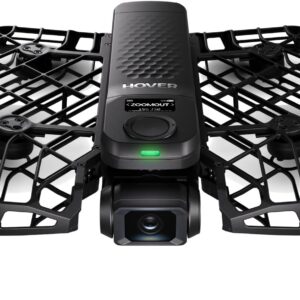
HOVERAir X1 PRO Standard 4K Follow-Me Camera
The HOVERAir X1 PRO Standard is a 192 g self-flying camera with automated subject tracking, horizontal 4K/60 video, vertical 2.7K/60 recording and a protected foldable design for sports and solo filming. Best for: Running,…
The HOVERAir X1 PRO Standard is a 192 g self-flying camera with automated subject tracking, horizontal 4K/60 video, vertical 2.7K/60 recording and a protected foldable design for sports and solo filming.
- Best for
- Choose the X1 PRO Standard for compact, controller-free sports tracking and 4K/60 recording. The…
- Product type
- Camera Drones, Drones, Under 249g Drones
- Best for
- Choose the X1 PRO Standard for compact, controller-free sports tracking and 4K/60 recording. The…
- Product type
- Self-flying follow-me camera
Who Should Buy the HOVERAir X1 PRO?
The X1 PRO makes the most sense when the camera needs to become part of an activity rather than the activity stopping so you can operate a drone. A runner can launch it, start moving and get a follow shot. A cyclist can use activity-specific tracking. A skier can use a system designed around cold-weather and fast-motion scenarios. A traveler can carry a 192 g folding camera instead of a conventional drone, controller and larger equipment case.
That is a fundamentally different buyer from someone shopping for a traditional GPS camera drone. If your priority is landscape photography, long manual flights, waypoint-style control or all-around obstacle sensing, the X1 PRO is not automatically the better tool just because it is compact.
The category position is still current, not just launch-era enthusiasm. In TechRadar's August 2026 best-drone guide, the X1 PRO remains its pick for the best selfie drone, while Tom's Guide continues to include it among the strongest current selfie-drone options. That does not decide our verdict, but it confirms that the product is still competitive in the job it was built to do.
| Decision factor | X1 PRO reality | Buyer implication |
|---|---|---|
| Core job | Automated subject tracking and short self-filming sequences | Strong fit when you want a moving camera operator more than a piloting hobby |
| Weight | 192 g with battery | Easy to carry during sports and below the U.S. 250 g recreational registration threshold when the flight qualifies for that exception |
| Video | Horizontal 4K up to 60 fps; vertical video up to 2.7K/60 | Strong for action clips and social content, but vertical recording is not 4K on the PRO |
| Tracking speed | Manufacturer-rated auto-follow up to 42 km/h or 26 mph under test conditions | Fast enough for many running, cycling and skiing scenarios, but not a promise of reliable lock at maximum speed on every route |
| Obstacle sensing | Rear ToF proximity sensing plus downward positioning sensors | Useful assistance, not omnidirectional protection |
| Navigation / positioning | No conventional onboard GPS navigation; OmniTerrain supports outdoor positioning and Beacon can add return functions | Treat the X1 PRO as a close-range tracking camera with positioning assistance, not a substitute for a GPS camera drone |
| Flight time | Up to 16 minutes under HOVERAir test conditions | One Standard-kit battery is better suited to multiple short clips than a long continuous filming session |
| Standard package | Core package centers on the X1 PRO and one Smart Battery | Beacon, JoySticks, charging hub and extra batteries can materially change the real setup cost |
If you are still deciding whether a sports-focused tracking camera is the right category at all, our Best Follow-Me Drones for Sports guide compares the X1 PRO with other approaches to automated filming.
The Route-Risk Matrix: Where the X1 PRO Makes Sense
The most useful way to evaluate this drone is not by asking whether its tracking is good in isolation. Ask whether the route gives that tracking system enough room to work safely. HOVERAir's current X1 PRO uses rear proximity sensing rather than full omnidirectional obstacle avoidance, so environment matters as much as subject speed.
| Use case | Buyer fit | Why | What to verify first |
|---|---|---|---|
| Running on an open trail or path | Excellent | Low setup friction and strong subject tracking match the job well | Choose a clean path and test subject lock at walking speed before the run |
| Road cycling or wide gravel riding | Excellent | Cycling-focused tracking and higher follow speed are major strengths | Traffic, non-participants, wind and route width |
| Mountain biking on a flowing, visible trail | Good with planning | Published tracking tests show strong path-following behavior | Branches, sudden turns, vegetation intruding into the flight path and places where recovery would be difficult |
| Tight forest singletrack | Conditional | Tracking can be impressive, but rear-only sensing does not make every narrow route safe | Overhanging branches, wires, side obstacles, lighting and escape space |
| Skiing in open terrain | Strong | Ski-specific modes and optional cold-weather battery support target this use case directly | Temperature, terrain, people, visibility and battery choice |
| Travel selfies and hiking clips | Excellent | Palm launch and preset camera moves minimize setup time | Local flight restrictions and enough clearance around the planned shot |
| Traditional cinematic aerial photography | Weak fit | The product is optimized around self-filming and automated tracking rather than long, controller-led camera flights | Consider a conventional camera drone instead |
This is the core of our verdict: the X1 PRO is easiest to recommend when the route is predictable enough that good tracking can do its job without being asked to substitute for full obstacle avoidance.
Tracking Performance Is the Reason to Buy It
HOVERAir designed the X1 PRO around subject filming from the beginning. The aircraft can launch from the palm and run supported automatic modes without a conventional controller. Key modes include Follow, Dolly Track, Orbit, Zoom Out and activity-specific options such as Cycling and Ski modes.
The manufacturer rates maximum auto-follow speed at 42 km/h (26 mph) under controlled conditions and lists an instantaneous tracking-speed figure up to 60 km/h (37 mph). Those are capability ceilings, not route-planning speeds. Wind, subject visibility, lighting, terrain and obstacles can all reduce what is practical.
The more important evidence comes from people who have actually pushed the tracking system. TechRadar's hands-on X1 PRO review reported strong tracking with both slower and faster moving subjects and found cycling tracking effective even without relying on the Beacon. DC Rainmaker's Gauntlet test is particularly useful because it evaluates the drone as a sports-tracking tool through a repeatable obstacle-heavy course rather than only demonstrating a clean follow shot in an open field.
DC Rainmaker also highlights a meaningful difference inside Cycling Mode: a narrow-route option is intended to mirror the rider's path more closely, while the open-route option can smooth the trajectory and use more space. That distinction reinforces the route-first way of thinking about this aircraft. The best mode is partly determined by how much clearance exists around the subject.
Buyer takeaway: The X1 PRO's tracking is not merely a bonus feature attached to a small camera drone. It is the product's core competence, and that is why it makes sense for solo sports filming even when a conventional drone may offer better manual flight or broader sensing.
Obstacle Sensing and Positioning Are the Limits You Need to Understand
The X1 PRO has rear active collision detection using a ToF proximity sensor. Downward vision and ToF sensors support positioning. The more expensive X1 PROMAX adds rear vision sensing on top of proximity sensing, but even the PROMAX is not an omnidirectional-sensing camera drone.
That distinction matters because an automated tracking camera can move in directions you are not actively commanding with sticks. A system that follows beautifully through one section of trail can still encounter a thin branch, wire, side obstacle, poor lighting condition or abrupt environmental change that its active sensing does not cover reliably.
HOVERAir's own flyaway-prevention guidance tells X1 PRO and PROMAX users to verify OmniTerrain outdoors and specifically warns that water can interfere with positioning sensors. The company states that the aircraft is not waterproof and recommends at least 1.5 m of height when flying over water with OmniTerrain enabled.
This does not make the tracking feature unsafe by definition. It means the route has to be part of the safety system. Open roads, visible trails, ski runs and hiking locations with predictable clearance suit the product better than environments where obstacles can intrude from every direction.
No built-in GPS changes what recovery means
Tom's Guide and T3 both identify the lack of built-in GPS as a material X1 PRO limitation. That does not mean the aircraft has no outdoor positioning or return behavior. HOVERAir's current OmniTerrain system can maintain an outdoor position lock, and its support documentation says an X1 PRO or PROMAX with OmniTerrain enabled can automatically return after a prolonged connection loss when the configured conditions are met.
The optional Beacon adds a more explicit Return to Beacon workflow. HOVERAir states that Beacon-assisted return requires OmniTerrain, Hoverlink and an open area with a strong GNSS signal. The practical distinction is important: the X1 PRO's recovery stack is not the same architecture as a conventional camera drone with an onboard GPS navigation system and a familiar GPS Home Point workflow.
Buyer implication: Do not interpret the 500 m app range or 1 km Beacon range as permission to fly until the aircraft becomes a tiny dot. Those numbers describe communication capability under favorable conditions. The X1 PRO is strongest as a close-range tracking camera where you can maintain visual awareness of the aircraft and the route.
For buyers who want automation plus substantially broader obstacle sensing, the DJI Neo 2 specifications guide shows how its sensing, camera, storage and control options differ from the X1 PRO. The X1 PRO still has a strong case when sports tracking, portability and the HOVERAir activity ecosystem are the priority.
The Camera Is Good Enough to Make the Tracking Useful
The X1 PRO uses a 1/2-inch sensor with a 104-degree field of view and records horizontal video up to 4K/60 fps. Slow motion reaches 1080p at 100 or 120 fps. Vertical capture tops out at 2.7K/60 on the PRO, which is worth knowing if vertical social content is the main reason you are buying it.
Stabilization combines a two-axis mechanical gimbal, electronic image stabilization and horizon leveling under HOVERAir's SmoothCapture 2.0 system. That hybrid approach makes sense in a compact tracking camera because the aircraft is constantly making small positional corrections while trying to keep a moving person framed.
Published testing is broadly favorable toward video quality. TechRadar found video stronger than still-photo performance, which fits the product's design priorities. The PRO records JPEG stills rather than the PROMAX model's RAW option, and it does not offer the PROMAX model's higher-resolution and expanded color-workflow capabilities.
| Camera feature | Published capability | What it means in practice |
|---|---|---|
| Horizontal video | Up to 4K/60 fps | Enough resolution and frame-rate flexibility for most sports, travel and social-video workflows |
| Vertical video | Up to 2.7K/60 fps | Useful native vertical capture, but buyers expecting vertical 4K need to look higher in the lineup |
| Slow motion | 1080p at 100 or 120 fps | Useful for jumps, passes and action moments where temporal detail matters more than 4K resolution |
| Stabilization | Two-axis gimbal + EIS + horizon leveling | Appropriate for a small aircraft that is constantly correcting position while tracking |
| Still photos | 12 MP JPEG | Serviceable for casual use, but photography is not the strongest reason to choose the PRO |
The important distinction is that the X1 PRO does not need to beat a conventional camera drone in every imaging category. It needs to make automated follow footage good enough that the convenience is worth the tradeoff. For most action-sports and solo-creator use, 4K/60 plus competent stabilization clears that bar.
Noise is another practical consideration because follow cameras often spend more time close to the person being filmed than a conventional camera drone does. If that matters for your use, our quietest drones comparison looks at sound evidence, noise character and shooting distance rather than relying on unsupported standalone dB claims.
The Standard Bundle Is Where the Value Decision Gets Complicated
The X1 PRO's advertised maximum flight time is 16 minutes, but HOVERAir's current support documentation gives unusually useful context for that number: its test used no wind, steady forward flight at 2 m/s, 1080p/30 recording and a discharge from full battery to 0%. A buyer should not plan a real sports session around 16 usable minutes with no reserve.
The Standard configuration on FPV Drone is the entry path and centers on the aircraft plus one 1,920 mAh Smart Battery. That is enough to use the core controller-free automatic modes. It is not the same ownership experience as a bundle with two batteries, a charging hub, Beacon, JoySticks, a 65W power adapter or sport-specific accessories.
This matters because the X1 PRO is best used in short sequences. A hiking day might involve several quick launches at scenic points. A cyclist may want repeated takes of the same section. A skier may capture several runs. One battery can handle a few clips, but it can also become the reason you stop filming before the activity ends.
HOVERAir currently states that one battery takes about 45 minutes in the optional charging hub and two batteries take about 60 minutes with the supported 65W charging setup. The X1 PRO Smart Battery also includes self-discharge protection, and HOVERAir recommends periodic charging during long-term storage.
Buying the Standard configuration? Check the current package contents before ordering. The aircraft is usable without the optional control accessories, but an extra battery or charging hub can be a more important upgrade than a controller for many sports users.
You Can Start Simple and Add Controls Later
One of the X1 PRO's best design decisions is that its core automatic modes do not require you to carry a conventional controller. Select the supported mode, confirm subject recognition and launch from the palm. The Hover X1 app adds activation, firmware management, camera settings, previews, media transfer and supported manual controls.
The optional Beacon and JoySticks expand the system for buyers who want a dedicated live display, more direct manual intervention and a longer control link. HOVERAir rates transmission at up to 500 m through a phone in large open low-interference environments, while the Beacon can extend the published maximum to 1 km. The company also notes that typical urban phone range can be closer to about 100 m depending on interference and the smartphone.
Those are transmission ratings, not permission to fly beyond visual line of sight or evidence that the battery can safely support a 1 km outbound mission. They also do not erase the aircraft's lack of conventional onboard GPS navigation. Beacon-assisted return has its own OmniTerrain, Hoverlink and GNSS requirements, so range is more useful as control headroom than as a reason to turn the X1 PRO into a long-distance drone.
32 GB is useful, and the microSD slot matters
The PRO includes 32 GB of internal storage. HOVERAir's current media guidance supports microSD cards from 64 GB through 1 TB and calls for exFAT formatting with V30 or V60 speed-class media. That is a meaningful ownership advantage for users who record repeated 4K sessions and do not want to offload the internal memory constantly.
Remote ID support now matters for U.S. commercial users
At 192 g, the X1 PRO falls below the FAA's 250 g registration threshold only when it is flown exclusively under the limited recreational exception. The FAA requires Part 107 aircraft to be registered regardless of weight, and aircraft that require registration generally must comply with Remote ID.
HOVERAir added built-in U.S. Remote ID support for the X1 PRO and PROMAX. Its current instructions specify aircraft firmware v7.9.3 or later and app version v2.33.0 or later to view the Remote ID information. HOVERAir also tells users to verify the specific Remote ID serial range against the FAA Declaration of Compliance database before relying on it for registration.
That is a significant improvement over older X1 PRO reviews that correctly reported the system before built-in U.S. Remote ID support was available. Current buyers should use the latest HOVERAir and FAA documentation rather than assuming a launch-era review still reflects the regulatory setup.
What Has Changed Since the X1 PRO Launched?
This is one of the areas where older X1 PRO reviews can now mislead a current buyer. The hardware has not changed into a fundamentally different aircraft, but HOVERAir has added meaningful software and regulatory features since many launch reviews were published.
| Update | Current status | Why it matters now |
|---|---|---|
| Built-in U.S. Remote ID | Available with compatible X1 PRO firmware and current Hover X1 app versions | Older reviews that said an external Remote ID module was required are outdated for eligible updated aircraft |
| Voice Control | Added for X1 PRO and PROMAX through later firmware and app support | Expands hands-free control for the exact kind of solo filming this product targets |
| Firmware v8.2.7 | Added Smart Ascend, Pilot Assist, CoPilot improvements and additional ski-focused behavior | The tracking and creative-control experience is more developed than it was in launch-period reviews |
| Current market position | Still listed as TechRadar's best selfie-drone pick in August 2026 | The X1 PRO remains a relevant current-category leader even as newer drones have reached the market |
The practical takeaway is not that every owner needs every new feature. It is that a buyer should update the aircraft and app before judging tracking, recovery behavior, Remote ID or control options against an older review. Launch-day limitations and current ownership are no longer identical.
What Should You Buy Instead?
Choose DJI Neo 2 if broader sensing and the DJI ecosystem matter more
The DJI Neo 2 review is the first comparison point for most buyers. Neo 2 is also a compact follow-me camera, but it takes a different approach with broader sensing, DJI's controller and app ecosystem, and a lower-cost path in many configurations. The X1 PRO remains especially compelling for action-sports users who prioritize HOVERAir's tracking behavior, sport-specific modes and compact self-flying workflow.
U.S. buyers comparing the two should also check our DJI Neo 2 U.S. availability and buying-risk guide before treating the purchase decision as a simple feature comparison. Seller support, warranty coverage and current U.S. availability can materially affect the better choice.
Choose X1 PROMAX if the camera is the limiting factor
The X1 PROMAX shares the same broad product concept but upgrades the imaging system. HOVERAir lists a larger 1/1.3-inch sensor, up to 8K video, 4K slow motion, expanded color modes, RAW stills, 64 GB of internal storage and an additional rear vision sensor. That is the model to investigate when the PRO's 4K ceiling, JPEG-only stills or simpler rear sensing are the reasons you are hesitating.
Choose a conventional camera drone if you actually want to pilot
If your normal shot begins with launching a controller, positioning the aircraft manually, composing a landscape and flying for a longer uninterrupted session, you may be shopping in the wrong category. The X1 PRO's advantage is removing piloting work from self-filming, not replacing every capability of a conventional camera drone.
Final Verdict: The X1 PRO Is Excellent When the Route Matches the Drone
The HOVERAir X1 PRO deserves its reputation as one of the better self-flying cameras for active users. The tracking is the real product, not a novelty mode. Independent tests from TechRadar, Tom's Guide and DC Rainmaker support that conclusion, while the 192 g folding design, palm launch and 4K/60 recording make the system easy to carry and quick to use.
The reasons not to buy it are equally clear. Rear proximity sensing is not full obstacle avoidance. The aircraft does not use a conventional onboard GPS navigation system, so OmniTerrain and Beacon-assisted recovery need to be understood on their own terms. A 16-minute controlled-condition flight-time figure does not make one battery a full-day solution, and the Standard configuration can become more expensive once you add the battery, charging and control accessories that your specific activity needs.
For runners, cyclists, skiers, hikers and solo creators who mostly film on routes with predictable clearance, those tradeoffs are reasonable. For buyers who expect a tiny aircraft to autonomously improvise through dense obstacles, or who primarily want traditional aerial photography, they are not.
Our recommendation: buy the X1 PRO when you want a camera crew in your pocket and you are willing to plan the route like a pilot. Skip it when you want obstacle avoidance to do the route planning for you.
Check the current Standard package before ordering so you know whether one battery is enough for your use and which optional accessories would actually improve your filming workflow.
Sources
- HOVERAir X1 PRO and PROMAX official specifications: verified current camera, weight, stabilization, sensing, storage, speed, transmission, battery and charging specifications.
- HOVERAir flyaway-prevention and OmniTerrain guidance and Beacon and JoySticks documentation: verified current positioning, connection-loss and Beacon-assisted return behavior.
- HOVERAir firmware v8.2.7 release notes and Remote ID update: verified current post-launch features and U.S. Remote ID support.
- TechRadar hands-on HOVERAir X1 PRO review and TechRadar current best-drone guide: used for attributed tracking observations and current market-position context.
- Tom's Guide X1 PRO / PROMAX hands-on review: used for attributed observations on tracking, battery life and the lack of conventional built-in GPS navigation.
- DC Rainmaker X1 PRO sports-tracking test: used for the route-following, Cycling Mode and obstacle-course analysis.
- FAA drone-registration guidance: verified current U.S. registration requirements referenced in the article.
Last checked: August 22, 2026.