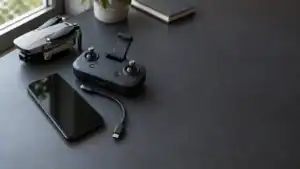
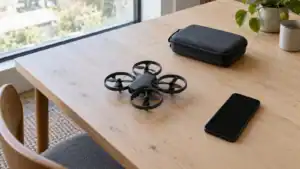
The Potensic ATOM SE is an under-249 g GPS camera drone with a 12 MP sensor, 4K/30 fps recording, a 35.8 mph published top speed, Return to Home, RAW photos, and support for microSD cards up to 256 GB. Those specifications make it a capable low-cost flight platform, but two details define the experience: its camera uses electronic stabilization instead of a three-axis gimbal, and its downward sensors do not provide obstacle avoidance.
This guide translates every important specification into what it changes in flight, filming, storage planning, and the buying decision. Maximum speed, transmission distance, wind resistance, and flight time are manufacturer limits under favorable conditions, not promises for every flight.
Quick Answer
The ATOM SE has the core hardware of a useful beginner GPS drone, not a disposable Wi-Fi toy. It can record real 4K/30 video, capture JPEG and RAW DNG photos, fly up to a published 16 m/s in Sport mode, and return toward a recorded Home Point. The tradeoff is that aircraft roll remains visible because EIS cannot level the horizon like a three-axis gimbal.
Best for
Learning GPS-assisted flight, casual daylight photography, RAW stills, and budget-focused flying in open areas.
Not ideal for
Smooth cinematic video, automatic filming near obstacles, low-light work, or buyers expecting visual subject tracking.
Most important specification
“Single-axis gimbal with EIS” controls camera tilt but does not mechanically stabilize roll and yaw.
Required extra
A compatible microSD card is needed for full-resolution photos and video because the aircraft has no useful internal recording storage.
Featured product
Use the product record to check the current seller and package. ATOM SE listings can include different battery counts, charging hardware, cases, and accessories, so compare the complete bundle rather than the headline price alone.

Featured gear
Potensic ATOM SE GPS Camera Drone
The Potensic ATOM SE is an under-249 g GPS camera drone with 4K/30 fps EIS video, 12 MP RAW photos, Return to Home, a 4 km manufacturer-rated transmission system, and two batteries rated for…
The Potensic ATOM SE is an under-249 g GPS camera drone with 4K/30 fps EIS video, 12 MP RAW photos, Return to Home, a 4 km manufacturer-rated transmission system, and two batteries rated for up to 31 minutes each.
- Best for
- Best for a beginner or traveler who wants an under-249 g GPS camera drone…
- Skill level
- Beginner
- Product type
- Beginner Drones, Camera Drones, Drones, Under 249g Drones
- Best for
- A beginner or traveler who wants an under-249 g GPS camera drone with 4K…
- Skill level
- Beginner
- Product type
- Foldable GPS Camera Drone
Potensic ATOM SE Key Specifications at a Glance
The table below consolidates the current product page and manual into one reference. The buyer-impact column is the part a retail specification list usually leaves out.
| Specification | Published value | What it means in practice |
|---|---|---|
| Takeoff weight | Under 249 g | Compact and below the U.S. recreational registration threshold in its stock configuration, with important operating and accessory-weight qualifications. |
| Camera sensor | 1/3-inch Sony CMOS, 12 MP | Suitable for daylight casual use and RAW stills, but with less low-light and highlight latitude than larger modern sensors. |
| Video | 4K/30, 2.7K/30, 1080p/60 or 30 | Real high-resolution recording, although stabilization and bitrate affect the result as much as resolution. |
| Photos | 4608 × 2592, JPEG or JPEG + RAW DNG | RAW capture adds editing flexibility that many inexpensive beginner drones omit. |
| Stabilization | Single-axis camera tilt with ShakeVanish EIS | The camera tilts remotely, but the horizon can lean when the aircraft banks because there is no three-axis stabilizing gimbal. |
| Maximum horizontal speed | 16 m/s in Sport mode | About 35.8 mph or 57.6 km/h under suitable conditions, with longer stopping distance and more visible aircraft movement. |
| Maximum flight time | Up to 31 minutes | A controlled-condition maximum. Usable flight time must include a reserve for the return, approach, and landing. |
| Transmission | PixSync 2.0, up to 4 km, 720p live view | The 4 km figure is a favorable-condition radio limit, not a recommended flight distance or permission to leave visual line of sight. |
| Positioning | GPS, GLONASS, Galileo, BeiDou, downward vision, and ToF | Supports outdoor position hold, automated routes, Return to Home, and low-altitude positioning. It does not detect forward obstacles. |
| Storage | microSD, 4 GB to 256 GB, Class 10 or U1 minimum | A card is required for full-resolution recording. FAT32 and exFAT are supported. |
| Published wind resistance | 38 km/h, Level 5 | A claimed control limit, not a promise of level video or enough battery to return against the same wind. |
| Operating temperature | 0°C to 40°C | Cold and heat can reduce battery performance and should narrow the flight plan even inside the published range. |
The defining tradeoff: The ATOM SE invests more of its cost in GPS flight capability, radio control, battery value, and RAW photos than in mechanical camera stabilization. That can be a smart balance for learning to fly, but it is the wrong balance when consistently level video is the main goal.
What the 4K Camera Specifications Actually Deliver
The camera uses a 1/3-inch 12 MP Sony sensor behind an f/2.2 lens with a very wide 118-degree field of view. Potensic lists 4K at 30 fps, 2.7K at 30 fps, and 1080p at either 30 or 60 fps. Still images can be saved as finished JPEGs or as JPEG plus RAW DNG files.
That is a credible camera specification for a budget drone, but “4K” describes resolution, not the stability, dynamic range, compression, or horizon control of the finished clip. The manual lists a maximum 40 Mbps H.264 bitrate. That is adequate for ordinary daylight footage, but it gives fast movement, fine foliage, water, and detailed ground textures less compression headroom than higher-bitrate systems.
| Camera function | ATOM SE behavior | Buyer implication |
|---|---|---|
| Full-resolution video | Records to the aircraft’s microSD card at up to 4K/30. | Insert a card before flight and copy files from the card for the original quality. |
| Live controller view | Displays a 720p feed through the PotensicPro app. | The phone preview is for framing and telemetry, not a representation of the final 4K file. |
| App-downloaded video | The manual says video downloaded through the app is 720p. | Use a computer and the microSD card when you need the original-resolution recording. |
| Camera movement | Published tilt range is +20 degrees to -90 degrees. | The thumbwheel aims the camera up or down, but the axis does not level roll or smooth yaw. |
| Electronic stabilization | ShakeVanish EIS digitally reduces vibration and movement. | It can improve a calm clip, but aircraft lean and hard corrections can remain visible. |
| 1080p/60 framing | The manual lists an approximately 66-degree field of view because the mode crops the sensor. | You gain smoother motion and a narrower view, which can help distant subjects but reduces the wide-angle look. |
Single-Axis Gimbal Does Not Mean Gimbal-Stabilized Video
The phrase “single-axis gimbal” is easy to misread. On the ATOM SE, that axis lets the pilot change camera pitch. Stabilization across the image relies on EIS. When the aircraft rolls into a crosswind or banks during a turn, the camera cannot mechanically rotate in the opposite direction to hold the horizon level.
A published TechRadar flight review found the controls sensitive and noted that the horizon could tilt as the aircraft leaned in wind. That does not make the camera unusable. It means the best results come from good daylight, calm conditions, Video mode, gradual stick inputs, and slower turns.
If smooth aerial video matters more than bundle cost, compare the Potensic ATOM SE and DJI Mini 4K. The Mini 4K’s three-axis gimbal changes footage quality more consistently than a longer theoretical range or an extra speed mode.
Potensic ATOM SE Top Speed by Flight Mode
The published ATOM SE top speed is 16 m/s, which converts to about 35.8 mph or 57.6 km/h. That figure applies to Sport mode. Video and Normal modes intentionally limit horizontal, ascent, and descent speed to provide a more manageable response.
| Flight mode | Horizontal speed | Ascent | Descent | Best use |
|---|---|---|---|---|
| Video | 6 m/s, 13.4 mph | 2 m/s | 1.5 m/s | Gentler camera movement, first practice, and smoother framing. |
| Normal | 10 m/s, 22.4 mph | 4 m/s | 3 m/s | General outdoor flying after basic controls are familiar. |
| Sport | 16 m/s, 35.8 mph | 5 m/s | 4 m/s | Fast repositioning in a large clear area, not the default filming mode. |
Sport mode is not simply Normal mode with more speed. The manual warns that responsiveness and braking distance increase and calls for 30 m of braking space in windless conditions. The ATOM SE has no forward obstacle sensor to create that clearance for you.
First-time activation starts in Beginner mode, which restricts height and distance to 30 m and uses Video-mode speed. That is useful for orientation practice. Do not disable the limits merely because the aircraft feels stable in a hover.
Use Video mode for filming and Sport mode for repositioning.
The top-speed number is a flight capability, not an image-quality feature. Faster flight increases lean, stopping distance, battery demand, and the movement EIS must correct.
GPS, 4 km Range, and Return to Home Explained
The current manual lists GPS, GLONASS, Galileo, and BeiDou satellite positioning. Outdoors with a valid Home Point, those systems support position hold, map-based flight functions, and Return to Home. Near the ground, a downward monocular camera and time-of-flight sensor can improve hovering when the surface and lighting are suitable.
| Feature | How it works | Important limit |
|---|---|---|
| Satellite positioning | Supports outdoor hovering, navigation, Home Point recording, and automatic return. | Buildings, metal structures, poor sky view, and magnetic interference can degrade position or compass reliability. |
| Downward vision and ToF | Helps low-altitude positioning and landing over readable surfaces. | It can struggle over water, glass, plain surfaces, repeating patterns, low light, or abrupt lighting changes. |
| Return to Home | Can be commanded by the pilot or triggered by low battery, lost signal, or an aircraft abnormality. | The drone must record a Home Point in GPS mode, and it cannot avoid obstacles during the return. |
| Follow Me | Uses the location of the connected mobile device and current following distance. | It is GPS tracking, not visual recognition that keeps a person framed in the image. |
| Circle Flight | Flies a configurable circle around a selected center point. | The pilot must verify that the entire circle is clear because there is no obstacle avoidance. |
| Waypoint Flight | Follows a saved sequence of 2 to 30 map points. | A map does not reveal wires, branches, temporary obstacles, or the aircraft’s actual clearance. |
Return to Home Is Useful but Not Obstacle-Aware
RTH consists of climbing toward the configured return altitude, flying toward the Home Point, and landing. Before takeoff, wait for the app to confirm the Home Point and set a return altitude that clears known obstacles. Do not launch below a tree canopy or overhang and assume the aircraft will find an open route home.
The manual also notes that a takeoff in optical-positioning mode cannot use the original takeoff point for RTH merely because GPS becomes available later. Home Point confirmation is therefore a required preflight check, not a status message to ignore.
The 4 km Specification Is a Radio Limit, Not a Route
Potensic publishes up to 4 km of PixSync 2.0 transmission with a 720p live feed and approximately 200 ms latency. Interference, terrain, buildings, antenna orientation, regional radio limits, and the connected phone can reduce performance. A maximum radio distance also says nothing about whether the battery can return against wind.
In the United States, the FAA requires recreational pilots to keep the aircraft within visual line of sight, complete TRUST, follow airspace rules, and give way to other aircraft. A 4 km link does not override those requirements.
Is the ATOM SE an FPV Drone?
It provides a live first-person camera view on a phone, but it is primarily a GPS camera drone. It is not a low-latency goggles-based freestyle or racing system, and its automated positioning behavior is designed around stable camera flight. If immersive manual flight is the goal, use our best FPV drone guide to compare beginner kits, cinematic platforms, and freestyle aircraft by the type of flying they actually support.
microSD Card and Storage Requirements
The ATOM SE records full-resolution media to a microSD card, and the card is not included according to the manual. Supported capacity is 4 GB through 256 GB using FAT32 or exFAT. Potensic specifies Class 10 or U1 as the minimum speed rating, while also warning that recording can stop on some cards that do not sustain the needed write speed.
For a new purchase, a reputable 64 GB or 128 GB U3/V30 card is the practical choice. That rating exceeds the published minimum, provides more write-speed margin, and offers enough room for several batteries of footage without putting an entire season of recordings on one card.
| Card capacity | Approximate maximum-bitrate video | Practical fit |
|---|---|---|
| 32 GB | About 1 hour 45 minutes | Enough for a short outing, but easier to fill when several batteries are used. |
| 64 GB | About 3 hours 30 minutes | A strong default for one- or two-battery ownership. |
| 128 GB | About 7 hours | Useful for repeated outings or owners who do not offload after every flight. |
| 256 GB | About 14 hours | The published capacity limit, but more media is at risk if the card is lost or corrupted. |
A Reliable Recording Workflow
- Insert the card while the aircraft is powered off. Removing or inserting it with power on can damage files or the card.
- Format it through the supported workflow. Confirm FAT32 or exFAT and verify that the app recognizes the available capacity.
- Record a short ground clip before launch. Check that the timer advances and the file plays correctly.
- Use the card for original files. The app preview and app-downloaded 720p copy are not substitutes for the aircraft’s full-resolution recording.
- Offload and back up important footage. Reformat only after confirming that the files exist in at least one other location.
Storage takeaway: Card speed and workflow matter more than buying the maximum capacity. A dependable 64 GB or 128 GB card that is checked before launch is a safer choice than a questionable 256 GB card that fails mid-recording.
Battery, Weight, Dimensions, and Environmental Limits
The smart flight battery is a 2S 2,500 mAh lithium-ion pack rated at 7.2 V and 18 Wh. Potensic publishes up to 31 minutes of flight and 28 minutes of indoor hovering. Those are maximums, so a useful flight plan must leave enough energy for the return, approach, and landing rather than treating the last minute as available filming time.
Wind, temperature, repeated climbs, Sport-mode flying, battery age, and the distance required to return all reduce usable time. Our dedicated Potensic ATOM SE battery guide covers realistic planning, USB-C charging, two-battery rotation, storage level, and replacement compatibility without duplicating that guidance here.
| Item | Published specification | Planning consequence |
|---|---|---|
| Folded dimensions | 88 × 143 × 58 mm | Small enough for a compact case, but protect the camera, propellers, and arm hinges during transport. |
| Unfolded without propellers | 210 × 152 × 58 mm | The airframe is compact, but the safe operating area must account for propeller span and drift. |
| Unfolded with propellers | 300 × 242 × 58 mm | Use a flat takeoff surface with clearance around every rotor. |
| Battery | 2S Li-ion, 2,500 mAh, 7.2 V, 18 Wh, 103 g | Use the model-specific smart battery and approved charging method rather than substituting a generic pack. |
| Operating temperature | 0°C to 40°C | Shorten the route in cold or heat and monitor voltage behavior rather than relying on the 31-minute claim. |
| Extra payload | Not supported | Do not attach action cameras or accessories that change balance, performance, or takeoff weight. |
What Under 249 g Means in the United States
A stock ATOM SE below 250 g is generally exempt from FAA registration only when flown solely under the recreational exception. Recreational pilots still need TRUST and must follow airspace, visual-line-of-sight, and safety rules. Part 107 operations require registration regardless of the aircraft’s weight, and a drone that is required to be registered must also satisfy the applicable Remote ID requirement unless operated within an allowed exception such as a FRIA.
Accessories can also change the takeoff weight. Check the complete flying configuration and current FAA registration guidance for the operation you intend to conduct.
What These Specifications Mean for Buyers
The ATOM SE specifications are strongest when evaluated as a budget GPS training platform with a usable daylight camera. They are less convincing when the aircraft is compared as a modern creator drone, because newer models add the three-axis gimbal and visual tracking that change the footage more than another speed or range claim.
| Your priority | Fit | Reason |
|---|---|---|
| Lowest-cost credible GPS flight | Good fit at a clear discount | Position hold, Return to Home, a proper controller, and multiple speed modes provide real training value. |
| RAW still photography in daylight | Reasonable fit | DNG files offer useful editing flexibility, although the small sensor still limits image quality. |
| Smooth travel or real-estate video | Weak fit | EIS cannot mechanically keep the horizon level through wind and aircraft movement. |
| Automated tracking in open space | Limited fit | GPS Follow Me can track the phone’s location, but it does not visually recognize the subject or avoid obstacles. |
| Flying near trees or structures | Poor fit | There is no forward, rear, side, or upward obstacle avoidance, including during Return to Home. |
| Long-term creator platform | Spend more | A current gimbal-equipped model provides more usable footage and greater room to develop filming skills. |
Potensic’s official store page was marked unavailable when checked on August 24, 2026, although retailer inventory may remain. That makes seller terms, warranty support, and the price gap to newer models especially important. Read the full current ATOM SE buyer verdict before treating an older listing as an automatic bargain.
If the SE still fits, use the ATOM SE bundle guide to compare battery count, charging hardware, case contents, and replacement cost. Two useful batteries normally improve a beginner’s experience more than paying for a transmission distance that should never become the target.
Verify These Items Before the First Flight
- Confirm the exact model. ATOM SE, ATOM, ATOM 2, ATOM 3, and ATOM LT have different cameras, gimbals, tracking systems, and transmission specifications.
- Check the battery count and charger. Retailer bundles do not always match the manufacturer’s package names.
- Install a compatible microSD card. Use 4 GB to 256 GB capacity with sufficient sustained write speed, then verify a test recording.
- Connect through PotensicPro. Update the app and firmware, verify the phone cable, and confirm that live view and telemetry work.
- Wait for GPS and Home Point confirmation. Do not depend on RTH after an optical-mode takeoff that never recorded the original Home Point.
- Set the RTH altitude for the route. The aircraft cannot see or avoid trees, wires, walls, or overhangs during return.
- Start in Beginner or Video mode. Learn stopping distance and camera movement before using the 16 m/s Sport setting.
- Inspect the environment. Avoid magnetic interference, crowds, traffic, poor weather, and automated routes that pass near obstacles.
Our Potensic ATOM SE app and first-flight guide walks through activation, firmware, calibration, storage, Home Point verification, and a controlled first launch in the correct order.
Final Takeaway
The Potensic ATOM SE specifications describe a capable budget GPS drone: under 249 g, 4K/30 recording, 12 MP RAW photos, a published 35.8 mph top speed, up to 31 minutes of flight, automated GPS modes, and microSD support through 256 GB. The specifications do not describe a gimbal-stabilized creator drone or an obstacle-aware aircraft.
Buy it when the discount is meaningful, the bundle includes the batteries you need, and learning to fly matters more than perfectly level video. Choose a three-axis-gimbal alternative when the camera is the reason for the purchase.
Check the current ATOM SE listing
Verify availability, battery count, charging hardware, microSD inclusion, seller support, and return terms before comparing the final bundle cost.
Sources
- Potensic ATOM SE specifications: Official aircraft, camera, positioning, transmission, storage, battery, and environmental limits.
- Potensic ATOM SE product page: Official feature descriptions, package information, flight modes, and current store availability.
- Potensic app and manual downloads: Official source for the current ATOM SE user manual and PotensicPro support.
- Potensic ATOM versus ATOM SE comparison: Official clarification of gimbal, tracking, camera-control, range, storage, and flight-mode differences.
- TechRadar Potensic ATOM SE review: Attributed hands-on observations about control sensitivity, wind behavior, horizon tilt, and camera limitations.
- FAA recreational flyer guidance and FAA drone registration guidance: Current U.S. registration, TRUST, visual-line-of-sight, and Remote ID requirements.
Last checked: August 24, 2026.