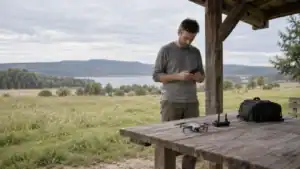
Yes, the original DJI Neo can follow you using its Follow intelligent shooting mode and AI subject tracking. It can launch from your palm and track a clearly visible person without a handheld controller. The critical limitation is that it has no obstacle avoidance, so it can follow the subject toward a branch, wall, wire, or other hazard instead of safely routing around it.
Follow works best with one clearly visible person moving through a bright, open area at a predictable pace. It is useful for walks, runs, travel clips, and simple self-filming. It is a poor choice for wooded trails, crowded spaces, complex indoor routes, or any shot that depends on the aircraft detecting and avoiding objects by itself.
This is a research-based feature guide using current DJI product information, specifications, support documentation, release information, and specifically attributed reporting. It is not presented as original FPV Drone flight testing. Tracking performance can change with firmware, lighting, contrast, subject movement, wind, control method, and the surrounding environment.
Quick answer
DJI Neo is a genuine follow-me drone for human subjects, but it is not an autonomous navigation system. Its camera identifies and follows the person while the aircraft changes position to maintain the shot. The pilot remains responsible for choosing a safe route, supervising the aircraft, and stopping the flight before tracking carries it into danger.
Works best for
Walking, jogging, hiking, and casual self-filming in open areas with a clear path, good light, manageable wind, and one obvious human subject.
Not reliable for
Obstacle-rich trails, crowds, tight indoor routes, low light, a repeatedly hidden subject, or reliable tracking of pets, vehicles, and other unsupported targets.
Main safety limit
The original Neo has downward positioning sensors but no forward, rear, side, upward, or omnidirectional obstacle-avoidance system.
DJI Neo

Featured gear
DJI Neo Drone
The DJI Neo is a 135 g compact camera drone with palm takeoff, subject tracking, built-in propeller guards, 4K/30fps recording, and controller-free or optional remote and goggles control. Best for: Beginners, travelers, family clips,…
The DJI Neo is a 135 g compact camera drone with palm takeoff, subject tracking, built-in propeller guards, 4K/30fps recording, and controller-free or optional remote and goggles control.
- Best for
- Compact first-generation DJI flying camera for palm launch, subject tracking, short self-filming clips, and…
- Skill level
- Beginner
- Product type
- 135 g selfie drone, Beginner Drones, Camera Drones, DJI Drones, DJI flying camera, Drones,…
- Best for
- Compact first-generation DJI flying camera for palm launch, subject tracking, short self-filming clips, and…
- Skill level
- Beginner
- Product type
- Compact Camera and Selfie Drone
How does DJI Neo Follow mode work?
Follow is one of Neo's intelligent shooting modes. The aircraft uses its camera and subject-recognition software to identify a person, keep that person framed, and adjust its flight as the person moves. Basic use does not require a traditional remote controller, which is the feature's main appeal.
The important word is tracking, not navigating. Neo can react to the subject's position in the camera image, but the original model does not build a protected route through the environment. If a tree, sign, fence, doorway, cable, or wall enters the aircraft's path, the tracking system does not turn into obstacle avoidance.
For the same reason, a recognized subject does not make the flight hands-off in a legal or practical sense. The user must select the route, watch the aircraft, monitor wind and battery, and remain prepared to stop the automatic movement.
Plain-language distinction: Neo can decide where the person is in the frame. It cannot decide that the route to that person is clear.
Subject tracking is not the same as every automatic shot
DJI groups several automatic filming tools around the recognized subject, but they do different jobs. Understanding the difference prevents a buyer from expecting every mode to follow continuously.
| Mode type | What the aircraft does | Is it continuous follow? | Best use |
|---|---|---|---|
| Follow | Tracks a recognized person and changes position as that person moves. | Yes, while the mode remains active and the subject stays trackable. | Walking, running, and other continuous movement in an open area. |
| Spotlight | Uses subject recognition to help keep the person framed while the user has more control over the aircraft's movement. | No, not in the same hands-off sense as Follow. | Shots where the user wants tracking assistance with more deliberate positioning. |
| Preset automatic shots | Performs a defined movement such as moving away, rising, or circling around the recognized subject. | No. The movement has a planned pattern and endpoint. | Short reveals and social clips that need repeatable camera motion. |
| Manual flight | The pilot controls the aircraft with a phone, remote, motion controller, or compatible FPV setup. | No automatic following should be assumed. | Precise placement, exploration, or piloted filming. |
If the goal is for the drone to keep moving with you, select Follow. If the goal is one dramatic reveal or orbit, choose the relevant preset movement. Calling both features "tracking" can hide that practical difference.
Do you need a controller for DJI Neo to follow you?
No traditional controller is required for basic Follow use. Neo was designed to launch from a palm and run selected automatic shooting modes using controls on the aircraft. Connecting a phone through DJI Fly provides a live view and additional settings, while compatible remote and goggles equipment is intended for more direct piloting.
Controller-free palm operation
This is the fastest route to a follow shot. Select the intended mode on the aircraft, face the camera toward the subject, launch from a flat stationary palm, and allow the aircraft to recognize the person. It is convenient, but the user has less immediate physical control than with a conventional remote.
DJI Fly mobile control
A phone connection adds framing feedback and access to compatible intelligent shooting settings. It is the better choice when the user wants to confirm what the camera sees before starting. DJI publishes a direct Wi-Fi control rating of 50 m in an open, low-interference environment, but that maximum is neither a target tracking distance nor a reason to let the aircraft leave visual line of sight.
Remote controller or goggles
A compatible remote expands manual control and uses DJI's O4 transmission system. Compatible goggles and motion or FPV controls create a different piloted experience. Buying one of those packages does not remove the original Neo's obstacle limitation, and manual range specifications should not be confused with how far an unattended Follow flight should travel.
How to use DJI Neo Follow mode more safely
The exact on-screen wording can change with DJI Fly and firmware, so use the current DJI manual for the final button sequence. The safe setup logic remains consistent.
Pre-flight and Follow setup checklist
- Update and verify the system. Confirm the aircraft, battery, and DJI Fly app are current, then review any release notes that affect tracking or intelligent flight.
- Inspect the aircraft. Check the propellers, guards, battery seating, camera, gimbal movement, and internal storage space.
- Plan the complete route. Look for branches, wires, poles, walls, signs, roof edges, vehicles, animals, water, and uninvolved people throughout the intended flight volume.
- Check light, surface, and wind. Use a well-lit location with enough surface texture for downward positioning and conditions comfortably inside the aircraft's published limits.
- Choose Follow and confirm the subject. Face the camera toward one clearly visible person and verify that the intended subject is recognized before moving.
- Start slowly. Walk before running or cycling so you can confirm framing, aircraft response, route clearance, and the correct tracking direction.
- Keep watching the aircraft. Do not focus only on the recording or assume the propeller guards make a collision harmless.
- End with battery margin. Stop the shot before a low battery, stronger wind, or changing route turns a simple landing into a recovery problem.
A controlled first pass is more useful than immediately testing maximum speed. If Neo loses the subject, drifts, or approaches a hazard, stop and reset the shot instead of waiting for the software to recover.
How well can the DJI Neo keep up?
Neo is well matched to walking and ordinary jogging in an open area. Faster motion is more conditional. Speed changes, sharp turns, wind, subject occlusion, low contrast, and uneven terrain all make the camera's job harder and reduce the margin available to the lightweight aircraft.
A November 2024 firmware update substantially increased tracking performance. The Verge reported a DC Rainmaker cycling test in which the updated aircraft tracked at roughly 20 mph. That is one attributed test result, not a DJI guarantee and not proof that cycling at that speed is safe in every route, wind condition, or filming direction.
What helps tracking remain stable
- one clearly visible person who occupies a useful portion of the camera frame;
- daylight or other even, adequate illumination;
- steady movement without abrupt direction changes;
- a background that gives the subject visible contrast;
- an open route without objects passing between camera and subject;
- calm wind and enough battery reserve for the complete flight.
What can cause the drone to lose you
Common risk factors include moving behind an object, leaving the camera's view, becoming too small in the frame, abrupt acceleration, a sharp turn, low light, strong backlighting, similar colors between subject and background, and wind that prevents the aircraft from maintaining the intended position. Tracking software can improve through firmware, but it cannot remove those visual and flight limits.
Performance takeaway: Neo's upgraded tracking can be fast, but route safety and subject visibility are more important than the fastest speed reported in one test.
The main limitation: tracking without obstacle avoidance
The original DJI Neo has a downward visual positioning system and an infrared sensing system. These help it determine position and support stable low-altitude flight in suitable conditions. They do not detect obstacles across the flight path and do not provide forward, backward, sideways, upward, or omnidirectional avoidance.
Full-coverage propeller guards reduce exposed-propeller contact and can limit damage in some minor bumps. They do not protect the camera and aircraft from every impact, prevent the drone from becoming stuck, or make it acceptable to fly close to faces, traffic, crowds, or fragile property.
The pilot is still responsible during automatic flight
Follow mode controls part of the aircraft's movement, not the pilot's responsibility. In the United States, ordinary recreational operations generally require the flyer or a visual observer to keep the aircraft within visual line of sight and follow current airspace and operating rules. Requirements vary by country and by the purpose of the flight.
This becomes easy to overlook when the person being filmed is also the person supervising the aircraft. Running or cycling can divide attention between the route ahead and the drone behind or beside you. If the shot cannot be monitored while moving safely, use another person to supervise or choose a different shot.
Water, snow, darkness, and reflective surfaces need extra caution
Downward vision systems depend on usable visual information. Poor light, repeating patterns, textureless surfaces, reflections, and water can reduce positioning reliability. An open-looking route over water may have no physical obstacle, but a positioning or battery problem there has much higher consequences.
DJI Neo tracking scenario guide
The table below turns the feature list into a practical route decision. It assumes the original Neo, current firmware, one visible human subject, active supervision, and compliance with local rules.
| Scenario | Fit | Main reason | Safer decision |
|---|---|---|---|
| Walking across an open field | Good | Predictable pace and clear flight volume suit basic person tracking. | Survey the route, begin slowly, and preserve landing space. |
| Jogging on a wide open path | Good with conditions | Neo can follow faster movement when the subject stays visible and the route remains open. | Test the direction and framing at walking speed before accelerating. |
| Cycling on a closed open course | Conditional | Updated tracking can be fast, but speed reduces reaction time and divides the rider's attention. | Use a spotter, avoid public traffic, and do not treat one published test as a guaranteed speed. |
| Wooded or branch-covered trail | Poor | The aircraft cannot detect and route around trunks, limbs, or overhanging branches. | Use a manually supervised shot in a cleared area or choose a drone with suitable sensing. |
| City sidewalk or crowded event | Poor | People, poles, signs, vehicles, wires, and changing paths create too many unmanaged hazards. | Choose a controlled location and follow rules for operations near people. |
| Large bright indoor room | Conditional | Positioning may work with good light and surface texture, but walls and fixtures remain unprotected. | Keep speed and distance low, clear the room, and supervise continuously. |
| Over water, snow, or reflective ground | Poor | Downward positioning can be challenged and recovery consequences are high. | Use a safer route over suitable ground and maintain extra battery margin. |
| Pet or vehicle tracking | Not a dependable buying case | DJI presents Neo's feature around human-subject tracking, not guaranteed general object tracking. | Buy only if reliable person tracking satisfies the intended use. |
Is DJI Neo 2 better for following?
Yes. Neo 2 is the more capable follow-camera platform. DJI lists faster tracking up to 12 m/s, eight-direction tracking, omnidirectional monocular vision, forward-facing LiDAR, downward infrared sensing, a two-axis gimbal, stronger wind resistance, and gesture controls. Those upgrades address several of the original model's biggest tracking limitations.
That does not make Neo 2 collision-proof. Thin branches, difficult surfaces, speed, lighting, and the limits of any sensing system still require supervision. It does mean the newer aircraft has tools the original Neo simply lacks.
The original Neo can remain the value choice for slow, open-area self-filming when its complete package is meaningfully cheaper. For the broader ownership decision, read our DJI Neo review. Buyers deciding between a tracking-first flying camera and a longer-range traditional camera drone should also see the DJI Mini 4K vs DJI Neo comparison.
If your main goal is automated tracking for running, cycling, skiing, or other sports rather than choosing between one DJI model and another, compare our best follow-me drones for sports to see which current options actually track a moving subject and where their sensing and route-safety limits differ.
Final takeaway: DJI Neo can follow you, but the route must be safe first
The original DJI Neo genuinely can follow a person without a traditional remote controller. Its palm launch, Follow mode, compact 135 g design, guarded propellers, and automatic framing make it useful for uncomplicated walks, runs, travel clips, and solo content creation.
The feature should not be mistaken for autonomous obstacle navigation. Neo sees the subject, but it does not protect the route. Use it where the entire flight volume is open, the person remains visible, wind and light are suitable, and someone can supervise the aircraft throughout the shot.
If the intended route includes trees, structures, crowds, or frequent direction changes, the original Neo is the wrong tool. Choose a safer location, a manually controlled shot, or a newer aircraft with appropriate sensing rather than asking Follow mode to solve a problem it was not designed to solve.
Frequently asked questions
Can DJI Neo follow you without a phone?
Yes. The aircraft's on-body mode controls and palm-launch workflow can start basic automatic Follow filming without a phone or handheld controller. A phone adds a live view and compatible settings that can make setup easier to verify.
Does DJI Neo have ActiveTrack?
DJI markets the original model with AI Subject Tracking and a Follow intelligent shooting mode. Do not assume that label includes the obstacle sensing, route planning, or advanced directional behavior associated with more capable DJI tracking systems.
Can DJI Neo follow a bike?
Updated firmware materially improved its ability to track faster subjects, and an attributed test reported approximately 20 mph while cycling. That does not guarantee safe performance. Use only a clear, controlled route, keep the aircraft supervised, and account for wind, battery, turns, traffic, and stopping distance.
Will DJI Neo avoid trees while following?
No. The original Neo has no obstacle-avoidance system. Its downward sensors support positioning but do not scan ahead for trees, branches, wires, walls, or other hazards.
Can DJI Neo follow pets or cars?
Do not buy the original Neo on that assumption. DJI's published feature is centered on tracking people. Detection of another target in a particular situation would not establish dependable pet or vehicle tracking.
How far can DJI Neo follow you?
DJI publishes a 50 m maximum direct Wi-Fi control distance under ideal open, low-interference conditions, while compatible O4 control equipment has much larger communication ratings. Neither figure defines a safe Follow distance. Subject recognition, battery, wind, route clearance, supervision, and visual-line-of-sight rules create the practical limit.
Sources
- DJI Neo official product information: AI subject tracking, palm operation, intelligent shooting modes, control methods, and product positioning.
- DJI Neo official specifications: aircraft weight, sensing system, flight limits, wind rating, Wi-Fi control range, and transmission information.
- DJI Neo official FAQ: Follow behavior, palm controls, intelligent modes, obstacle limitations, and control-method details.
- DJI Neo downloads and support page: current manuals, safety guidance, DJI Fly information, and release documentation.
- The Verge report on the November 2024 Neo update: specifically attributed third-party cycling test and improved tracking-speed context.
- FAA recreational flyer guidance: U.S. visual-line-of-sight, airspace, and recreational operating context.
Last checked: July 14, 2026.