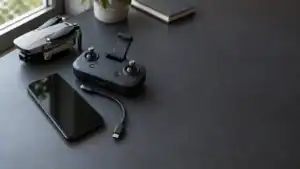
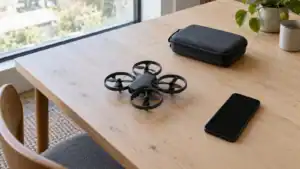
The BETAFPV Aquila20 FPV Kit is a good beginner choice if you want one complete package that can take you from an assisted first hover to full Manual mode. It includes the drone, ExpressLRS radio, analog goggles, two batteries, charger, tools, and a case. The important tradeoff is that it is a forgiving trainer, not an HD camera drone, precision racer, or long-range system.
This is a research-based review. FPV Drone evaluated current BETAFPV specifications and manuals, firmware documentation, package contents, and specifically attributed hands-on flight reports. We did not personally flight-test this unit.
Quick verdict
Aquila20 removes most of the compatibility work that makes a first FPV purchase confusing. Its assisted N mode lowers the difficulty of early flights, the supplied LiteRadio 4 SE works with FPV simulators, and Manual mode gives the pilot somewhere to progress. Its protected 2S aircraft also has more outdoor capability and longer manufacturer-rated flights than a typical tiny 1S whoop.
Buy it as a first training system. Skip it if you already know that you want sharp digital video, Betaflight configuration, aggressive freestyle, racing precision, GPS recovery, or a radio and goggles you are unlikely to replace later.
Best for
A first-time FPV pilot who wants a matched ready-to-fly kit, protected propellers, assisted early flights, and a path to conventional stick-controlled Manual mode.
Not ideal for
Pilots prioritizing HD footage, compact indoor racing, precise freestyle, long range, GPS features, or a fully open tuning platform.
Verify before buying
Confirm that the offer is the analog Aquila20 kit, not Aquila20 HD, and check the Mode 1 or Mode 2 stick layout, two-battery package, seller, and warranty.
Featured beginner FPV kit

Featured gear
BETAFPV Aquila20 FPV Kit
The BETAFPV Aquila20 FPV Kit is a complete analog RTF system with a 122 g brushless whoop, ExpressLRS LiteRadio 4 SE transmitter, VR04 DVR goggles, assisted N mode, Manual mode, and approximately ten-minute manufacturer-rated…
The BETAFPV Aquila20 FPV Kit is a complete analog RTF system with a 122 g brushless whoop, ExpressLRS LiteRadio 4 SE transmitter, VR04 DVR goggles, assisted N mode, Manual mode, and approximately ten-minute manufacturer-rated flights.
- Best for
- Best for a beginner who wants a complete analog FPV learning kit with assisted…
- Skill level
- Beginner to Intermediate
- Product type
- Beginner Drones, Drones, Under 249g Drones
- Best for
- A beginner who wants a complete analog FPV learning kit with assisted hovering, simulator-compatible…
- Skill level
- Beginner to Intermediate
- Product type
- Analog Ready-to-Fly FPV Whoop Kit
What does the Aquila20 FPV Kit include?
The standard analog package is genuinely ready to fly after charging, reading the controls, and completing the preflight checks. BETAFPV's current package list includes the matched aircraft, radio, goggles, two independent flight batteries, charger, spare propellers, basic tools, cables, and storage bag.
| Included item | What it does | What the buyer should know |
|---|---|---|
| Aquila20 brushless whoop | Protected 2S FPV aircraft with N, S, and M flight modes | This is the analog version and does not record stabilized onboard HD video. |
| LiteRadio 4 SE | ExpressLRS 2.4 GHz radio for the aircraft and simulator practice | Choose Mode 2 for the common U.S. throttle-left layout unless your existing training uses Mode 1. |
| VR04 goggles | Displays the 5.8 GHz analog piloting feed and supports DVR recording | A compatible microSD card is required for recording and is not listed in the package. |
| Two 2S HV 1100 mAh smart batteries | Provide two separate flight packs | They use Aquila20's BT3.0 arrangement and require the correct LiHV charging method. |
| 2S HV charger and voltage tester | Charges and checks the supplied batteries | The standard setup handles one battery at a time and still needs a suitable USB power source. |
| Spares, tools, cables, and case | Cover basic prop replacement, connection, setup, and transport | The box includes one spare propeller set, not a complete long-term repair inventory. |
This completeness is the Aquila20's first major advantage. A beginner does not need to match a receiver protocol, radio, video transmitter, goggles, battery connector, and charger independently. If those terms are still unfamiliar, our guide to how FPV drones work explains the separate control and video links.
Important distinction: Ready to fly does not mean ready to fly safely the moment the box opens. Charge all equipment, inspect the batteries and propellers, learn the arm and disarm controls, confirm the radio bind, and verify a clean goggle feed before takeoff.
Why is the Aquila20 good for beginners?
The useful feature is not simply that Aquila20 has three modes. It is that those modes create a deliberate progression instead of forcing a new pilot to begin with completely unassisted throttle, pitch, roll, and yaw control.
N mode reduces first-flight workload
BETAFPV describes N mode as its altitude-hold and stable-hover setting. With the sticks centered, the aircraft helps maintain a steady hover so the pilot can focus on looking through the goggles, understanding orientation, and making smaller directional inputs. This is assistance, not GPS. The aircraft does not provide map-based positioning, automatic Return to Home, obstacle avoidance, or a recovery route if the pilot flies out of sight.
Published hands-on results add an important condition. Oscar Liang's Aquila20 test found the assisted hover notably stable once the aircraft was roughly one to two meters above the ground, while some drift remained near the surface and during yaw. Unmanned Tech's hands-on review found the bottom-facing assistance most dependable below about three meters and over textured surfaces, with reflective or featureless surfaces creating problems. Those are attributed observations from individual review aircraft, not guaranteed operating limits.
S mode is the transition, M mode is the destination
In the cited Oscar Liang test, S mode behaved as a self-leveling mode without assisted altitude hold. The pilot had to control height continuously, but the aircraft still leveled when the direction stick returned to center. M mode removed self-leveling and required full pilot control. That sequence makes sense for learning: simulator first, low-speed N mode in a clear area, S mode after consistent hovering and landings, then M mode only after manual stick control becomes predictable.
Do not plan to use N mode as an airborne rescue switch. Unmanned Tech reported that mode changes were locked during flight on its test firmware, and current listings warn about in-flight transitions involving N mode. Firmware behavior can change, so verify the current manual and aircraft behavior on the ground, then choose the intended mode before takeoff.
The included radio supports simulator practice
The official manual says the LiteRadio 4 SE can connect by USB while powered off and appear to a computer as a BETAFPV Joystick. It lists support for common simulators including VelociDrone, Uncrashed, DRL, DCL, Liftoff, TRYP FPV, FeelFPV, and FPV Freerider. This is more important than it sounds. The radio can build Manual-mode muscle memory without consuming batteries, propellers, or frames.
- Practice arming and emergency disarming until the control is automatic.
- Learn to hold altitude manually before attempting flips or rolls.
- Use the same Mode 1 or Mode 2 stick layout in the simulator and on the aircraft.
- Start the real aircraft in a large, clear area at the lowest useful speed setting.
- Move to M mode only when recovery inputs are deliberate rather than guesses.
Buyer takeaway: Aquila20 is beginner-friendly because it makes the first steps less punishing while still including a real Manual mode. It does not make Manual mode easy or eliminate the need for practice.
Flight performance, durability, and realistic range
Aquila20 is larger and heavier than the tiny 1S whoops commonly flown around a living room. BETAFPV lists a 100 mm wheelbase, Gemfan 2218 three-blade propellers, 1103 10500KV motors, a 2S power system, and a takeoff weight of 122 grams. That combination gives it useful outdoor power, but it also carries more momentum into a wall, person, or piece of furniture.
| Specification or feature | Published value | What it means in practice |
|---|---|---|
| Takeoff weight | 122 ± 1 g | Light compared with camera drones, but substantially heavier and more forceful indoors than a small 1S whoop. |
| Propulsion | 2S, 1103 10500KV motors, Gemfan 2218 props | Enough power for outdoor training and basic acro, with more noise and momentum than a smaller indoor trainer. |
| Flight time | About 10 minutes under manufacturer conditions | A useful ceiling for gentle practice, not a guaranteed duration for aggressive M-mode flying. |
| Video transmitter | Adjustable 25 to 350 mW | Higher power can help in suitable conditions but does not overcome poor antenna geometry, obstacles, interference, or local power restrictions. |
| Rated video range | More than 200 m in manufacturer conditions | Plan for short-range training and turn back at the first meaningful degradation rather than treating 200 m as a target. |
| Frame | Protected PA whoop-style structure | Better protection for props and electronics during normal training impacts, but not crash-proof or harmless around people. |
Better in a backyard or small field than a tight room
Oscar Liang reported that the 2S aircraft handled outdoor conditions better than smaller 1S whoops, but also described it as loud and less precise in tight indoor turns because of its weight. The protected frame makes a minor mistake more survivable, but the best first environment is still a clear yard, empty gym, or small field rather than a furnished room.
Use the video link as the limiting range
BETAFPV rates the analog link beyond 200 meters under its conditions. That is not a promise of a clear image through walls or trees. In his test, Oscar Liang reported noticeable video breakup near 100 meters and weak penetration through obstacles despite the stated 350 mW maximum. The control link may remain connected after the piloting image becomes poor, which is exactly why a beginner should establish a conservative turnaround point based on video quality rather than continue toward a published maximum.
Buyer takeaway: Aquila20 has enough power and endurance to be a practical outdoor trainer. Its frame, weight, and analog link are better suited to short, controlled practice routes than racing through a small room or exploring at distance.
Analog video and the VR04 goggles
The standard Aquila20 sends a 5.8 GHz analog feed from its C04 camera to the included VR04 goggles. Analog video is responsive and widely used across hobby FPV, but it will not look like a modern digital headset. Expect a functional piloting view with visible noise and breakup as conditions deteriorate, not a sharp image intended for cinematic playback.
The VR04 manual documents a foldable single-antenna receiver, automatic frequency search, 48-channel reception across six bands, a built-in battery, and microSD recording and playback. A card must use FAT32 and the manual lists a maximum supported capacity of 64 GB. The recording captures the feed received by the goggles, including interference. It is not clean onboard footage from a stabilized camera.
The single receiver is one reason to keep expectations modest. Oscar Liang found the goggles comfortable enough for glasses and liked the simple controls, but noted that the receiver is not diversity and does not accept an external receiver module. That makes VR04 reasonable starter equipment for a backyard or small park, not a premium headset likely to satisfy a pilot pursuing longer range or better image quality.
Choose the correct version: The standard Aquila20 uses analog VR04 goggles. Aquila20 HD uses a different P1 digital video system and VR04 HD goggles. Read our Aquila20 analog versus HD comparison before paying more for the digital package.
If you expect to add other aircraft, check video compatibility before buying any goggle upgrade. Our FPV goggles compatibility guide explains why analog, ArtLynk, DJI, Walksnail, and HDZero components cannot be mixed simply because they use the term FPV.
Battery life, charging, and ownership costs
BETAFPV supplies two 2S high-voltage 1100 mAh smart batteries. The company rates each for about ten minutes of smooth flight and lists approximately 40 minutes for a full charge with the supplied charger. Flight time will fall with aggressive throttle, higher video-transmitter power, wind, cold, battery wear, and the landing reserve you choose to keep.
The hands-on results show why the published number needs context. Unmanned Tech reported roughly ten minutes during calm, conservative flying but closer to five or six minutes when the aircraft was pushed. Those observations fit the product's role: the battery is sized for long training circuits, while full-power Manual flying uses that energy much faster.
The battery is convenient but less universal than a conventional loose LiPo pack. It uses an Aquila20-specific smart enclosure and BT3.0 arrangement. The supplied charger is intended for the high-voltage 2S pack, and BETAFPV warns that using it with a standard 8.4 V 2S battery can overcharge that battery. Do not select replacements by capacity alone.
What you may need beyond the box
- A suitable USB power adapter for the supplied charging equipment.
- A compatible FAT32 microSD card if you want to record with the goggles.
- More Aquila20 2S HV 1100 mAh batteries if two flights are not enough.
- An Aquila20 multi-battery charging solution if one-at-a-time charging becomes the bottleneck.
- Additional propellers and eventually a replacement frame or motors.
- Simulator software for Manual-mode training.
Before buying extra packs, confirm current replacement availability and shipping to your location. Batteries are consumable items, and a training system becomes much less useful if its proprietary packs are difficult to replace. For charging, storage, damage inspection, and disposal guidance, use our FPV drone battery guide.
Check the exact package
Confirm the analog version, Mode 1 or Mode 2 radio, two flight batteries, VR04 goggles, charger, seller, and included warranty before ordering.
Upgrade path and the limits you may outgrow
Aquila20 has a mixed upgrade story. The control and video standards create some reuse, while the aircraft firmware, entry-level hardware, and battery system create clear limits.
What can carry forward
The LiteRadio 4 SE uses ExpressLRS 2.4 GHz V3. It can control other compatible ExpressLRS aircraft after the required binding and configuration checks. The VR04 can receive conventional 5.8 GHz analog video from many other analog aircraft. That gives the kit a more flexible next-drone path than a system whose radio and goggles work only with one proprietary aircraft family.
What will probably be replaced
The supplied radio is compact and adequate for training, but hands-on reviewers identify its limited configuration, internal antenna, and lack of a module bay as long-term constraints. The goggles use a basic single-receiver design. A pilot who stays in FPV may eventually want better gimbals, more radio controls and model management, a stronger link, a diversity receiver, or digital video.
The aircraft is not a Betaflight trainer
Aquila20 runs BETAFPV's simplified firmware rather than conventional Betaflight. The manufacturer provides its own Configurator and exact Aquila20 firmware files. That reduces setup work for a beginner, but its configuration workflow does not transfer directly to the Betaflight ecosystem used by many freestyle and racing builds.
Firmware updates also require care. BETAFPV's current support page says the February 2026 flight-controller firmware supports both analog and HD aircraft and requires restoring defaults after the update. Its March 2026 analog VTX file is restricted to a specific PA chip and board silkscreen. Do not flash a file based only on the Aquila20 name. Match the exact hardware and follow the current manufacturer instructions.
Buyer takeaway: The Aquila20 teaches useful stick skills and introduces analog FPV plus ExpressLRS, but it should be viewed as a first system. A serious long-term pilot is likely to replace the radio, goggles, aircraft, or all three as priorities become clearer.
Who should choose a different starter system?
Aquila20 is not the universal beginner winner. The better option depends on the skill or result you actually want six months from now.
| Your priority | Better starting point | Reason |
|---|---|---|
| The easiest low-cost path from hover to Manual mode | BETAFPV Aquila20 analog | Assisted N mode, protected frame, simulator radio, two batteries, and complete matched gear. |
| A clearer digital piloting view | BETAFPV Aquila20 HD | Similar learning progression with 1080p ArtLynk video, at a higher cost and with a narrower video ecosystem. |
| Direct preparation for outdoor freestyle | EMAX Tinyhawk III Plus Freestyle RTF | More conventional manual-freestyle behavior, but exposed propellers and a much steeper first-flight learning curve. |
| Stabilized immersive 4K video | DJI Avata 2 | A polished camera and digital-goggle experience, but a different price class and control path. |
Our complete beginner FPV kit comparison examines the included goggles, controllers, batteries, hidden costs, and progression paths in more detail.
Final verdict: Is the Aquila20 worth buying?
Yes, for the right beginner. The BETAFPV Aquila20 FPV Kit is worth buying when the goal is to start flying without researching every component separately and then progress toward Manual mode at a manageable pace. The assisted hover, protected frame, two independent batteries, simulator-capable ExpressLRS radio, analog goggles, and complete accessory package solve most of the problems that derail a first FPV purchase.
The limitations are equally real. Analog video is basic, the practical video range can fall well short of the published maximum, the aircraft is large and loud for a tiny indoor space, the smart battery is not a generic pack, and the simplified firmware is not Betaflight. Pilots pursuing racing, precise freestyle, long range, or polished footage will outgrow it.
The best reason to buy Aquila20 is not that every component will last forever. It is that the complete system can help a cautious new pilot learn what to upgrade next without making compatibility research the first lesson.
Check the current Aquila20 offer
Match the listing to the analog VR04 kit and verify the radio stick mode, batteries, charger, seller, and return terms.
BETAFPV Aquila20 FAQs
Is the Aquila20 FPV Kit actually ready to fly?
It includes the aircraft, matching radio, goggles, two flight batteries, charging equipment, spare propellers, tools, cables, and case in BETAFPV's standard package. You still need to charge the equipment, read the controls, verify binding and video reception, and complete a preflight inspection.
Can the LiteRadio 4 SE be used with an FPV simulator?
Yes. BETAFPV's manual explains how to connect the powered-off radio to a computer by USB so it appears as a BETAFPV Joystick. The radio must use the same stick layout in the simulator that you plan to fly on the aircraft.
Does the Aquila20 record HD video?
No. The standard Aquila20 is an analog FPV kit. The VR04 goggles can record the received analog feed to a compatible microSD card, but that footage is not stabilized onboard HD video. Choose Aquila20 HD for a clearer digital FPV feed or a camera-focused aircraft for polished footage.
Can the Aquila20 be flown indoors?
It can, but a large clear indoor area is more appropriate than a furnished room. The 122 gram 2S aircraft is louder and carries more momentum than a small 1S whoop. Use the lowest practical speed setting and keep people, pets, fragile objects, and spinning propellers separated.
How long does an Aquila20 battery last?
BETAFPV rates the 2S HV 1100 mAh battery for about ten minutes of smooth flight. Published hands-on results indicate that gentle training can approach that figure, while aggressive Manual-mode flying can reduce the session substantially.
Sources
- BETAFPV Aquila20 FPV Kit product page: Official specifications, flight modes, rated flight time, video power and range, package contents, and supported parts.
- BETAFPV Aquila20 analog user manual: Official controls, goggles operation, DVR requirements, charging procedure, simulator connection, preflight checks, and safety guidance.
- BETAFPV Aquila20 firmware support page: Current flight-controller and analog VTX firmware restrictions and reset instructions.
- Oscar Liang Aquila20 review: Attributed hands-on observations about assisted flight, indoor and outdoor handling, analog video, range, radio, and goggles.
- Unmanned Tech Aquila20 review: Attributed hands-on observations about sensor conditions, flight duration under different flying styles, mode behavior, and Manual-mode performance.
Last checked: July 27, 2026