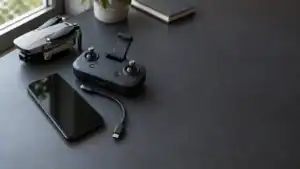
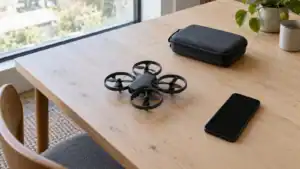
Choose the DJI Mini 3 if you want better aerial photos, longer flights, stronger wind resistance, and a traditional camera-drone experience. Choose the DJI Neo if you primarily want the drone to follow and film you with minimal setup. The Mini 3 is the better general-purpose camera drone, while the Neo is the more convenient personal flying camera.
Comparison basis: This is a research-based comparison, not a claim of hands-on testing by FPV Drone. The findings are based on current DJI specifications, support documentation, controller compatibility information, and U.S. operating guidance checked July 28, 2026.
Quick verdict: The Mini 3 wins on camera capability, mechanical stabilization, battery life, wind resistance, and deliberate long-range composition. The Neo wins on subject tracking, palm launch, protected propellers, controller-free use, and speed from bag to recording. If you are unsure which experience you want, the Mini 3 is the more versatile first drone. If most of your planned clips include you running, hiking, cycling, traveling, or speaking to the camera, the Neo is more likely to capture those clips without another person operating it.
Choose DJI Mini 3
For landscapes, travel footage, RAW photos, true vertical shooting, longer sessions, and learning conventional drone control.
Choose DJI Neo
For palm-launched self-filming, automated subject following, close-range social clips, and flying without a separate controller.
Do not assume
Neither model has forward, rear, or omnidirectional obstacle avoidance. Both depend on the operator choosing a clear flight path.
DJI Mini 3

Featured gear
DJI Mini 3 Drone
The DJI Mini 3 is a lightweight beginner camera drone with 4K HDR video, True Vertical Shooting, a 1/1.3-inch CMOS sensor, and up to 38 minutes of standard-battery flight time. Best for: beginners, travel…
The DJI Mini 3 is a lightweight beginner camera drone with 4K HDR video, True Vertical Shooting, a 1/1.3-inch CMOS sensor, and up to 38 minutes of standard-battery flight time.
- Best for
- Best for beginners and casual creators who want a lightweight DJI camera drone with…
- Skill level
- Beginner
- Product type
- Beginner Drones, Camera Drones, DJI Drones, Drones, Under 249g Drones
- Best for
- Beginners and casual creators who want a lightweight DJI camera drone with 4K HDR…
- Skill level
- Beginner
- Product type
- Camera Drone
DJI Neo

Featured gear
DJI Neo Drone
The DJI Neo is a 135 g compact camera drone with palm takeoff, subject tracking, built-in propeller guards, 4K/30fps recording, and controller-free or optional remote and goggles control. Best for: Beginners, travelers, family clips,…
The DJI Neo is a 135 g compact camera drone with palm takeoff, subject tracking, built-in propeller guards, 4K/30fps recording, and controller-free or optional remote and goggles control.
- Best for
- Compact first-generation DJI flying camera for palm launch, subject tracking, short self-filming clips, and…
- Skill level
- Beginner
- Product type
- 135 g selfie drone, Beginner Drones, Camera Drones, DJI Drones, DJI flying camera, Drones,…
- Best for
- Compact first-generation DJI flying camera for palm launch, subject tracking, short self-filming clips, and…
- Skill level
- Beginner
- Product type
- Compact Camera and Selfie Drone
DJI Mini 3 vs DJI Neo: Key Differences at a Glance
These drones overlap in price-sensitive beginner shopping, but they solve different filming problems. Mini 3 is a folding camera platform that expects the pilot to frame the shot. Neo is a compact flying camera designed to place the owner in the shot automatically.
| Decision factor | DJI Mini 3 | DJI Neo | Advantage |
|---|---|---|---|
| Best use | Scenic aerial photos and planned camera movement | Automated self-filming and close-range activity clips | Depends on use |
| Takeoff weight | 248 g with standard battery and microSD card | Approximately 135 g | Neo |
| Maximum flight time | 38 minutes with standard battery | Approximately 18 minutes, or 17 with propeller guards | Mini 3 |
| Camera sensor | 1/1.3-inch CMOS, 12 MP or 48 MP photos | 1/2-inch sensor, 12 MP photos | Mini 3 |
| Maximum video | 4K at 30 fps, 2.7K at 60 fps | 4K at 30 fps, 1080p at 60 fps | Mini 3 |
| Stabilization | Three-axis mechanical gimbal | Single-axis gimbal with electronic stabilization | Mini 3 |
| Vertical video | Camera rotates for true vertical capture | 1080p vertical crop | Mini 3 |
| Subject following | No ActiveTrack or continuous follow mode | Automated human-subject following | Neo |
| Control without a remote | No | Palm modes and mobile-app control | Neo |
| Obstacle avoidance | No, downward positioning only | No, downward positioning only | Tie |
| Maximum wind resistance | 10.7 m/s, Level 5 | 8 m/s, Level 4 | Mini 3 |
| Storage | MicroSD required, no internal storage | 22 GB internal storage | Depends on preference |
The comparison is not simply better camera versus lower price. Mini 3 asks you to operate a drone to create a shot. Neo can create several useful shots while you remain the subject. That workflow difference should decide the purchase before minor specifications do.
| Compare | DJI Mini 3 Drone | DJI Neo Drone |
|---|---|---|
| Product |
View DJI Mini 3 Drone |
View DJI Neo Drone |
| Best for | Best for beginners and casual creators who want a lightweight DJI camera drone with 4K HDR video, True Vertical Shooting, a 1/1.3-inch CMOS sensor, long flight time, and DJI’s stable camera-drone flight experience. Skip it if you want true FPV freestyle, racing, full obstacle avoidance, Follow Me, or higher-end Pro camera features. | Compact first-generation DJI flying camera for palm launch, subject tracking, short self-filming clips, and optional controller or goggles use. Best when discounted enough below the Neo 2 and purchased in the correct bundle. |
| Skill level | Beginner | Beginner |
| Product type | Beginner Drones, Camera Drones, DJI Drones, Drones, Under 249g Drones | 135 g selfie drone, Beginner Drones, Camera Drones, DJI Drones, DJI flying camera, Drones, Under 249g Drones |
| Product page | View product | View product |
| Retailer | Check Price | Check Price |
Camera Quality and Vertical Video
The DJI Mini 3 is the clear choice when image quality is the priority. Its 1/1.3-inch sensor is larger than Neo's 1/2-inch sensor, and its f/1.7 lens gathers more light than Neo's f/2.8 lens. Mini 3 also records at up to 100 Mbps, captures DNG RAW photos, and supports both 12 MP and 48 MP stills. Neo records at up to 75 Mbps and saves 12 MP JPEG photos.
The larger distinction is stabilization. Mini 3 uses a three-axis mechanical gimbal to keep the camera level as the aircraft moves. Neo mechanically stabilizes only the tilt axis and relies on RockSteady or HorizonBalancing electronic stabilization for the remaining motion. That is appropriate for quick follow clips, but it gives the Mini 3 a stronger foundation for slow pans, horizon control, and footage intended for editing.
Mini 3 is substantially better for vertical content
Both drones can produce portrait video, but they do it differently. Mini 3 rotates its camera 90 degrees, preserving the camera's capture area for true vertical photos and video. Neo creates a 1080p vertical recording through a crop and does not rotate its gimbal. If Instagram Reels, TikTok, or YouTube Shorts are the goal, Neo is faster at putting the owner in the frame, while Mini 3 provides the stronger vertical source file.
Mini 3 also gives photographers RAW files, automatic exposure bracketing, panoramas, and more room to adjust the result after landing. Neo's wide 14 mm-equivalent view is useful for keeping a nearby moving person in frame, but its camera system is designed for immediacy rather than post-production flexibility.
For a deeper explanation of its recording modes and camera limits, see our DJI Mini 3 specifications guide. The practical takeaway is straightforward: Neo makes it easier to get a clip of yourself, while Mini 3 makes the stronger image once a pilot has composed the shot.
Tracking and Control Options
DJI Neo wins decisively for automated self-filming. It can recognize and follow a person, launch from a palm, perform preset filming movements, and return for a palm landing without a conventional remote controller. Phone control adds a live view and virtual sticks, while compatible DJI remotes and goggles expand how it can be flown.
DJI currently limits Neo's automatic subject confirmation to people. It should not be treated as a universal vehicle, pet, or object-tracking system. Tracking also does not mean obstacle avoidance. The aircraft can keep a person framed while still being unable to detect and route around a branch, cable, wall, or other obstacle in its path.
Mini 3 supports QuickShots such as Dronie, Helix, Rocket, Circle, and Boomerang, but those are preset camera movements rather than continuous ActiveTrack. It cannot independently follow a runner or cyclist along a changing route. Our guides to Mini 3 tracking limitations and how DJI Neo follows a subject explain that difference in greater detail.
Mini 3 is better for learning conventional drone control
Mini 3 requires a remote controller. The standard RC-N1 uses a connected phone, while DJI RC has its own screen. That setup creates more equipment, but it also provides physical sticks, a persistent live view, dedicated controls, and the predictable workflow expected from a conventional camera drone.
Neo can also use physical controls. DJI lists RC-N3, RC-N2, and DJI RC 2 as compatible conventional controllers, while supported goggles and motion or FPV controllers provide an immersive path. Those accessories can make Neo much more capable, but they also change its cost and simplicity. A Drone Only package should not be compared directly with a controller-equipped Mini 3 package as if the boxes provide the same flying experience.
Safety distinction: Full propeller guards make Neo more tolerant of some low-speed contact, but neither drone can avoid obstacles. Use Neo's Follow modes only in open, well-lit areas with a visible, predictable path.
Compare Current Prices
Compare complete packages, including the controller, battery count, charger, storage, and accessories you actually need.
Flight Time, Range, and Wind Performance
Mini 3 provides more than twice Neo's advertised flight time with their standard configurations. DJI rates Mini 3 for up to 38 minutes and Neo for approximately 18 minutes, or about 17 minutes when the propeller guards are fitted. Both figures come from controlled tests that run the battery far lower than a cautious pilot normally would.
That endurance difference changes the entire session. Mini 3 gives the pilot more time to take off, check conditions, reach a viewpoint, try multiple compositions, and return with reserve. Neo is better treated as a short-clip aircraft. Its quick launch reduces setup time, but repeated takes can consume a single battery quickly.
Mini 3 also accepts an Intelligent Flight Battery Plus that DJI rates for up to 51 minutes. That battery increases takeoff weight to roughly 290 g, which removes the standard configuration's under-250 g advantage and can change registration or operating requirements. Availability also varies by region.
Transmission range is not the same as useful flight distance
Mini 3 uses DJI O2 and carries a manufacturer maximum of 10 km under the FCC standard in an unobstructed, low-interference environment. Neo's phone connection is rated for 50 m, while compatible O4 remote hardware extends its control and transmission capability substantially. In either case, the battery, wind, interference, return route, airspace, and visual-line-of-sight rules set a more meaningful limit than the signal headline.
Our DJI Mini 3 range guide and DJI Neo range guide separate maximum transmission claims from practical flight planning. Neo should not be purchased as a long-range drone merely because a compatible controller can produce a strong link.
Mini 3 has the stronger wind specification
DJI rates Mini 3 for 10.7 m/s wind resistance and Neo for 8 m/s. Neither rating guarantees a safe return in gusts. Wind at altitude can be stronger than conditions at the launch point, and a lightweight aircraft may spend much of its battery holding position or returning into a headwind.
Mini 3 is the better choice for exposed scenic locations and deliberate higher-altitude compositions. Neo's ideal environment is closer, calmer, and easier to inspect before launch.
Safety, Portability, and U.S. Rules
Neo is lighter at approximately 135 g and arrives with full-coverage propeller guards. Mini 3 weighs 248 g in its standard configuration and folds into a narrower package, but its propellers remain exposed during normal flight. Neo does not fold, yet its ready-to-launch body is easy to pull from a bag for a short clip.
The guards make Neo the more practical choice for close-range operation, but they do not make it safe to fly through clutter or around uninvolved people. DJI explicitly states that Neo lacks obstacle avoidance. Mini 3 also has only a downward vision system for positioning, not forward or rear collision sensing.
Which is better indoors?
Neo is usually the more manageable indoor option because of its guarded propellers, palm modes, and compact size. Indoor flight still requires a large, well-lit, controlled space. Both aircraft rely on downward vision that can perform poorly over reflective, dark, uniform, or low-detail surfaces, and neither can identify obstacles ahead.
Under 250 g does not mean rule-free
In the United States, the standard Mini 3 and Neo are below 250 g as sold. The FAA generally exempts a drone below 250 g from registration only when it is flown exclusively under the recreational exception. Recreational pilots must still complete TRUST, follow airspace rules, maintain visual line of sight, and operate safely. Drones used under Part 107 must be registered regardless of weight.
Adding the Mini 3 Intelligent Flight Battery Plus raises the aircraft above 249 g. Other accessories can also change takeoff weight. Buyers should evaluate the aircraft in the configuration they will actually fly, not only the number printed on the standard product page.
Bundles, Accessories, and Total Ownership Cost
Do not compare a bare Neo aircraft with a controller-equipped Mini 3 package solely by the checkout total. First decide whether you need physical controls, multiple batteries, a charging hub, and a dedicated display.
What the Mini 3 system needs
Mini 3 always needs a compatible remote controller. An RC-N1 package also needs a supported phone, while a DJI RC package includes a controller with a screen. The aircraft has no internal storage, so add a suitable microSD card. Extra batteries and the sequential Two-Way Charging Hub make sense for longer outings, but the standard battery already provides substantially more time than Neo's battery.
What the Neo system needs
Neo can record with the aircraft and a charged battery, using palm modes without a remote. Its 22 GB of internal storage removes the immediate need for a memory card. A phone adds live view, settings, file transfer, virtual controls, and additional shooting options.
The cost rises if you want conventional sticks or goggles. Confirm the exact remote, goggles, motion controller, firmware, and included accessories before ordering. Neo's charging hub can charge up to three batteries simultaneously with sufficient USB PD input, while Mini 3's hub charges batteries in sequence.
Compare these items before choosing a bundle:
- Exact remote controller and whether it requires a phone
- Number of flight batteries and the battery type
- Charging hub and compatible USB-C power adapter
- MicroSD card requirement or available internal storage
- Spare propellers, guards, cables, and carrying case
- Whether the final takeoff weight remains below 250 g
Our DJI Mini 3 bundle guide explains the RC-N1, DJI RC, Fly More, and Battery Plus choices. The DJI Neo bundle guide covers controller-free, Fly More, and goggles-based configurations.
The better value is the package that already includes the control method and batteries you will use. A low entry price is not a saving if it requires an immediate controller and battery upgrade.
Which Drone Fits Your Use Case?
| Your priority | Better choice | Why |
|---|---|---|
| Travel landscapes | DJI Mini 3 | Longer flight time, stronger wind rating, larger sensor, and three-axis gimbal |
| Running, hiking, or cycling clips | DJI Neo | Human-subject following and controller-free self-filming |
| RAW photography | DJI Mini 3 | DNG files, exposure bracketing, and broader still-photo controls |
| Fastest launch-to-record workflow | DJI Neo | Palm takeoff, built-in shooting modes, and internal storage |
| True vertical photos and video | DJI Mini 3 | The camera rotates rather than cropping a horizontal sensor image |
| Learning traditional drone piloting | DJI Mini 3 | Physical controller, longer practice sessions, and conventional camera-drone workflow |
| Occasional indoor filming | DJI Neo | Compact guarded design, provided the space is open, controlled, and well lit |
| Immersive goggles option | DJI Neo | Compatible DJI goggles, motion controls, and FPV controller paths are available |
| One drone for mixed scenic use | DJI Mini 3 | More flexible camera, endurance, wind tolerance, and flight planning |
Choose DJI Mini 3 when the scene is the subject
Mini 3 is the better purchase when you imagine the drone looking outward at coastlines, buildings, farms, mountains, family gatherings, or travel destinations. It gives you more time and stronger camera tools to choose the shot yourself. Read our full DJI Mini 3 review for its remaining strengths, missing safety features, and current buyer fit.
Choose DJI Neo when you are the subject
Neo is the better purchase when you imagine the drone looking back at you. It reduces the equipment and attention required to create short activity clips, and its small guarded design makes spontaneous use more realistic. Read our DJI Neo review for a closer look at its tracking, battery limits, camera compromises, and upgrade path.
If you regularly need both types of footage, Mini 3 is the stronger single-drone system, but it cannot replace a camera operator for follow shots. Neo is the better second camera for someone who already owns a conventional drone and wants a dedicated self-filming tool.
Final Verdict: DJI Mini 3 or DJI Neo?
DJI Mini 3 is the better overall camera drone, while DJI Neo is the better personal follow camera. Mini 3 earns the general recommendation through its larger sensor, RAW photos, true vertical shooting, three-axis gimbal, 38-minute maximum flight time, and stronger wind rating.
Neo becomes the better choice when convenience and self-filming matter more than image flexibility or endurance. Palm launch, human-subject following, guarded propellers, internal storage, and controller-free modes let it capture clips that Mini 3 cannot create without another operator.
If you are undecided, buy Mini 3 for the broader range of aerial photography and video tasks. Buy Neo only when you specifically want the aircraft to keep you in the frame with as little setup as possible. Neither should be chosen for obstacle avoidance, because both require an open flight path and active pilot judgment.
Choose Your Drone
Check the exact controller, battery count, charging equipment, and included accessories before comparing offers.
Sources
- DJI Mini 3 official specifications: Aircraft weight, dimensions, flight time, wind resistance, camera, gimbal, sensing, transmission, battery, and storage specifications.
- DJI Neo official specifications: Aircraft weight, flight time, camera, stabilization, sensing, phone-control range, battery, charging, and storage specifications.
- DJI Neo official FAQ: Palm control, intelligent shooting, human-subject confirmation, obstacle-avoidance limitations, camera modes, and charging behavior.
- DJI Neo controller compatibility guidance: Supported conventional remotes, goggles, motion controllers, FPV controller, and phone control.
- DJI aircraft portrait-mode guidance: Verifies Mini 3 camera rotation and Neo's cropped 1080p vertical mode.
- FAA drone registration guidance: U.S. recreational under-250 g exception, Part 107 registration, and Remote ID responsibilities.
Last checked: July 28, 2026. Product specifications, controller compatibility, firmware features, bundles, availability, and operating requirements can change. Verify the current product page, support documentation, and local rules before purchasing or flying.